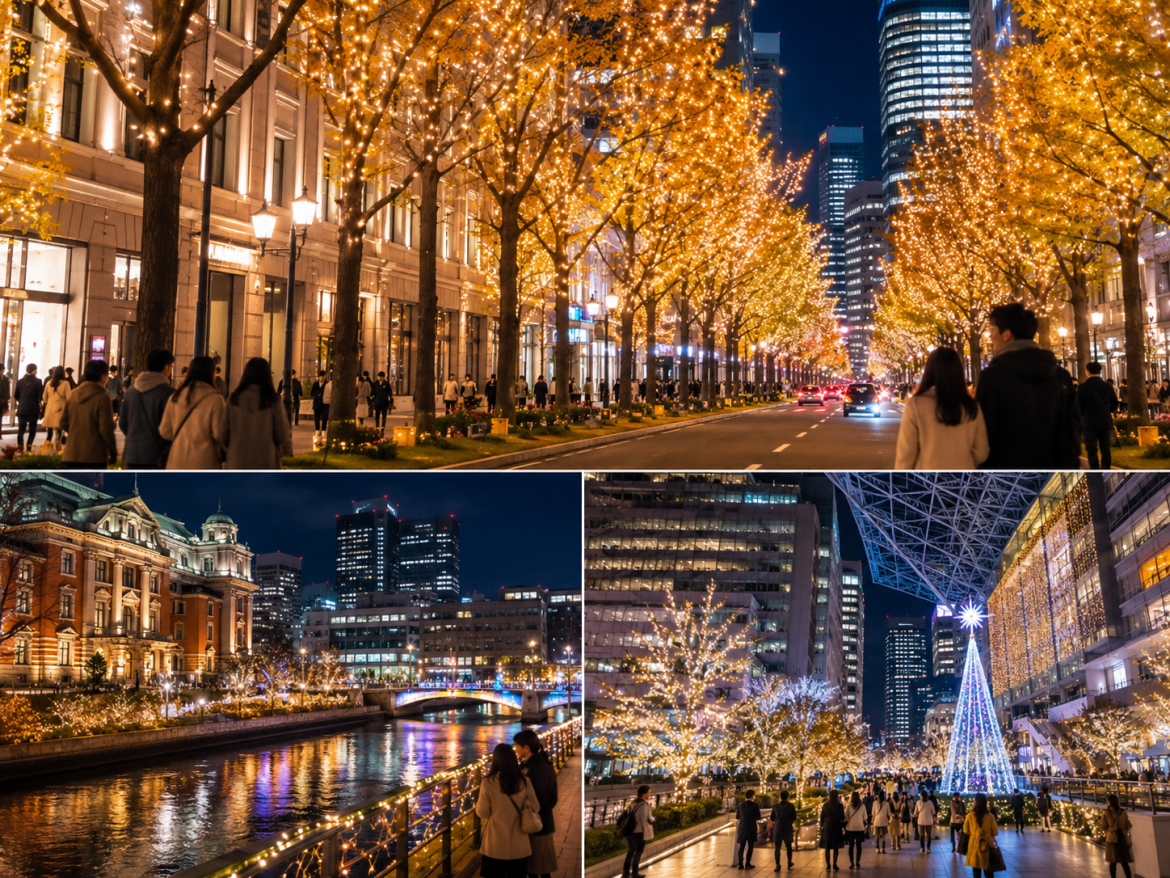
For a November visit, you can combine the Midosuji illuminations with the longer-running City Hall facade and Nakanoshima street lights. The projection and main Nakanoshima programme run only from December 11 to 25. The November 23 lighting ceremony is a separate special event on part of Midosuji between Yodoyabashi and Semba Chuo 3, not the November 3 opening of the illuminations.
Official Osaka City announcement for this season’s main programs
Osaka’s winter illumination season is less about one giant Christmas tree and more about an extended citywide nightscape. Lights stretch from Osaka Station and Umeda through Midosuji, Nakanoshima, Shinsaibashi and Namba, making it easy to combine several areas by subway without spending an entire day on a dedicated excursion.
The main thing to understand is that Midosuji Illumination, OSAKA Hikari Renaissance in Nakanoshima and the various Christmas installations around Umeda are separate events. Their dates and closing times do not necessarily match.
For 2026, the key confirmed events are Midosuji Illumination from November 3 to December 31 and the main OSAKA Hikari Renaissance program from December 11 to 25. Detailed themes and schedules for individual Umeda commercial facilities should still be checked when they are formally announced.
A practical first-time route is to start around Umeda before sunset, take the subway to Yodoyabashi for Nakanoshima, then finish with one section of Midosuji between Shinsaibashi and Namba. Families, older travelers and anyone who wants less walking can simply choose Umeda plus Nakanoshima, or Nakanoshima plus Shinsaibashi.

Osaka Winter Illuminations 2026: Quick Overview
| Question | Practical answer |
|---|---|
| Worth visiting? | Yes, particularly if you are already staying in central Osaka and want a mostly free evening activity. |
| Admission | The core Midosuji and Nakanoshima outdoor illuminations are generally free. Separate attractions may charge admission. |
| Reservations | Not required for the street illuminations. Observation decks, buses and separately ticketed attractions are different. |
| Time needed | About 1–1.5 hours for one area, or roughly 3.5–5 hours for Umeda, Nakanoshima and a short section of Midosuji. |
| Best transport | Osaka Metro Midosuji Line, especially Umeda, Yodoyabashi, Shinsaibashi and Namba stations. |
| Main challenge | The illumination area is huge, station exits are complicated and walking distances are easy to underestimate. |
| Families | Choose two areas rather than attempting the full route, especially around the busiest 19:00–21:00 period. |
| Older travelers | A shortened route works well; Yodoyabashi also has accessible elevator routes. |
Confirmed Osaka Illumination Dates and Times
| Event | Dates | Time | Main area |
|---|---|---|---|
| Osaka Festival of Lights overall program | November 3 to January 31 of the following year | Varies | Osaka City and locations across Osaka Prefecture |
| Midosuji Illumination | November 3–December 31 | About 17:00–01:00 | Hanshin-mae intersection to Namba Nishiguchi intersection |
| OSAKA Hikari Renaissance | December 11–25 | Central Public Hall projection 17:30–21:30; final show 21:20. Market 16:00–22:00 | Osaka City Hall to Nakanoshima Park |
| City Hall façade and Nakanoshima Illumination Street | November 3–December 31 | 17:00–01:00 | Osaka City Hall and nearby Nakanoshima |
| Umeda commercial-facility illuminations | To be announced by each venue | Varies | Osaka Station, Grand Front, Grand Green, Umeda Sky Building and nearby facilities |
Midosuji has the longer season. The full Nakanoshima program is much shorter. A November trip can include Midosuji, but not necessarily the Central Public Hall projection, market and full festive program.
December 11–25 is the most useful overlap if you want to combine the major Nakanoshima program with Midosuji in one evening. After December 25, Midosuji continues, but the main Hikari Renaissance program has ended.
Three Areas, Not One Venue
Midosuji Illumination
Midosuji Illumination has no ticket gate and no single main entrance. The illuminated boulevard extends for about 4 km from the Hanshin-mae intersection in the north to Namba Nishiguchi in the south.
You can join from Umeda, Yodoyabashi, Hommachi, Shinsaibashi or Namba. There is no need to walk all 4 km. For a first visit, two particularly practical sections are Yodoyabashi to Hommachi, which pairs easily with Nakanoshima, and Shinsaibashi to Namba, where the lights mix with busy commercial streets and Osaka nightlife.
Nakanoshima
The main winter-event area is not beside Keihan Nakanoshima Station. It is concentrated around Osaka City Hall, Osaka City Central Public Hall, Naniwabashi and Nakanoshima Park. Yodoyabashi or Naniwabashi is normally more convenient for the main program.
Nakanoshima stands out because the experience combines historic architecture, river views, reflections, projection mapping and seasonal food stalls rather than relying only on illuminated trees.
Umeda
Umeda does not have one unified illumination organizer. Osaka Station City, Grand Front Osaka, Grand Green Osaka, Umeda Sky Building and other facilities may announce their own winter installations and Christmas displays.
For 2026, use Umeda as a convenient starting point, but do not assume that installations photographed in a previous season will return unchanged.
Do You Need Tickets?
Midosuji Illumination and the core outdoor areas of OSAKA Hikari Renaissance are generally free and require no reservation. You can simply walk through the event areas.
Paid options only become relevant if you add attractions such as Umeda Sky Building, a sightseeing bus or another independently ticketed experience.
| Transport or ticket | Best for | Skip it when |
|---|---|---|
| ICOCA or another IC card | Only two or three subway rides and a flexible route | You will make many subway trips throughout the day |
| Osaka Metro / bus pass | A full sightseeing day with repeated subway travel | You are staying in one area or visiting only one illumination zone |
| Osaka Amazing Pass | Multiple participating paid attractions plus transport | Your day is mainly free illuminations and shopping |
| Umeda Sky Building ticket | Combining sunset, an observation deck and evening illuminations | You already have another observation deck planned |
If you are also visiting several eligible paid attractions during the day, compare the Osaka Amazing Pass guide. Buying the pass purely for free winter illuminations usually makes little sense.
Best Time to Visit
| Time | Best feature | Watch for |
|---|---|---|
| 16:30–17:30 | Early dinner and blue-hour photography | Popular viewpoints begin filling before full darkness |
| 17:30–19:00 | Good balance of lights, restaurants and transport | Commuters and visitors begin overlapping |
| 19:00–21:00 | Strongest festive atmosphere | Highest crowds on weekends and near Christmas |
| 21:00–22:00 | Midosuji becomes easier for photos | Some Nakanoshima programs and stalls are approaching closing time |
| After 22:00 | Quieter Midosuji streets | Too late for most of the Nakanoshima program |
If you are choosing one arrival time, around 17:30 on a weekday works particularly well for Nakanoshima. Photograph the Central Public Hall and river before the sky becomes completely dark, see the evening illuminations and projection program, then continue to Shinsaibashi or Namba around 19:30.
Best First-Time Route: Umeda → Nakanoshima → Shinsaibashi → Namba
- 16:00–17:15: Umeda shopping areas, plazas or Umeda Sky Building.
- 17:15–17:30: Take the Midosuji Line from Umeda to Yodoyabashi.
- 17:30–19:15: Osaka City Hall, Central Public Hall and Nakanoshima Park.
- 19:15–19:30: Return to Yodoyabashi and take the subway to Shinsaibashi.
- 19:30–20:30: Walk south along Midosuji from Shinsaibashi to Namba.
- After 20:30: Dinner in Dotonbori or return to your hotel.
This route avoids walking all 4 km of Midosuji while still giving you three very different Osaka night scenes: Umeda’s modern commercial district, Nakanoshima’s historic riverfront and the busier southern section of Midosuji.
What to See
Midosuji’s 4 km Boulevard
The appeal is the scale rather than one individual installation. The best views combine rows of illuminated street trees with traffic, office towers and reflections from glass façades. Photograph from wide sidewalks or other safe positions rather than stopping in pedestrian crossings.
Osaka City Hall
Approaching from Yodoyabashi, Osaka City Hall is the easiest landmark for orienting yourself. During the main event period, it is also useful for toilets, rest areas, nursing facilities and event assistance.
Osaka City Central Public Hall Projection
The red-brick façade and classical architecture provide one of Nakanoshima’s signature winter scenes. For 2026, projection mapping runs December 11–25 from 17:30 to 21:30, with the final presentation starting at 21:20.
Nakanoshima Riverfront
This is where Nakanoshima feels most different from a shopping-mall illumination. Bridges, water, historic buildings and city lights appear together, with particularly attractive reflections in calm conditions. The riverfront can feel noticeably colder than the commercial districts, so bring wind-resistant outerwear, gloves and a scarf.
Seasonal Market
The Hikari Renaissance market adds to the Christmas atmosphere, but queues and seating can be unpredictable. Families and anyone with dietary restrictions are better off eating a proper meal in Umeda, Yodoyabashi or Kitahama first and treating the market as a stop for snacks and drinks.
Umeda Sky Building
If you want to turn the evening into a fuller skyline itinerary, visit the Kuchu Teien Observatory around sunset before heading to Nakanoshima. Allow roughly one to two hours. Outdoor observation areas may be affected by strong wind or poor weather.
For access details, see the Umeda Sky Building guide.
Walking Distance and Difficulty
| Section | Approximate walking | Notes |
|---|---|---|
| Osaka/Umeda Station to Umeda Sky Building | 10–15+ minutes | Choosing the wrong station exit can add substantial distance. |
| Yodoyabashi Station to Osaka City Hall | A few minutes | Use an elevator-equipped route if step-free access is required. |
| City Hall to Central Public Hall | 5–10 minutes | Event crowd control may create detours. |
| Main Nakanoshima area | About 1–2 km | Movement slows when crowded and the riverfront feels colder. |
| Shinsaibashi to Namba | 15–25 minutes | Several traffic lights. |
| Full Midosuji route | About 1 hour without stops; usually 1.5–2.5 hours with photos | No dedicated illumination rest area or temporary toilets. |
The route is mainly flat city pavement. Distance, cold weather, long periods of standing and crowds are more significant than stairs or steep slopes.
Families, Strollers and Accessibility
Osaka’s illuminations work well for families, but young children are unlikely to enjoy walking the entire Midosuji route. A two-area plan such as Umeda plus Nakanoshima is much easier.
With children, 17:00–19:30 is a practical window. Eat early, spend one or two hours outside and return before both crowds and temperatures become less comfortable.
Strollers are usable on most routes, although elevators can take extra time around Osaka Station and temporary event crowd-control routes may require detours in Nakanoshima. Osaka City Hall provides toilets, rest facilities and a nursing room.
Wheelchair users can view the main Nakanoshima areas, although certain installations may require detours. From Osaka Metro Yodoyabashi Station, follow the step-free route via the elevator-equipped central-south ticket-gate area and nearby building elevators to street level.
How to Get There
From Osaka Station or Umeda
After seeing Umeda’s winter displays, use Osaka Metro’s Midosuji Line from Umeda to Yodoyabashi. From there, walk to Osaka City Hall to enter the main Nakanoshima area.
Osaka Station, Umeda Station, Higashi-Umeda and Nishi-Umeda belong to different railway or subway systems. The underground network is extensive, so first-time visitors should specifically follow signs for the Osaka Metro Midosuji Line rather than simply following signs marked “Umeda.”
From Shin-Osaka
The Midosuji Line runs directly to Umeda, Yodoyabashi, Hommachi, Shinsaibashi and Namba. Get off at Yodoyabashi if Nakanoshima is your priority, or Umeda if you want to start farther north.
From Shinsaibashi or Namba
Both are on the southern section of Midosuji Illumination. You can walk from Shinsaibashi to Namba or reverse the route, then use the Midosuji Line to reach Yodoyabashi for Nakanoshima.
From Kansai International Airport
If you are staying in Namba, take Nankai Railway into the city, leave your luggage at your accommodation and start sightseeing afterwards. For Osaka Station or Umeda, JR services or airport buses are possible options.
Do not drag large suitcases through the illumination areas. Midosuji has no dedicated event luggage storage and crowded Nakanoshima is inconvenient with bulky baggage.
From Kyoto
JR services to Osaka Station work well if you want to begin in Umeda. Keihan services to Yodoyabashi or Kitahama are convenient when Nakanoshima is your main destination. If returning to Kyoto the same evening, check your final train before starting the night route.
Driving
There is no dedicated Midosuji illumination parking area, and organizers encourage public transport. City-center parking costs, congestion and possible traffic management make driving unnecessary for most visitors.
Suggested Half-Day and Full-Day Plans
Classic Evening: Nakanoshima + Shinsaibashi
| 16:30 | Early dinner around Yodoyabashi or Kitahama |
| 17:30 | Osaka City Hall and Nakanoshima illumination |
| 18:00–19:15 | Central Public Hall, riverfront and Nakanoshima Park |
| 19:30 | Midosuji Line to Shinsaibashi |
| 19:45–20:45 | Walk the southern Midosuji section to Namba |
| 21:00 | Dinner in Dotonbori or return to your hotel |
Full Day: Osaka Castle + Umeda + Nakanoshima + Namba
Spend the morning around Osaka Castle, have lunch and shop in Umeda, visit Umeda Sky Building around sunset, continue to Nakanoshima around 18:00, then finish with Midosuji between Shinsaibashi and Namba around 20:00.
This is a busy itinerary suited to adults with good stamina. Families should remove either the Osaka Castle interior or the observation deck rather than trying to fit everything into one day.
Low-Walking Family Route
Eat in Umeda around 16:30, take the subway to Yodoyabashi around 17:30, see Osaka City Hall and Central Public Hall, then return to Yodoyabashi around 19:15 and take the subway directly back to Umeda or your hotel.
Rainy-Day Route
Spend most of the afternoon indoors around Osaka Station and Umeda, wait for lighter rain before traveling to Yodoyabashi, see only the City Hall and Central Public Hall area, and skip long riverfront or Midosuji walks.
Alternative for Less Walking: Osaka Night Sightseeing Bus
Osaka’s open-top double-decker night sightseeing bus departs from Osaka Station and travels through areas including Midosuji, Nipponbashi and Shinsekai. It is not an official Osaka Festival of Lights shuttle and does not guarantee coverage of every seasonal display, but it can suit travelers who prefer seeing the city from a vehicle.
Check operating dates and weather conditions before booking. Because the bus is open-top, winter clothing is important.
Crowds, Weather and Photography
On weekdays, arriving in Nakanoshima around 17:30–18:00 is usually practical. On weekends and near Christmas, arrive closer to 17:00 so you can identify City Hall, the Central Public Hall, toilets and your exit route before peak crowds build.
If Yodoyabashi Station is heavily congested when you leave, walking toward Kitahama can spread out the return journey. Families and older travelers may also prefer leaving 15–30 minutes before a major program ends rather than joining the largest wave of departures.
Light rain does not necessarily stop the event, but individual performances or outdoor installations may be cancelled because of poor weather. Check official announcements when strong wind or heavy rain is forecast.
Large tripods and equipment that obstruct pedestrians or traffic are discouraged on Midosuji, and drones should not be used in the crowded city-center event areas. A phone or handheld camera is the easiest option.
Where to Eat
Umeda: the easiest place for an early dinner, with department stores, Osaka Station City, Grand Front and underground shopping streets offering the widest choice.
Yodoyabashi and Kitahama: convenient for cafés and restaurants before Nakanoshima, although some business-district venues have shorter weekend or evening hours.
Nakanoshima event stalls: useful for festive drinks and snacks, but queues, seating and availability can vary. Do not rely on them as your only dinner plan if traveling with children or dietary restrictions.
Shinsaibashi and Dotonbori: convenient for takoyaki, okonomiyaki, kushikatsu, yakiniku and a later dinner after the southern Midosuji walk.
Where to Stay
You do not need a special hotel solely for the illuminations. Umeda, Yodoyabashi, Hommachi, Shinsaibashi and Namba all provide easy access.
Umeda works particularly well for travelers also visiting Kyoto, Kobe or Shin-Osaka. Yodoyabashi or Hommachi is convenient if Nakanoshima and Midosuji are your priorities. Shinsaibashi or Namba is ideal if you want late-night dining, shopping or easy access to Nankai trains for Kansai Airport.
December weekends, the Christmas period and New Year can bring higher hotel prices and faster-selling family rooms. Compare districts in the Osaka accommodation guide.
Common Planning Mistakes
- Using last year’s dates: Midosuji, Nakanoshima and Umeda programs are announced separately and can change each season.
- Looking for a Midosuji entrance: it is a 4 km illuminated boulevard, not a gated venue.
- Going to Nakanoshima Station for the main event: Yodoyabashi, Naniwabashi and Kitahama are generally more useful for City Hall and Central Public Hall.
- Walking all of Midosuji: one section is enough for most first-time visitors.
- Arriving too late in Nakanoshima: Midosuji remains lit much later than many Nakanoshima programs.
- Bringing large luggage: store it at your hotel or in station lockers first.
- Buying the Osaka Amazing Pass only for illuminations: the main illumination areas are free.
- Driving into the event area: public transport is usually simpler.
- Relying on food stalls for dinner: queues and seating are unpredictable.
- Underestimating the riverfront cold: Nakanoshima can feel colder than Umeda or the commercial sections of Midosuji.
Osaka Winter Illuminations FAQ
When do Osaka’s 2026 winter illuminations start?
Midosuji Illumination begins on November 3. The main OSAKA Hikari Renaissance program in Nakanoshima begins on December 11.
What time does Midosuji Illumination turn on?
The announced lighting time is approximately 17:00 until 01:00 the following morning.
When is the Central Public Hall projection mapping?
From December 11 to 25, 2026, between 17:30 and 21:30. The presentation lasts approximately 10 minutes, starts roughly every 12 minutes, and the final show begins at 21:20.
Are Osaka’s main winter illuminations free?
Yes. Midosuji and the core outdoor Nakanoshima programs are generally free. Observation decks and separately operated attractions may charge admission.
Do I need reservations?
No reservation is required for Midosuji or the outdoor Nakanoshima illumination areas. Paid attractions and sightseeing buses may be booked separately.
Do I need to walk the entire Midosuji route?
No. First-time visitors can simply walk Yodoyabashi to Hommachi or Shinsaibashi to Namba.
How long does the complete Midosuji walk take?
About one hour without stopping. With traffic lights, photography and sightseeing, allow roughly 1.5–2.5 hours.
Which station is best for Nakanoshima?
Yodoyabashi is the easiest first-time option. Naniwabashi and Kitahama are also convenient depending on which side of the event you want to visit.
Is Nakanoshima Station convenient?
It is useful for western Nakanoshima but farther from the main City Hall and Central Public Hall event area.
Is the illumination suitable for children?
Yes, but choose one or two areas and aim for roughly 17:00–19:30 rather than attempting a long late-night route.
Can I use a stroller or wheelchair?
Most routes are flat. Crowds may require detours, and elevators can take extra time. Wheelchair users can access the main Nakanoshima areas via step-free routes from Yodoyabashi.
Are there toilets and nursing facilities?
During the main Nakanoshima event period, designated toilets are available at Osaka City Hall, and an accessible toilet is available around the rose garden east of Naniwabashi. Osaka City Hall also has a nursing room near the south entrance on the first floor.
Is there luggage storage at the illumination sites?
No dedicated event luggage storage is provided. Use your hotel or station lockers before visiting.
Will the event be cancelled if it rains?
Light rain does not automatically cancel the event, but individual performances or outdoor installations may be suspended because of weather.
What dates are best for seeing both Midosuji and the full Nakanoshima program?
A weekday between December 11 and 25 offers the strongest overlap between the two confirmed programs.
Can I go to Dotonbori after Nakanoshima?
Yes. Take the Midosuji Line from Yodoyabashi to Shinsaibashi or Namba and continue on foot.
Do I need a subway pass just for the illuminations?
Not necessarily. If you only make two or three rides, paying with ICOCA or another IC card is straightforward. Compare a day pass only if you are making frequent trips throughout the day.
Can I visit from Kyoto as a day trip?
Yes. JR works well for Osaka Station and Umeda, while Keihan offers convenient access to Yodoyabashi or Kitahama. Leave enough time for evening crowds and your return train.
Final Planning Tips
Osaka’s winter illuminations are easy to add to an existing city itinerary because the main areas are free and sit directly along some of Osaka’s most useful transport corridors.
For 2026, Midosuji Illumination is confirmed from November 3 to December 31, while the main OSAKA Hikari Renaissance program runs from December 11 to 25. If you want the fullest combination of both, plan for the overlapping period in mid-to-late December.
For a first visit, take the Midosuji Line from Umeda to Yodoyabashi, see Osaka City Hall, Central Public Hall and the Nakanoshima riverfront, then ride south to Shinsaibashi and walk the final illuminated stretch toward Namba.
There is little reason for most travelers to walk all 4 km of Midosuji. Families, older travelers and anyone sensitive to winter cold will usually get more from choosing two areas and using the subway between them.
Finally, remember that individual Umeda programs and some supplementary events may still be updated. Check official schedules, weather notices and transport information again shortly before your visit rather than relying on dates from a previous winter.