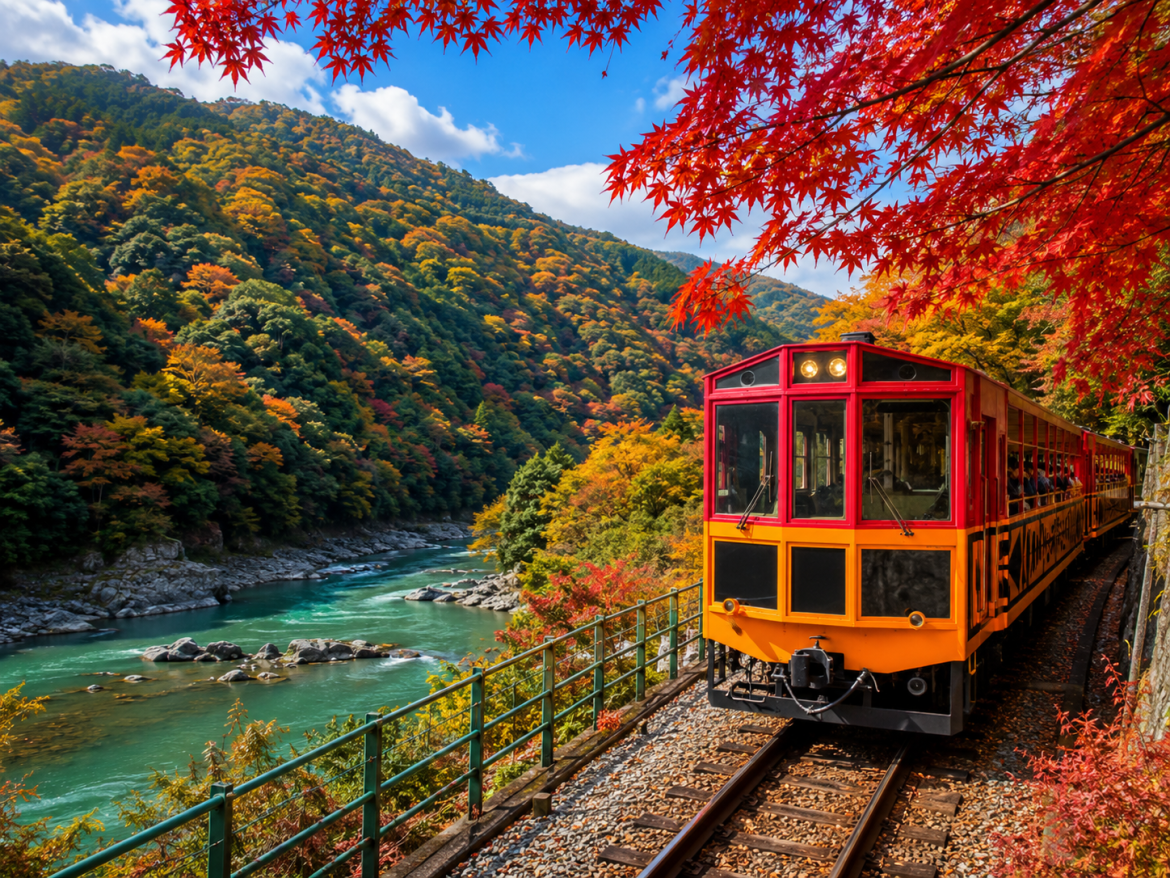

Sagano Romantic Train: book the direction that fits your day
The Sagano Romantic Train is a scenic railway along the Hozugawa gorge between Torokko Saga and Torokko Kameoka, with intermediate stops at Torokko Arashiyama and Torokko Hozukyo. Most journeys take roughly 25 minutes. The attraction is the river, wooded slopes, bridges and tunnels, rather than speed or a ride through the pedestrian bamboo grove.
For a first visit, travelling from Kameoka toward Arashiyama often creates the smoothest day: take JR to Umahori, walk to Torokko Kameoka, ride the scenic train back and begin sightseeing. If you want the Hozugawa boat as well, reverse the plan: train from Saga to Kameoka, transfer to the boat reception, then cruise downstream to Arashiyama.
The right departure matters more than a supposedly perfect seat. Decide whether this is a short addition to Arashiyama or the focus of an entire day before opening the booking calendar. The Kyoto itinerary guide helps place it within a longer visit; these linked destination guides are in Chinese.
| Decision | Practical answer |
|---|---|
| Who will enjoy it? | Travellers already visiting Arashiyama, railway enthusiasts, couples and families who enjoy scenery |
| Who can skip it? | Visitors with a rushed Kyoto stay or little interest in a scenic train |
| Time to allow | About 1½–2 hours with JR, walking and waiting; at least half a day with the boat |
| Seat priority | A or D for a window, then consider the direction of travel |
| Booking | Reserve early for weekends, blossoms, foliage and car 5 |
| Ticket type | One-way reserved scenic-train ticket, separate from ordinary JR travel |
Is the Sagano Romantic Train worth it?
It is a good addition when the bamboo grove, Tenryu-ji, Togetsukyo Bridge or Jojakko-ji are already on your itinerary. The gorge gives the day a different perspective from walking temple streets, and boarding at the Kameoka end lets you finish where you want to explore.
It is less compelling if you have only a day or two in Kyoto and are concentrating on Kiyomizu-dera, Gion and Fushimi Inari’s shrine area. Those guides cover separate parts of the city. Do not cross Kyoto solely to squeeze a short ride between distant bookings.
The wooden seats and older carriage design also feel different from a modern intercity train. Travellers sensitive to movement, those who dislike exposed weather or anyone unable to find a suitable departure may prefer an unhurried Arashiyama walk. A sold-out favourite seat is not a reason to dismantle a good itinerary.
Which direction should you ride?
| Plan | Route | Best for | Main trade-off |
|---|---|---|---|
| Kameoka to Arashiyama | Kyoto → JR Umahori → Torokko Kameoka → Torokko Arashiyama or Saga | A scenic start before walking Arashiyama | A walk from Umahori before boarding |
| Saga to Kameoka, then JR | Arashiyama sights → scenic train → walk to Umahori → Kyoto | A quiet early bamboo visit followed by an afternoon train | The scenic ride finishes away from Arashiyama |
| Saga to Kameoka, then boat | Scenic train → separate dock transfer → Hozugawa boat → Arashiyama | A full nature-focused day | More time, cost and weather dependence |
Kameoka first: a straightforward first visit
Take the JR Sagano Line to Umahori, walk to Torokko Kameoka and ride toward Saga. If stairs are no problem, get off at Torokko Arashiyama near the bamboo grove. Otherwise continue to Torokko Saga beside JR Saga-Arashiyama. From there, visit the bamboo, Tenryu-ji and the river in a walking loop.
Use the Arashiyama transport comparison for the ordinary JR, Hankyu and Randen approaches. The scenic train and the local railways have different station names and tickets.
Early bamboo, afternoon train
Start in Arashiyama before the main crowds, walk the bamboo and visit one or two temples. Later, board at Torokko Saga or Torokko Arashiyama for Kameoka, walk to JR Umahori and return to Kyoto. This protects the morning photography window but leaves less flexibility if you miss the booked afternoon departure.
Train outward, boat downstream
The useful order is Saga → Torokko Kameoka → dock transfer → Hozugawa boat → Arashiyama. The dock is not beside Torokko Kameoka. Check the bus, taxi or sightseeing carriage connection and boat check-in requirements before choosing the train.
A Sagano train and Hozugawa day tour can simplify coordination. Check exactly which transport, boating option, meeting point and guide language are included; a tour need not offer independent seat selection or unlimited time in Arashiyama.
How to reserve Sagano Romantic Train tickets
Online sales open at midnight Japan time one month before the travel date. The official booking system lets you choose a departure, carriage and seat, with up to eight tickets per transaction. For dates without a corresponding day in the preceding month, follow the release rule displayed by the operator.
- Open the official ticket page and follow its reservation link.
- Select your date, direction and passenger numbers.
- Choose the boarding and arrival stations and a suitable train.
- Select a standard carriage or car 5, then choose available seats on the seat map.
- Log in or register, review the details and complete the supported payment process.
- Keep the booking email and prepare to show the live e-ticket on your phone or tablet. The operator links to its official reservation system.
Check the direction before paying: Saga to Kameoka is not the same reservation as Kameoka to Saga. Also check the station’s own departure time; Torokko Arashiyama departures are later than the same train’s departure from Saga.
The operator’s e-ticket QR code is displayed on the travel day. A printed voucher alone is insufficient. Keep the device charged and allow time to retrieve the ticket before reaching the gate.
Changes, cancellations and same-day tickets
Under the standard online conditions, same-train seat changes are possible up to three times before 23:59 the previous day; some products close changes two days before travel. Changing the date, train or passenger count requires cancelling and rebooking. Standard refunds are free before 23:59 the previous day, with no same-day change or refund; always check your selected product’s terms.
When reserved seats sell out, a limited number of standing tickets can be sold at station counters on the day, excluding Torokko Hozukyo. They are first-come, capacity-limited tickets, not a guaranteed fallback. During peak foliage, choose an available departure rather than spending hours hoping for your original choice.
Booking through Klook
Klook’s Sagano Romantic Train product may suit travellers who prefer its checkout or are grouping activities together. Compare the exact direction, carriage, seat-selection rights, redemption instructions and cancellation rules. Do not assume a third-party option lets you choose A or D just because official booking does.
Fares, children and rail passes
| Passenger | Ordinary one-way fare | Important detail |
|---|---|---|
| Adult | ¥880 | Flat fare regardless of the section travelled |
| Child | ¥440 | School-age classification and the operator’s age rules apply |
| Infant or preschool child | Depends on seating and accompanying passengers | An individual seat requires a child ticket |
The short Saga–Arashiyama section is not a discounted substitute for the full gorge ride. Return journeys require separate one-way tickets. For families, check the official child rules, including the allowance for a child travelling on a ticketed passenger’s lap and the charge for additional children.
The Japan Rail Pass, Seishun 18 ticket and an ordinary JR ticket do not cover this train. A pass may cover the JR journey to Saga-Arashiyama or Umahori if its area and conditions allow it, but the scenic ticket remains a separate purchase. The Kansai pass comparison is useful for the wider trip.
Seat selection: windows, facing forward and river views
Seats are arranged in four-person bays. A and B share one bench; C and D face them. A and D are window seats, while B and C are aisle seats. Two people choosing A and D get two window seats facing each other, not two seats side by side.
| Direction | Forward-facing seats | Forward-facing window |
|---|---|---|
| Saga/Arashiyama → Kameoka | C and D | D |
| Kameoka → Arashiyama/Saga | A and B | A |
The river changes sides as the railway bends and crosses the gorge. There is no side that holds every view for the entire ride. Prioritise the right departure, then a window, then a forward-facing seat if travelling backwards bothers you. A claim that one side is always best is less useful than a seat that fits your actual direction.
Open the official seating diagrams while booking. The diagrams are more useful than trying to interpret left and right from a photograph taken in the opposite direction.
Should you book car 5, the Rich car?
The Rich car is the open-sided fifth carriage, with a glass roof and no normal window glazing. It brings more air, sound and exposure than standard cars 1–4. Its seats are not an upgrade to padded luxury seating; the attraction is the open feeling.
Choose it in settled weather if you enjoy photography, fresh air and the sensation of travelling through the gorge. Standard cars are usually the more comfortable choice in rain, cold or uncertain weather, especially with small children or older companions sensitive to temperature.
Rain can blow into car 5. Umbrellas are prohibited on board, so use a raincoat. Rain alone does not provide a same-day right to a refund, seat change or different train. Standard car windows can be opened, so choosing cars 1–4 does not mean losing the scenery.
The four stations and their practical differences
The route is Torokko Saga → Torokko Arashiyama → Torokko Hozukyo → Torokko Kameoka. Use the official station map and access pages rather than a generic map search for “Kameoka station.”
Torokko Saga
Beside JR Saga-Arashiyama, this is the easiest starting point from Kyoto Station. It suits families, travellers who need station facilities and anyone returning to JR afterward. Allow time for toilets and ticket retrieval before boarding.
Torokko Arashiyama
This is convenient for the upper bamboo area, Okochi Sanso and Jojakko-ji. However, approximately 60 steps separate the gate and platform, with no lift. Wheelchair users, travellers with walking sticks or families carrying a stroller should generally use Saga instead.
Torokko Hozukyo
An unstaffed gorge station reached by stairs and a suspension bridge, Hozukyo is better suited to a deliberate hiking plan than an impulsive sightseeing stop. It does not sell tickets. Once you leave the train, you cannot treat the same ticket as a hop-on, hop-off pass.
Torokko Kameoka
This is not JR Kameoka. For the usual JR approach, leave at Umahori and walk to Torokko Kameoka. A boat combination needs another transfer to the river reception. Build those links into the plan rather than assuming the station and dock form one terminal.
Timetable and operating calendar
Regular trains are approximately hourly, with extra departures only on designated dates. The official timetable effective 14 March 2026 gives the following pattern:
| Direction | Regular departures | Journey |
|---|---|---|
| Saga → Kameoka | 09:02 to 16:02, hourly | 23 minutes |
| Kameoka → Saga, earlier services | 09:30 to 15:30, hourly | 26 minutes |
| Kameoka → Saga, last regular service | 16:30 | Arrives 17:04; 34 minutes |
Read the current official calendar and timetable before arranging a connection. A Traditional Chinese calendar page is also available. The published 2026 calendar has winter closure in January and February and selected non-operating days during the rest of the year; November is scheduled daily. Extra and evening trains are date-specific, and a timetable pattern does not mean a train operates on every calendar date.
Do not carry this calendar automatically into a future year. For a later trip, book against the operator’s published travel-date calendar. Leave a buffer after the last Kameoka departure rather than assuming every return takes 25 minutes.
Getting there from Kyoto or Osaka
To the Saga end
Kyoto Station → JR Sagano Line → Saga-Arashiyama → walk to Torokko Saga. This is the simplest connection for families and passengers boarding toward Kameoka. Ordinary JR and the scenic train have separate tickets.
To the Kameoka end
Kyoto Station → JR Sagano Line → Umahori → walk to Torokko Kameoka. Check the local train’s stops and allow enough time for the walk and check-in. Do not choose JR Kameoka solely because the names match.
From Osaka
From Osaka Station or Shin-Osaka, travel to Kyoto and change to the Sagano Line. From Umeda, Hankyu can be useful for an Arashiyama sightseeing start, but its station is south of the river and not beside Torokko Saga. A fixed scenic-train booking needs a generous walking buffer. See the Osaka–Kyoto transport guide for the longer connection.
Three complete scenic-train itineraries
1. Kameoka to Arashiyama, then sightseeing
In the morning, take JR to Umahori and walk to Torokko Kameoka. Ride back toward Saga, leaving at Torokko Arashiyama if stairs are suitable or continuing to Saga otherwise. Walk the bamboo, visit Tenryu-ji, then have lunch and finish at Togetsukyo Bridge and the shops. This is the simplest sequence when the train is the opening experience.
2. Early bamboo, afternoon departure from Saga
Visit the river or bamboo early, then choose Tenryu-ji, Jojakko-ji or Okochi Sanso. Have lunch well before your departure, ride from Saga or Arashiyama toward Kameoka and use Umahori for the JR return. Set a reminder for the station approach so a restaurant queue does not make you late.
3. Train and Hozugawa boat day
Ride from Saga toward Kameoka, take the arranged dock transfer and check in for the downstream boat. Finish in Arashiyama, leaving any remaining temples flexible. The Hozugawa boat ticket suits travellers comfortable arranging their own train and transfer; an organised outing may suit those who want fewer separate arrangements.
The two rides show the gorge from different perspectives. The boat takes considerably longer, so allow at least half a day for transport and the two experiences, or a full day with the bamboo and temples. Do not make a tight lunch reservation immediately after the boat.
Best time of day and season
Morning departures work well when you want to sightsee afterward, while afternoon trains suit an early bamboo visit. Midday departures need a deliberate lunch plan: eat early or after the ride instead of joining a restaurant queue shortly before boarding.
Cherry blossoms are generally a late-March to early-April attraction, and foliage is usually of most interest from mid-November into early December, with weather-dependent variation. Those periods put more pressure on seats, platforms and Arashiyama paths. Use the Arashiyama autumn guide for a route that fits around your booking.
Late spring and summer bring green mountains and often more flexibility than the peak blossom and foliage weeks. Plan for heat, humidity and thunderstorms, particularly in the open car. A slightly less famous date with a relaxed schedule may be more enjoyable than chasing the presumed single best foliage day.
Rain, families, mobility and luggage
Rainy-day choices
Light rain can create misty gorge views, although visibility and photography change. Cars 1–4 offer more shelter than car 5. In severe weather, check actual operations before travelling. The boat can be affected independently, so keep Tenryu-ji, a café or an indoor Kyoto outing as an alternative.
Children and older travellers
The short ride is manageable for many families, but fold strollers before boarding and use Saga to avoid the Arashiyama stairway. Older travellers should consider the Umahori walk, wooden seats, platform crowds and any long boat ride, not just the train’s duration. Saga in a standard carriage is often the simplest arrangement.
Wheelchairs
Read the official accessibility instructions before booking. There are two wheelchair spaces, and the 65 cm doorway and station access may limit which equipment can be accommodated. Contact the railway in advance; purchasing an ordinary seat alone does not reserve wheelchair space. Avoid Torokko Arashiyama’s stairs.
Luggage
Store large bags before setting out. The train is not designed as a hotel-transfer service, and cramped luggage can make a short ride awkward. The published luggage limit is approximately 120 cm total across three dimensions, with items longer than one metre not permitted. Check the operator if your bag is close to the limit.
For family hotel planning, use the Kyoto family accommodation guide. A Kyoto Station base simplifies the JR approach; central Shijo suits evenings, and staying in Arashiyama suits a quieter, slower trip. Travellers based in Osaka can visit for the day but should start earlier.
Photography without spoiling the ride
- Choose a window seat if possible and prepare your camera before the scenery opens up.
- Expect sudden changes in brightness around tunnels; a short video can be easier than chasing every still frame.
- Watch for reflections in standard-car windows.
- Keep phones, cameras and selfie sticks inside the carriage.
- Stay clear of the aisle and other passengers’ seats.
- Secure hats and small belongings in the open car.
The river changes sides, so enjoy the view from your own seat instead of moving around whenever it disappears. Safety and a pleasant shared ride matter more than one extra photograph.
Nearby sights, meals and shopping
| Place | Useful scenic station | How to fit it in |
|---|---|---|
| Bamboo grove | Arashiyama or Saga | Arashiyama is close; Saga avoids its stairway |
| Jojakko-ji and Okochi Sanso | Arashiyama | Continue through the upper bamboo and Saga area |
| Tenryu-ji | Saga or Arashiyama | Connect the bamboo side and main street when the chosen entrance permits |
| Togetsukyo Bridge | Saga, then a walk | Finish after the bamboo and temple area |
| Hozugawa boat | Kameoka, then a separate transfer | Make it the day’s main additional experience |
Restaurants and souvenir shops cluster near Saga-Arashiyama, Torokko Saga, Tenryu-ji and the bridge. Lunch queues can be long, so begin the station approach around half an hour before the train as a planning buffer, rather than ordering lunch at the last minute. Leave shopping for after the time-sensitive ride.
Mistakes that make a scenic-train day harder
- Going to JR Kameoka when you meant Torokko Kameoka via Umahori.
- Allowing only the train’s ride time and forgetting walking, ticket retrieval and connections.
- Choosing Torokko Arashiyama with a wheelchair or difficult-to-carry stroller.
- Assuming car 5 is always the best choice regardless of weather.
- Expecting a JR or Kyoto city pass to include the scenic ticket.
- Booking a boat before checking the train’s operating calendar and the dock transfer.
- Trying to fit Kiyomizu-dera, Fushimi Inari, Kinkaku-ji and the gorge into half a day.
Choose a ticket or organised outing
A standalone scenic-train ticket suits travellers arranging their own JR journey and Arashiyama walk. Compare the selected plan with official booking if specific seats or car 5 matter.
A standalone Hozugawa boat experience suits a Saga-to-Kameoka train itinerary with time for the transfer. It is optional; do not force the boat into a day with poor weather or companions uncomfortable with the ride.
A train-and-river day tour can be easier for a first visit or an Osaka-based group. Check transport coverage, actual language, seat arrangements, walking requirements and the alternative offered if boating cannot operate.
Sagano Romantic Train FAQs
How far ahead should I book?
As soon as a suitable departure opens for busy seasons, weekends or car 5. Sales normally begin at midnight Japan time one month before travel.
Which window seat faces forward?
D toward Kameoka; A toward Saga. A and D face one another, while A+B or C+D are side-by-side pairs.
Is the left or right side better?
The main river view changes sides. Choose the direction and departure that work for your day before chasing a particular side.
Can I use a JR Pass?
No for the scenic train itself. Check coverage separately for the ordinary JR approach.
Can children, strollers and wheelchairs travel?
Families can ride, with the applicable child ticket and a folded stroller. Wheelchair arrangements require advance coordination; use the operator’s accessibility process and avoid the Arashiyama stairs.
How long should I allow with the boat?
At least half a day for the rides, transfer and check-in. A full day is more comfortable when adding temples and the bamboo grove.
A good route matters more than a perfect seat
Use Kameoka-to-Arashiyama for an easy scenic opening, or Saga-to-Kameoka when the downstream boat is central to your plan. Reserve a workable departure, check the calendar and weather, and leave enough time around the short train ride to enjoy the rest of Arashiyama.