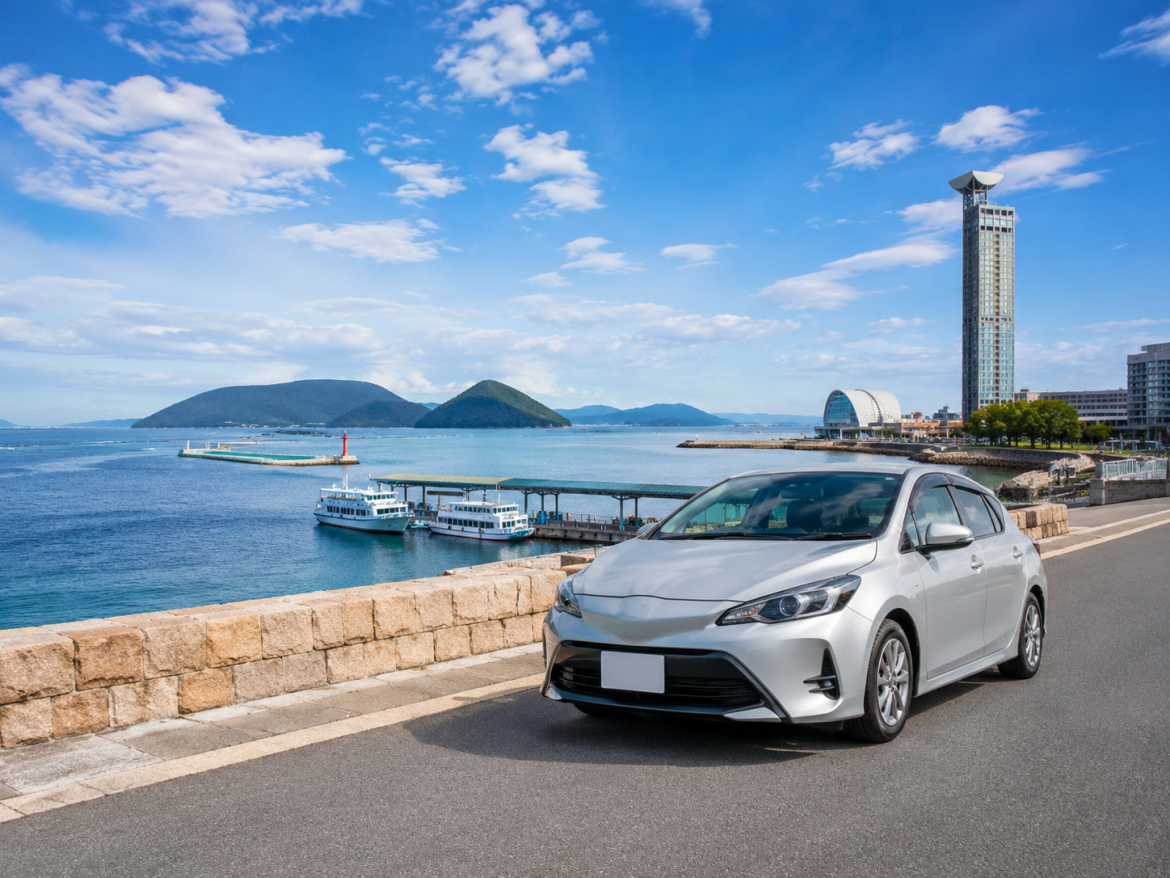

Rent a car for the countryside, keep Takamatsu city days car-free
Takamatsu is a useful starting point for a Shikoku road trip, especially if your plans include Kotohira, Zentsuji, Marugame, Chichibugahama or the Iya Valley. A car lets you combine rural stops without building the entire day around infrequent connections. It is less useful for Ritsurin Garden, the waterfront, shopping streets and a Naoshima or Teshima excursion.
The practical decision is when to start the rental. Collect at the airport if you are heading straight into Kagawa’s countryside; collect near JR Takamatsu Station after your city and island days if those come first. Use the Takamatsu travel guide and airport transport guide to plan those car-free days. Linked local guides offer more planning detail.
For actual dates and vehicle classes, compare Takamatsu rental offers. Include insurance, the ETC card, child seats, one-way fees and the cancellation deadline before deciding which quote is cheaper.
When is renting a car worthwhile?
| Your itinerary | Best approach | Main trade-off |
|---|---|---|
| Central Takamatsu and the port | Walk and use trains or buses | A parked rental adds little value |
| Airport to Kotohira, Marugame or western Kagawa | Airport rental | Allow for the shuttle and paperwork |
| Two or three scattered rural stops | One or two rental days | Choose a compact geographical route |
| Iya, Oboke or a mountain hot-spring hotel | Car if confident on narrow roads | Plan daylight arrivals and an overnight stay |
| Naoshima or Teshima | Usually travel as a foot passenger | Check the island’s own local transport |
| Shodoshima | Compare an island rental with an approved mainland car ferry trip | Port, vehicle capacity and rental permission all matter |
| Several Shikoku prefectures | Multi-day rental, perhaps one-way | Driving time, tolls and return fees grow quickly |
Families can benefit from fewer changes and room for a pushchair, but a five-seat vehicle is not automatically large enough for four people, two child seats and four suitcases. Travellers who are uneasy about left-side driving, plan to drink with dinner, or mainly want rail sightseeing should avoid renting merely because Takamatsu has rental offices.
Airport pickup: the desk and the car are in different places
The airport’s rental-car directory and floor map show reception on the first-floor arrivals level. The listed operators provide transfers between the terminal and their off-airport offices. Follow the instructions in your own confirmation rather than walking out expecting a car beside arrivals.
- Collect your baggage and find the correct rental desk.
- Have your reservation, driving documents and passport ready.
- Wait for the operator’s shuttle to the rental office.
- Review the agreement, equipment and vehicle condition before leaving.
For the return, navigate to the rental office, refuel as your contract requires, complete the inspection and ETC settlement, then take the shuttle to the terminal. Do not navigate directly to the airport departures lane. As a conservative planning allowance, aim to reach the rental office around two hours before a domestic flight and earlier for an international flight, adjusting for your airline’s check-in deadline and the operator’s instructions. This is a planning buffer, not a guaranteed minimum connection.
Airport or Takamatsu Station: choose around the first driving day
| Pickup area | Useful for | Check before booking |
|---|---|---|
| Takamatsu Airport | Arriving by day and continuing to Kotohira or western Kagawa | Last accepted pickup, shuttle and flight-delay procedure |
| JR Takamatsu Station | City/island days first; arrival by train from Okayama | Exact branch and walking route with luggage |
| Kawaramachi and central offices | Staying in the shopping district | Distance from your hotel and urban return route |
| Kotohira or Marugame | Starting with a train journey before driving locally | Vehicle selection, opening hours and one-way acceptance |
The airport lies south of central Takamatsu, so going into town only to drive back toward the countryside can waste time. Conversely, a station-area rental can remove several days of parking charges. If arriving from Okayama, rail plus a short local rental is a sensible alternative to driving across the bridge.
Do not treat every “Takamatsu Station” listing as the same office. Toyota lists its Takamatsu branch about a two-minute walk south of the station, while its Sunport branch is northwest of it and has different hours. Nippon lists a separate station-front office. Use each operator’s branch map or Kagawa directory to select the actual address.
Compare airport companies and their closing times
Eight brands appear in the airport directory. Opening hours alone do not establish the last acceptable arrival: baggage collection, immigration and the shuttle happen before you reach the office. Provider branch pages take priority over a general airport summary when they differ.
| Company | Usual airport-office hours checked | Booking consideration |
|---|---|---|
| Toyota | 08:00–20:00 | Compare return branches and vehicle-class restrictions |
| Nippon | 08:00–20:00 | Usually arrive at the office by 20:00; December 31, 2026–January 1, 2027 closes at 19:00 |
| Times | 08:30–19:00 | Branch page lists January 1 closed; January 2–3, 09:00–17:00 |
| Nissan | 08:00–20:00 | Check the selected vehicle and one-way conditions |
| ORIX | 08:00–19:00 | Reserve equipment and confirm the return office |
| Sky | 09:00–19:00 | Check final shuttle/pickup arrangements |
| Budget | 08:30–20:00 | Use the branch hours, not the booking call centre’s hours |
| Heisei | 09:00–18:00 in the airport and English directories | Japanese pages show differing office/shuttle hours; confirm the accepted pickup time directly |
Confirm the travel-date conditions on the Times, Budget or Heisei pages when using these companies. Do not assume a late flight extends opening hours.
Compare the whole trip cost, not the daily headline rate
Get quotes for the same pickup and return times, vehicle class, driver details and cancellation conditions. A cheap rate can cease to be cheap once protection and equipment are added. Demand also changes around Japanese holidays, school breaks, blossom and autumn-leaf trips, and major Setouchi events.
- Rental charge and tax, including how partial days or extra hours are counted
- Deductible waiver and separate NOC protection
- ETC-card rental, child seats and winter tyres
- One-way return or special delivery fees
- Fuel, tolls, parking and any vehicle-ferry tickets
- Cancellation deadline, late-return charges and driver eligibility
Compare the one-way fee with the fuel, tolls and time saved by avoiding a return drive. For a family, an adequately sized vehicle may be better value than the smallest car with no usable luggage space. A larger replacement is not guaranteed at pickup.
Driving documents depend on where your licence was issued
Check the National Police Agency requirements before booking. Taiwan licence holders need the original valid licence, an authorised Japanese translation and their passport. The translation route also applies to licences from Switzerland, Germany, France, Belgium and Monaco.
For other eligible issuing countries or regions, including Hong Kong, use the correct 1949 Geneva Convention international driving permit, with your original licence and passport. A 1968 Vienna Convention permit is not valid for driving in Japan. The permission period is limited by entry date and document validity; Japan residents have additional re-entry rules.
JAF’s translation application guidance currently lists an average of two to three business days for the six translation-route jurisdictions, with online applications from within Japan. Allow extra time and arrange the document before the driving day. Taiwanese travellers can also use the authorised translation process in Taiwan. Bring the printed valid translation, not just an application receipt.
Register every person who may drive and show their documents at pickup. Bring the required payment card in the appropriate driver’s name and confirm age or licence-tenure restrictions with the rental company. A reservation does not override missing or invalid driving documents.
CDW and NOC protect against different costs
The rental price may include basic insurance, but deductibles, limits and exclusions still apply. A collision damage waiver, often called CDW, generally waives specified deductibles. A non-operation charge, or NOC, compensates the company while a damaged or dirty car cannot be rented out. Buying one does not automatically waive the other.
For example, Toyota’s insurance explanation separates basic cover from NOC, and its W protection plan combines deductible and NOC waivers under stated conditions. This is a company example, not a universal rule for every quote.
Read the treatment of tyres, lost keys, towing, interior damage and prohibited use. “Full insurance” is not a promise of zero liability. If anything happens, stop safely and contact the police and the rental company; do not privately settle a scrape and assume the protection remains valid. Keep the operator’s emergency instructions with you.
Choose a vehicle for luggage and child seats
| Group | Practical starting point | Check |
|---|---|---|
| One or two people, light luggage | Compact | Boot dimensions and bag size |
| Two people, two large cases | Compact or larger hatchback | Actual boot capacity, not a seat-count icon |
| Three or four, light bags | Mid-size car | Rear-seat space after fitting child seats |
| Four with large suitcases | Estate or minivan | Usable luggage room with seats occupied |
| Five to seven travellers | Seven/eight-seat minivan | A full passenger load can leave little boot space |
| Winter mountain itinerary | Correctly equipped vehicle | Winter tyres, restrictions and driving experience |
A kei car can work for two lightly packed people making short local journeys. A compact is often more comfortable for motorway travel and larger bags. An SUV is unnecessary for ordinary visits to Kotohira, Marugame, Yashima or the aquarium; it does not make a narrow mountain lane wider. Four-wheel drive is not a substitute for winter tyres.
ETC cards, expressway passes and bridge tolls
An ETC reader installed in the dashboard is only the device. Reserve a separate ETC card, confirm it is inserted correctly, and ask how tolls are settled at return. Without a usable card, do not enter an ETC-only lane.
The San’in–Setouchi–Shikoku Expressway Pass, or SEP, offers three to ten calendar days on its designated network with a participating rental car and ETC card. Eligible users include non-Japanese passport holders and Japanese citizens with permanent residence overseas. Compare it for a multi-prefecture route such as Takamatsu–Iya–Kochi–Matsuyama; short local drives may cost less without it.
SEP excludes the Honshu–Shikoku bridge expressways. Budget separately for Seto-Ohashi, the Kobe–Awaji–Naruto route and Shimanami Kaido. Use the official coverage map and bridge toll tables; an ETC discount is different from pass inclusion. A separately advertised Shikoku Drive Pass has its own dates, exclusions and registration rules and should not be assumed interchangeable with SEP.
Where driving gets difficult
Central Takamatsu
Traffic around the station, Chuo-dori, Kawaramachi and shopping streets requires attention to cyclists, pedestrians, one-way streets and restricted entrances. Takamatsu’s Kotoden trains are not street-running trams; do not confuse the city with Matsuyama. Choose a legal car park before setting off instead of stopping suddenly to search for an entrance. Compared with Tokyo, the scale is smaller, but local rules still matter.
Kotohira and mountain roads
A car does not take you up to Kotohiragu Shrine’s main sanctuary. Park in a confirmed public or commercial car park, then walk; the approach to the main shrine involves 785 steps. In Iya, the last road to an inn or viewpoint can be much slower than the main road through Oboke. Allow for bends, passing traffic, rain and darkness, and reject a navigation shortcut if it takes you onto an unsuitable lane.
A pickup checklist worth slowing down for
- Check names, documents, registered drivers, dates and the return office.
- Read the insurance, deductible and NOC choices.
- Confirm the ETC card, child seats and booked winter equipment.
- Inspect the body, glass, wheels, bumpers and interior with staff.
- Photograph existing marks before leaving.
- Check the fuel type, return fuel level and receipt requirements.
- Find the lights, wipers, parking brake and gear controls.
- Set up navigation while parked and save the return-office address.
- Record the breakdown and accident contact procedure.
Do not skip the inspection because another customer is waiting. A short walk-around video complements, rather than replaces, the written damage record. Confirm unfamiliar controls before entering traffic.
Half-day, day-trip and multi-day routes
Arrival afternoon: airport, Ritsurin Garden and the waterfront
After a midday arrival, allow for pickup, visit Ritsurin Garden if opening hours permit, then check in before an evening waterfront walk or dinner. This is an itinerary outline rather than a fixed flight connection. If that is the whole day’s plan, the airport bus is usually simpler; an arrival-day rental makes more sense when leaving early for the countryside next morning.
Western Kagawa: Kotohira, Zentsuji and Marugame
Leave in the morning, give the shrine climb a generous first half of the day, eat lunch around Kotohira or Zentsuji, and choose Marugame Castle or Shikoku Aquarium afterward. The Marugame Castle guide helps assess its steep approach. With children or older relatives, do not add the aquarium, castle and a sunset beach stop to an already demanding shrine day.
Coastal day: aquarium, Kan-onji and Chichibugahama
Visit the aquarium first, lunch around Utazu or Marugame, then continue west. Arrange Chichibugahama around the tide, wind and sunset rather than assuming every evening produces mirror-like reflections. Staying in western Kagawa avoids a tired late drive back to Takamatsu.
Two days: Oboke and Iya
Travel to Oboke in the morning, choose the gorge boat trip or the vine bridge, and sleep locally. Use the next daylight period for a manageable mountain excursion before returning or continuing to Kochi. Naruto, Oboke, Iya, Oku-Iya and Kochi are not one sensible sightseeing day.
Three to five days across Shikoku
A five-day outline is Takamatsu–Kotohira–Marugame on day one; Oboke/Iya on day two; Kochi on day three; transfer toward Matsuyama on day four; and a local morning followed by an agreed return on day five. With only three days, cut the route rather than compressing all of it. Use the Matsuyama guide and Dogo Onsen accommodation guide when planning a western finish. A one-way rental must be confirmed for the particular branches and vehicle.
Taking a rental car to Naoshima or Shodoshima
For Naoshima, most visitors are better served by returning the car before the island visit or leaving it in an appropriate Takamatsu car park. Local buses, bicycles and walking suit many museum trips, and vehicle access near art sites is restricted. Use the Naoshima transport guide to choose a port and sailing.
Shodoshima has more widely separated sights, so a car can be valuable. Compare a prebooked island rental with taking a mainland car on a vehicle ferry. Before paying, obtain the rental company’s permission for the specific ferry/island journey and clarify breakdown recovery, insurance and return arrangements. The presence of a car deck is not rental permission. High-speed passenger boats cannot carry your car.
Allow for vehicle-ferry fares, extra passengers, reservations and loading deadlines. For the island-rental option, coordinate your arriving port with the pickup branch. See the Shodoshima transport guide and island accommodation guide.
Travelling with children or older relatives
Reserve correctly sized child seats with the car. Japanese law requires them for children under six; the police child-seat guidance also stresses secure installation and a seat appropriate to the child. Check how two seats affect access, passenger space and the pushchair’s storage. Never leave a child alone in a parked vehicle.
A car reduces station walking and waiting but does not remove a destination’s stairs, slopes or uneven surfaces. Kotohiragu, Marugame Castle and Iya’s vine bridge can still be physically demanding. A gentler combination might use gardens, Zentsuji, the aquarium, an accessible viewpoint and a hot-spring stay, choosing entrances suited to the actual traveller.
A private driver can be worth comparing when nobody wants mountain driving. Confirm the route, passenger count, luggage and child-seat provision rather than assuming a charter has unlimited time or capacity.
Winter equipment and mountain weather
Mild weather in central Takamatsu says little about Iya or mountain roads farther inland. Check road closures, the hotel’s final approach, forecast temperatures and the vehicle’s equipment before committing to the route. Winter tyres must be specifically booked and confirmed; four-wheel drive does not prevent sliding on ice.
Keep the final mountain leg in daylight, shorten the day if conditions deteriorate and be ready to omit a viewpoint. For autumn planning, the Shikoku autumn-leaf guide can help place overnight stops, but colour forecasts do not guarantee safe driving conditions.
Late arrivals: sometimes the best pickup time is tomorrow
A scheduled landing just before the office closes is too tight. Nippon’s airport branch instructions require reaching the office by its closing time, normally 20:00; the published December 31, 2026–January 1, 2027 hours end at 19:00. Other operators have their own acceptance and shuttle rules. Give them your flight details and learn the delay procedure before travelling.
If a safe margin is unavailable, take an airport bus or booked transfer, sleep near Takamatsu Station or Kawaramachi, and collect a car next morning. Groups with luggage or young children can compare an airport transfer, checking the destination and child-seat arrangements.
Visiting Iya, Oboke and Naruto without driving
Public transport is possible, but linking several rural sights in one day can be awkward. A tour can remove the mountain-driving and parking burden, at the cost of a fixed route and shorter stops. Read the exact itinerary: a product title mentioning several regions does not mean every departure visits all of them.
Naruto’s whirlpools depend on tidal conditions and weather. Neither a rental car nor a tour guarantees a strong display. Match the published sightseeing window with your actual visit and avoid combining a long mountain day with an inflexible late return.
Could a rail pass replace the car?
A rail-based trip works well for a sequence of major cities and stations. Rural baths, Chichibugahama and parts of Iya still need a bus, taxi, local rental or tour. Compare individual tickets against the pass for the journeys you will actually take.
For ALL SHIKOKU Rail Passes issued from October 1, 2026, Shodoshima Ferry and Shodoshima Olive Bus are no longer included. The KAGAWA Mini Rail & Ferry Pass has been withdrawn from sale. Check the official revision notice rather than relying on an older island-coverage chart. Rail passes do not pay car tolls or rental charges.
Where to stay on a driving trip
For a single rental day, the station or Kawaramachi area keeps restaurants and pickup offices convenient. Check whether hotel parking needs a reservation, the height limit, overnight fee and whether re-entry costs extra. “Parking available” need not mean free or on-site.
Before an island day, returning the vehicle and staying near the port or Sunport avoids paying for an idle car. The Setouchi accommodation guide provides wider island-stay ideas. For two days in western Kagawa, Kotohira, Marugame or Utazu can reduce backtracking. In Iya or Oboke, a local night is often more sensible than a late mountain return to the city.
First-time mistakes to avoid
- Renting throughout a city-and-island stay when the car spends most days parked
- Mistaking the airport reception desk for the vehicle pickup location
- Returning too late to refuel, inspect the car and transfer to the terminal
- Choosing by passenger count while ignoring luggage and child seats
- Assuming CDW includes NOC, or an ETC reader includes a card
- Driving toward the shrine itself instead of its legal parking approach
- Taking a car on a ferry without the rental company’s approval
- Relying on four-wheel drive without appropriate winter tyres
- Overloading one day with Kotohira, Marugame, Chichibugahama and Iya
- Letting an unregistered person drive or failing to document existing damage
Takamatsu car rental FAQ
Do I need a car for Takamatsu itself?
Usually not. Rent for the rural days, and use walking and public transport for the city and most art-island trips.
Can I collect a car directly at the airport?
Start at the arrivals rental desk, then take the operator’s transfer to its office. The pickup and return address is normally outside the terminal.
How many airport companies are listed?
The directory lists eight. Compare the exact branch’s travel-date hours, not just the brand, especially for late flights and New Year.
Is there a rental near the station?
Yes. Several station-area offices suit travellers arriving by train or collecting after city sightseeing. Check which side of the station and the specific office name.
Is a Taiwanese licence enough on its own?
No. Bring the valid original, authorised Japanese translation and passport. Every additional driver needs their own valid documents and registration.
Should I buy extra protection?
Compare deductible and NOC waivers separately, then read exclusions. Broader protection may reduce your exposure, but no plan removes the duty to follow the agreement and report accidents.
Do I need to reserve the ETC card?
Yes, reserve it if you need it. A vehicle’s installed reader does not guarantee card availability or an expressway pass.
Can I return in Matsuyama or Kochi?
Some branch and vehicle combinations permit this with a fee. Get the exact return approved before booking onward travel; do not assume all offices accept every car.
Is a car helpful for Kotohiragu or older relatives?
It can reduce transfers, but the shrine still involves many steps. Choose sights and parking approaches according to walking ability.
Should I take the car to Shodoshima?
Compare total ferry costs and approved rental conditions with an island rental. For Naoshima, a car is often unnecessary.
How early should I book?
Start comparing several weeks ahead for ordinary dates and earlier for holidays or scarce equipment. This is planning advice, not a guarantee that a particular class will remain available.
What matters most on the return day?
The rental-office deadline, refuelling, inspection, ETC payment and shuttle all come before airline check-in. Build the schedule backward from the flight and branch requirements.
The simplest first Takamatsu road trip
Keep the city and island visits car-free, then use one or two rental days for Kotohira, Zentsuji, Marugame and western Kagawa. Collect at the airport only when heading straight to the countryside or when an early next-day departure justifies the extra rental time.
For Iya or a longer Shikoku journey, add local overnight stays rather than longer daily drives. Choose the right luggage capacity, reserve child seats and an ETC card, separate CDW from NOC, and get the return branch and any ferry use confirmed. Those decisions matter more than finding the lowest headline day rate.