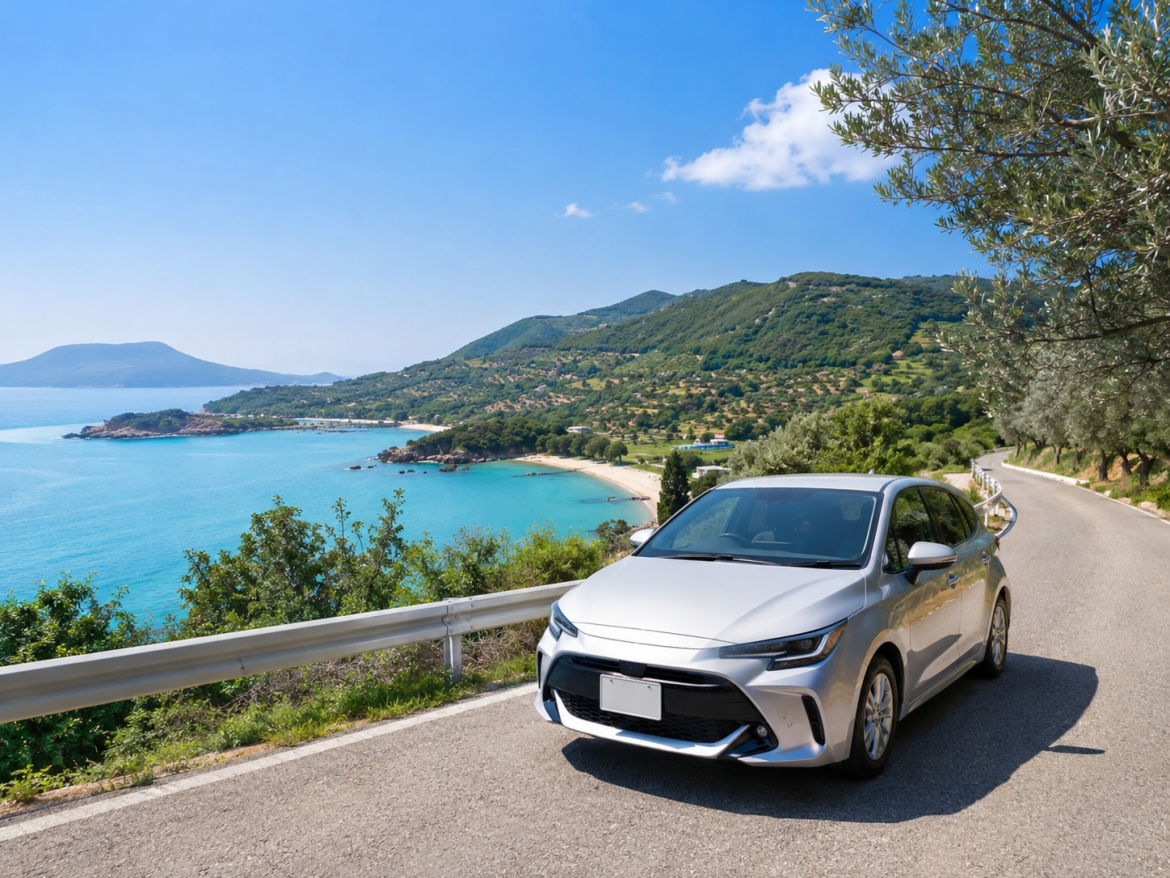

Book the ferry port and rental car as one plan
The first Shodoshima rental decision is where to collect the car and where to return it. Angel Road, Kankakei Gorge, Olive Park, the soy-sauce district and Twenty-Four Eyes Movie Village are spread across different parts of the island. A low rental price is not useful if the vehicle is waiting at the wrong port.
For a first visit from Takamatsu or Okayama, Tonosho is usually the easiest place to compare nearby offices. Ikeda can work well for a central-island stay with arranged delivery. Arriving at Sakate from Kobe or at Fukuda from Himeji requires a more deliberate pickup plan, especially if leaving from another port.
Start with the Shodoshima transport guide, then match the sailing, branch, office hours and return location. Local guide links here lead to Traditional Chinese articles. Do not build the trip around old Kusakabe or Obe ferry routes, and do not assume a smartphone-only rental accepts the same documents as a staffed office.
Is renting a car worth it on Shodoshima?
| Your plan | Recommendation | Trade-off |
|---|---|---|
| Tonosho, Angel Road and one main bus-served sight | Public transport or a tour can work | Choose fewer stops and check connections |
| Several scattered sights, including Kankakei or the movie village | A rental is useful | Mountain roads and the ferry deadline need attention |
| Family or older travellers with luggage | A car can reduce transfers | Reserve seats and check attraction accessibility |
| A short visit of 4–5 hours | Stay around the west/central island | Do not try to see every coast and the mountains |
| A full day of 8–9 hours | Choose three or four main stops | Allow lunch, parking and return time |
| Angel Road, Kankakei and several eastern sights | Stay overnight | More freedom over tide and weather |
A car’s main benefit is flexibility: you can move Angel Road to a useful tidal window or visit the gorge when visibility improves. It does not make every attraction fit into a day. If driving on the left or narrow roads would dominate your attention, a smaller bus-based itinerary or guided trip may be more enjoyable.
Current ferry and driving changes that affect your booking
Takamatsu–Tonosho fast boats have a reduced timetable
Since May 16, 2026, the operator has reduced this high-speed service to eight departures in each direction per day. The crossing is approximately 35 minutes, and cars, motorcycles and bicycles are not carried. Consult the current fast-boat timetable before setting a Tonosho pickup time. A car must travel on an appropriate vehicle ferry instead.
Kusakabe and Obe are not current regular arrival options
The Takamatsu–Kusakabe route remains suspended, as shown by Kagawa’s port information. The Hinase–Obe service is also suspended. Use a currently operating route to Tonosho, Ikeda, Sakate or Fukuda rather than a legacy ferry map.
Local-road speed rules are already in force
Since September 1, 2026, qualifying local roads without centre lines or lane markings have a default 30 km/h limit. Posted limits take precedence. The police explanation sets out the exceptions; a quiet village road is not permission to drive at the app’s assumed speed.
Use current fares and current pass coverage
Himeji–Fukuda fares changed from August 1, 2026. Check the operator’s current route page when comparing a car brought from Osaka or elsewhere in Kansai with an island rental. ALL SHIKOKU Rail Passes issued from October 1, 2026 no longer include Shodoshima Ferry or Olive Bus, and KAGAWA Mini is no longer sold. The official revision preserves the former island benefit for qualifying passes purchased by September 30, 2026; it never covers taking your rental car aboard.
Which port should you choose?
| Port | Main approach | Rental planning |
|---|---|---|
| Tonosho | Takamatsu; Shin-Okayama; Uno/Teshima services | Several nearby staffed offices; confirm ferry versus fast-boat meeting point |
| Ikeda | Takamatsu | Useful for central-island sights with prearranged delivery or transfer |
| Sakate | Kobe or Takamatsu East via Jumbo Ferry | Arrange a specific delivery/branch and time before arrival |
| Fukuda | Himeji | Northeastern arrival; check local office hours and any different-port return |
| Kusakabe/Obe | Former regular routes | Do not use as current ferry entry points |
Tonosho is convenient for an Angel Road start and a choice of rental styles. The fast-boat and vehicle-ferry facilities are not identical, so use the branch’s stated meeting point. Ikeda avoids travelling west to Tonosho when your hotel or first stop is nearer Olive Park or the island centre.
For Kobe arrivals, verify Jumbo Ferry’s Sakate and mainland terminal maps. Takamatsu East Port is different from the central Takamatsu port used by the Tonosho/Ikeda routes. From Okayama, choose the actual departure port and vessel type before reserving a car; not every connection through Teshima is a vehicle-carrying service.
Rental companies: useful differences and important restrictions
These are options to compare, not a cheapest-company ranking. Tell the office the licence-issuing jurisdiction, ferry arrival, passengers, luggage, child-seat needs and final port before paying. Legal eligibility to drive does not compel every rental company to accept the documents.
| Provider | Location/hours guidance | What changes the decision |
|---|---|---|
| ORIX Shodoshima | Tonosho, about 3–5 minutes on foot; 08:30–18:00 | No one-way departure/return service and no ETC-card rental at this branch |
| Niconico Tonosho | About 5 minutes from the port; 08:00–19:00 | Compare protection, equipment and cancellation conditions with the headline rate |
| Shodoshima Kanko Rent-a-Car | Tonosho fast-boat building, 09:00–18:00; separate Fukuda arrangements | Published rates include fuel; Tonosho–Fukuda transfer is restricted to kei cars and has a fee |
| Shodoshima Anzen | Shimachan Self SS plan 09:00–18:00; port meeting by arrangement | Do not confuse phone enquiry hours with rental hours; confirm the selected plan’s fuel/delivery terms |
| Sky Smart Service | App-based unattended service near Tonosho | Not a default option for foreign-licence visitors; eligibility must be established before relying on it. No one-way, child-seat-equipped or winter-tyre-equipped vehicles in its FAQ |
| Shodoshima Rent-a-Car / Mishima | Near Tonosho; 08:30–18:00 | Current site requires a Japanese driving licence and does not accept international driving licences; not an overseas-licence recommendation |
| Miki Rent-a-Car | Enquiries 08:00–20:00; arranged ports/hotels | Discuss delivery and collection at different locations, with the complete fee quoted in advance |
For a straightforward Tonosho return
Compare ORIX and Niconico when collecting and returning near Tonosho. ORIX’s explicit no-one-way rule makes it unsuitable for an assumed Sakate-to-Fukuda rental. A branch’s limited equipment is another reason to ask before booking rather than adding requests on arrival.
For fuel-inclusive pricing
Shodoshima Kanko’s published fuel-inclusive rates can simplify the return, but protection and optional seats are separate. Its Fukuda fleet is limited to kei cars and the cross-branch option is restricted accordingly. The operator’s older Fukuda opening notice and tourism summaries show differing hours, so obtain the accepted pickup and return time for that office; do not apply Tonosho’s 18:00 close to both.
For different ports or a hotel handover
Miki is a useful company to ask about a coordinated island itinerary. Provide both sailings and the hotel address, and request a quote including each delivery/recovery charge. An enquiry form is not automatically a confirmed reservation. Anzen’s port meeting also needs advance coordination; do not expect a staffed desk at every berth.
For an early or late self-service pickup
Sky’s unattended model is a distinct service, not simply a staffed counter open all night. Confirm that your licence type, account and payment method are accepted, complete approval in advance and understand the app’s unlock/return procedure. If that cannot be established, use a staffed rental and a compatible sailing. Its published restrictions make it unsuitable as an assumed solution for a family needing child seats or a winter Kankakei trip.
Mainland rental on the ferry or an island rental?
| Option | Costs to compare | Best reason to choose it |
|---|---|---|
| Arrive as a foot passenger, rent on Shodoshima | Passenger ferry plus island rental/protection | The car is needed only on the island |
| Bring an approved Takamatsu rental | Mainland rental, vehicle ferry, other passengers, fuel and recovery terms | You already have a multi-day Shikoku car and substantial luggage |
| Bring your own car from Himeji or Okayama | Vehicle-length fare, passengers and any surcharges | The car is already part of a wider domestic journey |
As a comparison example, the Takamatsu–Tonosho ordinary ferry lists a one-way adult fare of ¥700. The vehicle fare is ¥5,030 for a car 3 m to under 4 m long and ¥6,330 for 4 m to under 5 m, including one driver; other passengers are extra. “Under 5 m” is not one price for every smaller car. Check the current fare table for the actual vehicle and travel date.
For Shodoshima Ferry, vehicle reservations are available on eligible Takamatsu–Tonosho and Himeji–Fukuda sailings, while passenger-only bookings are not accepted; some vehicle departures also remain first-come. See the operator FAQ. A sold-out online allocation does not promise a same-day space, and arriving without a reservation does not guarantee boarding.
Before bringing a rental from Takamatsu, get the company’s permission for the specific ferry and island use. Ask who pays for recovery if the car cannot be driven back and whether the protection applies. Compare Takamatsu rental offers only after confirming this; ferry booking acceptance is not rental-company consent.
Buying the Takamatsu–Ikeda ferry ticket
The Ikeda crossing takes approximately an hour and can suit Olive Park, Furusato Village or a central-island stay. Use Ryobi’s timetable and booking guidance for the sailing you need. Its Takamatsu-route advance reservation deadline is 24 hours before departure; unreserved boarding is possible first-come, subject to capacity.
The Klook Takamatsu–Ikeda product is a passenger ticket, not a rental car or a vehicle-ferry booking. Read its redemption conditions and do not assume a voucher reserves car-deck space. If bringing a car, arrange the vehicle separately with the operator and follow its reporting deadline.
Driving documents for Taiwan and other licence holders
For Taiwan, bring the valid original driving licence, an authorised Japanese translation and passport with entry information. Also have the reservation and the payment card accepted by the company. Every additional driver must present the appropriate documents and be registered.
JAF’s translation fee for temporary driving with an eligible Taiwan licence remains ¥6,000; conversion to a Japanese licence is a separate purpose with a different fee. Use JAF’s current application guidance for eligibility, Japan-only online application, printing and processing arrangements. The original licence and its authorised translation must be carried together, and driving permission is limited by entry date, licence validity and special resident rules.
Other travellers must check the licence-issuing jurisdiction. A valid 1949 Geneva Convention IDP is the relevant permit route for eligible jurisdictions; a 1968 Vienna permit is not valid in Japan. Some jurisdictions instead use the authorised-translation route. Check the police requirements and the rental company’s acceptance policy before booking.
The Japan car rental guide covers the broader pickup, fuel and driving process. Mishima’s Japanese-licence-only policy illustrates why a legally usable foreign document and a supplier’s rental rules are separate questions.
Protection and island roadside assistance
Basic rental insurance is not a promise that every loss is paid, nor is every passenger/vehicle cover component a legal requirement. Check the included limits and deductibles. A damage waiver can reduce specified excess, while NOC concerns the rental company’s loss of use while a car is repaired or cleaned.
Shodoshima’s walls, narrow lanes and tight parking spaces are reasons to compare a plan addressing both deductible and NOC exposure. Read the terms for tyres, wheels, interior damage, keys and towing. Follow the accident-reporting process and contact the police and company even for a single-vehicle scrape; do not assume a private settlement preserves cover.
Island recovery deserves a separate question. If a mainland car breaks down, can it be repaired locally, who arranges the ferry recovery, and who pays? Do not rely on a generic “roadside assistance included” label without confirming that your permitted island use is covered.
Which vehicle suits the island?
| Travellers | Starting point | Check |
|---|---|---|
| One or two, light bags | Kei or compact | Boot size and comfort |
| Two or three with luggage | Compact | Actual suitcases, not just the seat count |
| Four with large bags | Larger car or small MPV | Width on lanes and room after child-seat fitting |
| Five to seven | Minivan | Limited island supply and reduced boot with the third row used |
| Winter Kankakei | Specifically equipped vehicle | Tyres, closures and driver experience |
| Electric vehicle | Only with a workable charging plan | Range, charger availability and vehicle-specific restrictions |
Two large suitcases can overwhelm the smallest car. A compact may be more practical when carrying luggage all day. Conversely, a large SUV does not make a village lane easier. Confirm the actual class, equipment and expected substitute vehicles before paying.
Tell the company each child’s age and size. The legal requirement covers children under six, and suitable restraints remain a safety consideration beyond that age. Do not assume any island office has spare seats available on demand.
Compare like-for-like rental prices
Use the same hours and vehicle requirements, then total the rental, deductible waiver, NOC cover, seats, port delivery, different-port collection, fuel, overtime and cancellation conditions. A fuel-inclusive quote with delivery may cost less overall than a cheaper base rate with several extras.
Clarify whether a “day” is a fixed time block, a calendar day or a 24-hour rental. If the return runs late, the next charge may not simply be the difference to the next advertised package. Save the accepted quote and return instructions. The ferry deadline and rental contract both matter.
Reserve early and leave space around the sailing
Book ahead even on ordinary dates when the car is important to the itinerary. Early planning matters more for multiple child seats, a minivan, winter tyres, an unusual vehicle, a remote-port delivery or different-port return. Island fleets cannot always replace a sold-out class quickly.
As a planning buffer, arrange pickup roughly 20–30 minutes after the scheduled arrival rather than at the exact docking time, adjusting for the branch’s location. For a foot-passenger departure after returning a car, aim to complete the return at least 60 minutes before sailing; allow around 90 minutes when refuelling, cross-port travel or unfamiliar self-service steps make it prudent. These are editorial buffers, not operator check-in rules or guaranteed connections.
If taking the car aboard, follow the ferry’s own vehicle reporting deadline instead and arrive earlier in busy periods. Keep the rental office informed of a ferry delay. Do not assume the last boat and the last accepted car return are compatible.
Short, full-day and overnight driving routes
A gentler west/central-island day
Collect at Tonosho, visit Angel Road at a suitable tide, choose a short Maze Town or Yokai Art Museum stop, have lunch and continue to Olive Park before returning. A 09:00–16:00 schedule is a relaxed short day, not a four-hour rental. To make it a true half-day, omit the town stop or Olive Park.
| Stage | Plan | Flexibility |
|---|---|---|
| Morning | Pickup and vehicle check; Angel Road if the tide fits | Swap Angel Road to later rather than waiting indefinitely |
| Late morning/lunch | One town stop and a proper meal | Do not attempt every small museum |
| Early afternoon | Olive Park | Allow time for the grounds and a break |
| Return stage | Refuel if needed, inspection and walk to the berth | Work backward from the booked sailing |
A fuller day with Kankakei
Choose Angel Road, Kankakei and Olive Park as the main anchors, with one soy-sauce stop only if opening hours and the ferry leave enough room. The mountain portion deserves an unhurried block, and a busy autumn day may require dropping the final attraction.
Do not add Twenty-Four Eyes Movie Village and Nakayama’s terraces merely because the route line passes nearby. Driving, parking, walking and meals consume the time between the map pins. Move to an overnight plan if photography, the ropeway and a full museum visit all matter.
Two days and one night
On day one, use Tonosho, Angel Road, a town stop, Olive Park and perhaps Nakayama if time permits, then stay centrally. On day two, choose Kankakei in good visibility and the southeastern soy-sauce/movie-village area, ending at the agreed return port. This gives a second chance at Angel Road’s tide and less pressure to drive the mountain in poor weather.
Use the Shodoshima accommodation guide to choose a base that fits both days rather than returning across the island for a cheaper room.
Sights, parking and the final approach
| Stop | Planning allowance | Parking/access consideration |
|---|---|---|
| Angel Road | About 45–75 minutes | Use designated parking; sandy walking is tide-dependent |
| Olive Park | About 60–90 minutes | Park once and allow walking around the grounds |
| Kankakei | About 90–150 minutes | Mountain approach, queues and winter conditions |
| Nakayama terraces | About 45–75 minutes | Limited space; respect farm and residential access |
| Soy-sauce district | About 60–120 minutes | Use facility/designated parking, then walk |
| Twenty-Four Eyes Movie Village | About 90–150 minutes | A separate southeastern excursion, not a quick drive-by |
| Maze Town | About 60–120 minutes | Park outside the small lanes |
These are itinerary allowances, not required visit lengths or guaranteed parking availability. At Kankakei, consider which ropeway station best suits the group and ask about the exact accessible route before travelling. Driving to the summit may reduce some climbing, but does not guarantee step-free access to every facility.
The Shikoku autumn-leaf guide can help with seasonal planning. Leave additional time on busy weekends rather than treating the navigation estimate as a promise. At Nakayama, never block a bend, home, field or farm entrance for a photograph. In the soy-sauce district, park once rather than moving the car between neighbouring shops.
What island driving is really like
Main roads near Tonosho are a different experience from the final lane to an inn, terrace or viewpoint. Watch the left edge, drainage channels, walls, pedestrians and oncoming vehicles. Do not follow the app into a narrow shortcut just because it is a minute faster.
On long downhill sections, use the appropriate lower gear or engine braking for the vehicle instead of continuously riding the brake. Keep a safe gap and never overtake around a blind bend. If unfamiliar with the controls, ask at pickup.
Rural roads can be poorly lit and services can close earlier than expected. Keep the first mountain drive in daylight. Save Japanese names, addresses and the actual parking entrance before setting out; an English attraction name may point to the wrong approach.
Family driving on Shodoshima
A rental can make naps, spare clothes and a pushchair easier to manage. It also creates equipment obligations: reserve correctly sized child seats, fit them securely and confirm the usable space after installation. See the official child-seat guidance.
- Plan three or four main sights rather than a complete circuit
- Leave time for a proper meal and breaks before mountain bends
- Small-wheel pushchairs are awkward on Angel Road’s sand
- Give Olive Park or the movie village enough time instead of rushing between them
- Never leave a child alone in the car
- Do not book an unattended service that cannot supply the required seats
Older travellers and mobility needs
A car reduces bus waiting but does not flatten the island. Angel Road has sand and uneven surfaces, Nakayama has gradients, and ropeway access depends on the station and route. Check the exact entrance, toilets, parking distance and assistance needed for the individual traveller.
A gentler plan can focus on Olive Park, a suitable Kankakei viewpoint, a soy-sauce museum and a sea-view hotel, with fewer long walks through the town lanes or terraces. If no family member wants the mountain-driving responsibility, compare a private tour and specify accessibility needs, passenger count and luggage before booking.
Can you visit without driving?
Yes. Choose a smaller itinerary: Tonosho and Angel Road, a bus trip to Olive Park, a prebooked sightseeing tour or an overnight stay splitting the sights over two days. Bus routes can reach major attractions, but connections and intervals limit spontaneous changes.
A Tonosho-based tour can be useful when you already have suitable ferry tickets and prefer not to handle left-side driving or parking. Check the actual meeting point, itinerary and finish time against both sailings. The product is an alternative to driving, not a guarantee that every desired stop or ropeway ride is included.
Season-by-season driving choices
| Season | Appeal | Adjustment |
|---|---|---|
| Spring | Comfortable outdoor sightseeing | Reserve ahead for holidays and popular dates |
| Summer | Coastal scenery and long daylight | Heat breaks, water and a realistic walking plan |
| Autumn | Kankakei colour | Earlier mountain start, congestion margin and daylight return |
| Winter | A quieter island stay | Check mountain ice, tyres, strong wind and ferry changes |
| Wet weather | Museums and local food | Reduce exposed coastal walks and mountain driving |
Do not rely on a season label to establish conditions on the day. A car booked for a warm coastal stay may be unsuitable for a freezing summit road.
How to change the route on a rainy day
Light rain need not cancel the visit, but a clear-day itinerary should not be followed automatically. In fog or heavy rain, Kankakei may offer little visibility while demanding more concentration. Consider the soy-sauce museum, an indoor art stop or a shorter Tonosho day instead.
Angel Road remains governed by tide, with extra slipping risk when wet. Wind and rough seas can affect sailings. On departure day, move toward the port earlier and check the operator’s status; do not wait until the last ferry to discover the route has changed.
Combining Shodoshima with nearby places
Takamatsu
A night before the island trip makes an early ferry easier, and a second island day can be added without trying to relocate every evening. Return the island car before continuing a rail or city itinerary.
Naoshima
Give the two islands separate sightseeing days and enough overnight time. Shodoshima’s landscape and food-production visits differ from Naoshima’s museum reservation schedule. Read the Naoshima transport guide and Chichu Art Museum booking guide before choosing the connection.
Himeji in, Takamatsu out
Arriving at Fukuda and leaving from Tonosho or Ikeda can suit a Kansai-to-Shikoku journey, but only with an explicitly accepted different-port rental. Do not book the ferries first and assume the rental company can recover the car anywhere.
Wider Setouchi island-hopping
Driving is useful on Shodoshima without being useful on every other island. Return the vehicle before a foot-passenger island-hopping section where practical, and use the Setouchi accommodation guide to place overnight stops.
Food stops that fit the route
Hand-stretched somen makes a good lunch around a central-island route. Soy-sauce-based dishes and hishio-don fit naturally with the soy-sauce district rather than a separate cross-island detour. Olive dishes, olive beef and citrus or olive-flavoured treats can work around a hotel or park stop, depending on the individual restaurant.
Tsukudani and soy-sauce ice cream are enjoyable snacks, but do not replace a meal before a long drive. Check restaurant hours and allow for queues. Finish driving before drinking alcohol with dinner.
Should you stay overnight?
A day trip can cover Angel Road, Olive Park and another selected stop when the sailings and tide fit. Stay overnight if you want Kankakei plus several eastern sights, a second tide opportunity, a sunset or a relaxed family pace.
- Tonosho or Angel Road area: practical for a first visit and a western departure
- Central/south coast near Olive Park or Ikeda: convenient for a two-day driving route
- Eastern accommodation: useful after a late Sakate arrival, avoiding an immediate cross-island drive
Confirm hotel parking and dinner arrangements. A scenic remote room is less convenient when the rental has already closed and the last meal option is elsewhere.
First-visit mistakes to avoid
- Booking a car without checking the arriving and departing ports
- Using a suspended Kusakabe or Obe route from an old map
- Assuming a high-speed boat has a vehicle deck
- Arriving with the wrong driving documents or using a company that does not accept them
- Confusing a low base rate with the total including fuel, protection and delivery
- Expecting every company to allow a different-port return
- Fitting Angel Road, Kankakei, Olive Park, the movie village, terraces and soy-sauce district into one rushed day
- Ignoring tide windows or the walk from the return office to the berth
- Parking at farm entrances or driving mountain lanes after dark without experience
- Assuming a 24-hour app service has seats, winter tyres or staffed assistance
Shodoshima car rental FAQ
Which port is easiest for a first rental?
Tonosho offers several nearby offices. Ikeda, Sakate and Fukuda can suit a particular route, but arrange the exact handover before arriving.
Can I rent at Ikeda or Sakate?
Prearranged delivery or a suitable local branch can work. Do not assume an available car will be waiting when the ferry arrives.
Can I return at a different port?
Only when explicitly accepted. Miki offers arranged locations, Kanko’s Tonosho–Fukuda option is class-restricted with a fee, and ORIX Shodoshima does not provide one-way service.
Can I arrive at Kusakabe or Obe?
Do not plan on the former Takamatsu–Kusakabe or Hinase–Obe regular routes. Choose one of the operating approaches instead.
Is a Taiwan IDP enough?
No. Use the original valid Taiwan licence, authorised Japanese translation and passport. Confirm the company accepts your documents before paying.
How much is JAF’s temporary-driving translation?
For the eligible Taiwan short-visit purpose, the published issuance fee is ¥6,000. Check printing and current application conditions; this is different from conversion to a Japanese licence.
Should I buy extra protection?
Compare deductible and NOC waivers, exclusions and island recovery. Broad protection is not unconditional cover.
Is a kei car big enough?
Often for one or two lightly packed people. Large suitcases, multiple child seats or more passengers justify checking a larger class.
Must I refill the tank?
Follow the selected plan. Some local rates include fuel, while others require a full tank and a receipt. Smartphone services can also have vehicle-specific rules.
Is 24-hour rental a reliable late-ferry solution?
Only after the specific unattended service has accepted your licence, account and payment setup. It is not a substitute for confirming eligibility, equipment or the return procedure.
Can I bring a Takamatsu rental?
Only with the rental company’s permission and suitable ferry booking. Vehicle tickets generally include one driver on the routes discussed, with other passengers extra; fast boats cannot carry cars.
Are vehicle reservations essential?
Rules differ by operator and sailing. Reserve where available when a particular departure matters, and follow its check-in deadline. First-come capacity is never a guaranteed space.
Can I drive around the island in a day?
A driving circuit and a sightseeing itinerary are different. Select a few main stops and leave time to enjoy them.
Can I drive to Kankakei in winter?
Only if the road, weather, equipment and your experience suit it. Winter tyres are not universal; cancel the mountain section when conditions are unsuitable.
Is an electric car a good idea?
Only with a confirmed vehicle-specific range and charging plan. Do not build an already full day around an unverified charger.
How much time should I leave after returning the car?
Aim for a generous buffer, commonly at least an hour before a foot-passenger sailing and more for complex returns. Follow the actual operator and rental deadlines.
What if I prefer not to drive?
Choose buses, a Tonosho-based tour, a private driver or two gentler days. Renting is an option, not an obligation.
The best rental is the one that fits your ports and pace
Choose the sailing and port first, verify the company accepts your driving documents, and get the pickup, return and equipment confirmed. Tonosho is a practical first choice; other ports work well when the handover is deliberately arranged.
Keep Angel Road flexible around the tide, give Kankakei a daylight weather window and add a night rather than rushing every major sight. A well-matched car, clear protection terms and an unhurried return make more difference than the lowest headline rental price.