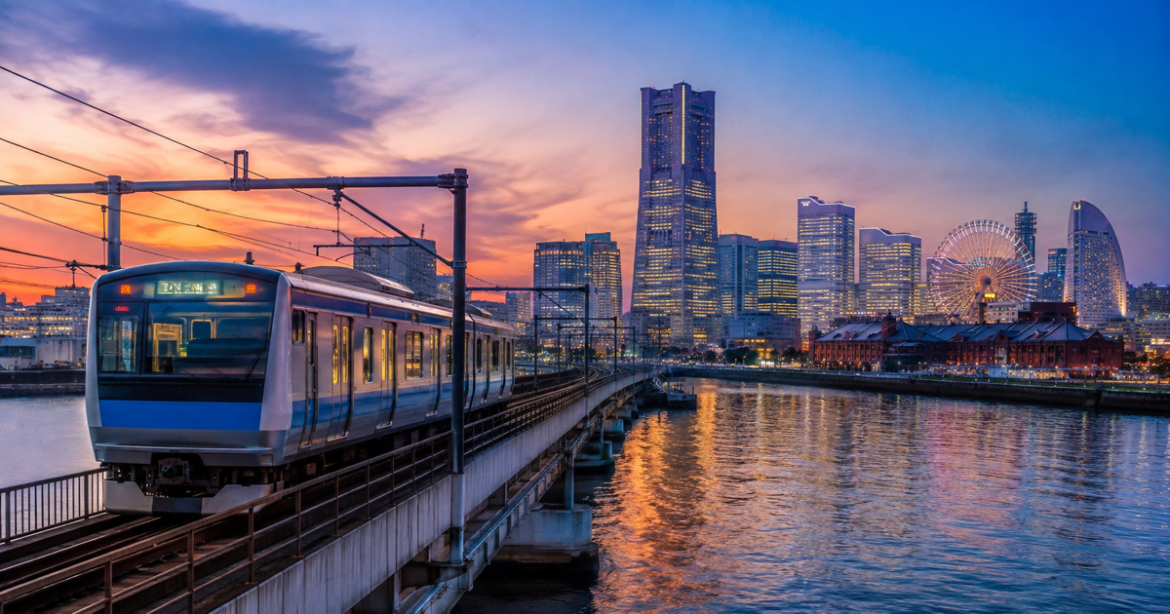

Tokyo to Yokohama: choose the station nearest your first stop
Yokohama is one of the easiest day trips from Tokyo. The two cities are connected by several direct railway lines, and most travelers can reach Yokohama Station in roughly 20–30 minutes from major Tokyo hubs such as Tokyo Station, Shinagawa, Shibuya and Shinjuku. Official Yokohama tourism information lists approximately 25 minutes from Tokyo Station, 16 minutes from Shinagawa and about 25 minutes from Shibuya, depending on the line used.
There is no single best route for everyone. From Tokyo Station, the JR Tokaido Line is usually the fastest and simplest choice. From Shinjuku, use the JR Shonan-Shinjuku Line. From Shibuya, the Tokyu Toyoko Line is especially useful because trains continue onto the Minatomirai Line toward Minatomirai and Motomachi-Chukagai, letting you bypass Yokohama Station if your real destination is the waterfront or Chinatown.
Yokohama works extremely well as a day trip, but an overnight stay is worth considering if you want the waterfront after dark, a relaxed Chinatown dinner, Hakkeijima Sea Paradise, or a second day toward Kamakura. If Tokyo is your main base, see the Todolist Japan Tokyo Travel Guide when deciding which Tokyo neighborhood gives you the easiest departure.
Tokyo to Yokohama: Quick Transportation Comparison
| Transportation Option | JR Tokaido Line |
|---|---|
| Best For | Tokyo Station and Shinagawa |
| Route Overview | Tokyo → Shinagawa → Yokohama |
| Pros | Fast, direct, frequent |
| Cons | Ends at Yokohama Station rather than the main waterfront sights |
| Editor’s Tip | Best default from Tokyo Station |
| Transportation Option | JR Shonan-Shinjuku Line |
|---|---|
| Best For | Shinjuku, Shibuya, Ikebukuro |
| Route Overview | Western Tokyo → Yokohama |
| Pros | Direct and fast |
| Cons | Busy during commuter periods |
| Editor’s Tip | Best JR route from Shinjuku |
| Transportation Option | Tokyu Toyoko Line |
|---|---|
| Best For | Shibuya and Minato Mirai sightseeing |
| Route Overview | Shibuya → Yokohama → Minatomirai Line |
| Pros | Low fare, direct through-services to waterfront districts |
| Cons | Different operator fares apply beyond Yokohama |
| Editor’s Tip | Excellent if Chinatown or Minato Mirai is your first stop |
| Transportation Option | Keikyu Main Line |
|---|---|
| Best For | Shinagawa and Haneda-side hotels |
| Route Overview | Shinagawa → Yokohama |
| Pros | Fast, frequent, useful from southern Tokyo |
| Cons | Less useful from Tokyo Station or Shinjuku |
| Editor’s Tip | Compare with JR if staying near Shinagawa |
| Transportation Option | JR Keihin-Tohoku / Negishi Line |
|---|---|
| Best For | Sakuragicho and Kannai |
| Route Overview | Tokyo → Yokohama → Sakuragicho / Kannai |
| Pros | No change required on suitable through trains |
| Cons | Slower than the Tokaido Line to Yokohama Station |
| Editor’s Tip | Useful when your real destination is the waterfront |
| Transportation Option | Tokaido Shinkansen |
|---|---|
| Best For | Shin-Yokohama only |
| Route Overview | Tokyo / Shinagawa → Shin-Yokohama |
| Pros | Very fast railway segment |
| Cons | Expensive and does not reach central Yokohama |
| Editor’s Tip | Do not use it for an ordinary Yokohama day trip |
| Transportation Option | Taxi / Private Car |
|---|---|
| Best For | Groups, late-night travel, heavy luggage |
| Route Overview | Door-to-door |
| Pros | Minimal luggage handling |
| Cons | Expensive and affected by road traffic |
| Editor’s Tip | Consider mainly for special circumstances |
Is There a Direct JR Train from Tokyo to Yokohama?
Yes. Several direct JR services connect Tokyo with Yokohama. From Tokyo Station, both the Tokaido Line and Yokosuka Line can reach Yokohama without a transfer, while slower Keihin-Tohoku services also run south. From Shinjuku and Shibuya, the Shonan-Shinjuku Line provides direct JR service to Yokohama. JR East’s current Yokohama Station timetable lists the Tokaido, Shonan-Shinjuku, Yokosuka and Keihin-Tohoku/Negishi lines among the station’s main services.
There is no need to reserve a seat on these ordinary commuter trains. An IC card such as Suica or PASMO is normally the easiest payment method.
JR East revised its passenger fares in March 2026, so travelers should be careful with older fare information found online. A Tokyo Station–Yokohama journey is now approximately ¥530 using a standard ticket, or ¥528 with an IC card.
Best Tokyo Departure Area for Yokohama
Tokyo Station / Marunouchi
Best for: First-time visitors, Ginza stays and travelers near central Tokyo.
The JR Tokaido Line is the simplest choice. Official Yokohama visitor information gives a journey of approximately 25 minutes from Tokyo Station to Yokohama.
Editor’s tip: Choose a Tokaido Line train rather than a slower local service when Yokohama Station is your first destination.
Shinjuku
Best for: Travelers staying in western Tokyo.
Use a southbound JR Shonan-Shinjuku Line train toward Yokohama, Ofuna, Zushi or farther south. A direct journey is usually around half an hour.
Editor’s tip: Yokohama-bound platforms at Shinjuku are busy. Check the destination and line name rather than simply boarding any southbound JR train.
Shibuya
Best for: Minato Mirai, Chinatown and the cheapest straightforward route.
The Tokyu Toyoko Line runs 24.2 km between Shibuya and Yokohama. The current ordinary fare for the full Tokyu section is ¥310 by ticket or ¥309 by IC card. Faster services normally complete the trip in roughly 25–30 minutes.
Editor’s tip: Look for through-services continuing beyond Yokohama onto the Minatomirai Line if you want Minatomirai or Motomachi-Chukagai.
Shinagawa
Best for: Haneda Airport connections and hotels in southern Tokyo.
Both JR and Keikyu serve Yokohama directly. Official Yokohama tourism guidance gives approximately 16 minutes by JR and 17 minutes by Keikyu.
Editor’s tip: Use whichever operator has the more convenient platform or fits the rest of your itinerary.
Tokyo to Yokohama Method 1: JR Tokaido Line from Tokyo Station
The JR Tokaido Line is the best all-round route from Tokyo Station.
Route: Tokyo Station → Shinagawa → Kawasaki → Yokohama Station.
The fastest ordinary Tokaido services normally take around 25 minutes. Trains run frequently, no reservation is required, and Suica or PASMO can be used at the gates.
Pros: Fast, simple, frequent and easy to understand.
Cons: Yokohama Station is north of the main Minato Mirai waterfront, so most sightseers continue by train, subway, bus or on foot.
Editor’s tip: If you want Landmark Tower or the Red Brick Warehouse immediately, compare this route with taking a direct Keihin-Tohoku/Negishi service to Sakuragicho.
Choose an ordinary-class carriage for the standard fare. The train’s Green Cars require a separate Green Car ticket. At Tokyo Station, Tokaido and Yokosuka services use different platform areas, so leave time to reach the correct line rather than treating them as adjacent departures.
Tokyo to Yokohama Method 2: JR Shonan-Shinjuku Line
The Shonan-Shinjuku Line is the most convenient JR route for travelers staying around Shinjuku, Shibuya or Ikebukuro.
Route: Shinjuku → Shibuya → Osaki → Yokohama.
There is normally no transfer, and the fastest services put Yokohama roughly 25–35 minutes from Shinjuku depending on the stopping pattern.
Pros: Direct journey from western Tokyo and full JR coverage.
Cons: Trains can become extremely busy during weekday commuting periods.
Editor’s tip: Families with strollers or travelers carrying suitcases should avoid the busiest rush-hour departures when possible.
Tokyo to Yokohama Method 3: Tokyu Toyoko Line from Shibuya
The Tokyu Toyoko Line is arguably the smartest sightseeing route from Shibuya because many trains continue directly onto the Minatomirai Line.
Instead of getting off at Yokohama Station, you can remain onboard for stations including Shin-Takashima, Minatomirai, Bashamichi, Nihon-odori and Motomachi-Chukagai.
This can eliminate an unnecessary transfer when visiting Chinatown, Yamashita Park or Minato Mirai.
Pros: Inexpensive, frequent and exceptionally convenient for waterfront sightseeing.
Cons: Tokyu and the Minatomirai Line are separate fare systems, so continuing beyond Yokohama costs more than the Shibuya–Yokohama Tokyu fare alone.
Editor’s tip: For a classic day trip, travel Shibuya → Minatomirai, walk through the waterfront and Chinatown, then return from Motomachi-Chukagai. This avoids backtracking.
The ordinary Tokyu Limited Express is a commuter service without a limited-express surcharge. Separately ticketed reserved-seat services have different rules. Look for a train continuing toward Motomachi-Chukagai; through-running does not make the Minatomirai section free.
Tokyo to Yokohama Method 4: Keikyu from Shinagawa
Keikyu is a practical alternative to JR when staying around Shinagawa, Sengakuji or the Haneda Airport corridor.
Route: Shinagawa → Keikyu Kawasaki → Yokohama.
Fast services complete the journey in roughly 17 minutes. Keikyu also sells the Yokohama 1DAY Ticket, combining discounted Keikyu travel with unlimited transport across specified Yokohama rail, subway and bus sections. The current adult ticket from Shinagawa is ¥1,350.
Editor’s tip: The pass is worth comparing if you are starting from Shinagawa and expect to use several covered Yokohama services. For a simple return journey, ordinary fares are usually easier.
Tokyo to Yokohama Method 5: JR Keihin-Tohoku / Negishi Line
This route is slower to Yokohama Station but can be more useful for actual sightseeing.
Suitable southbound through trains continue beyond Yokohama to Sakuragicho, Kannai and Ishikawacho. Sakuragicho is convenient for Landmark Tower and the Minato Mirai waterfront, while Kannai and Ishikawacho work well for Chinatown and Yokohama Stadium.
Editor’s tip: Do not automatically choose the fastest train to Yokohama Station. A slightly slower direct train to the station nearest your first attraction can save a transfer and walking time.
Tokyo to Yokohama Method 6: Tokaido Shinkansen to Shin-Yokohama
The Tokaido Shinkansen connects Tokyo and Shinagawa with Shin-Yokohama, but this is rarely the best way to visit central Yokohama.
Shin-Yokohama is several kilometres northwest of Yokohama Station and the waterfront. You would still need the Yokohama Municipal Subway, JR Yokohama Line or another connection afterward.
The JR Tokyo Wide Pass also does not cover the Tokaido Shinkansen because it is operated by JR Central rather than JR East.
Editor’s tip: Use the Shinkansen only when Shin-Yokohama itself is your destination, such as Yokohama Arena or the Shin-Yokohama Ramen Museum, or when you are arriving from another Shinkansen city.
Tokyo to Yokohama Method 7: Haneda Airport bus to YCAT
This is an airport connection rather than an alternative to a short train ride from a Tokyo hotel. The official Haneda–YCAT service lists a standard adult fare of ¥800 and child fare of ¥400. Designated late-night/early-morning services to YCAT or Sakuragicho cost ¥2,000/¥1,000 instead. Check the terminal, direction and operating calendar.
YCAT is at Yokohama Station’s east side, so waterfront hotels may need another ride. The bus can reduce luggage handling but remains subject to road delays. For the full airport route, see Haneda Airport to Yokohama. Narita has different services and travel times: use the separate Narita Airport to Yokohama guide.
Tokyo to Yokohama Method 8: guided tours and private cars
A guided day tour can simplify a multi-stop itinerary, while a private car can help a group with luggage or a cruise-terminal transfer. Confirm pickup, exact drop-off terminal, guide language, luggage capacity, tolls, parking and overtime. Neither choice guarantees an escape from congestion.
For an ordinary Minato Mirai and Chinatown day, independent trains are usually enough. A paid tour is more useful when its actual route matches several places you want to visit. Choose the itinerary first and compare inclusions rather than assuming every advertised Yokohama activity includes Tokyo transport.
Tokyo to Yokohama Method 9: driving
Driving is flexible for a wider Kanagawa road trip, but central Yokohama sightseeing adds expressway tolls, parking charges and busy urban streets. Check the destination’s parking arrangements and restrictions before leaving, especially during major events.
For a simple day trip, use the railway and walk between waterfront districts. For Hakkeijima or an overnight trip with a car, compare the full parking and travel cost against rail before deciding. Never use a short map distance as a guarantee of a quick drive.
Tokyo to Yokohama Ticket and Pass Comparison
| Ticket / Pass | Suica / PASMO |
|---|---|
| Best For | Most travelers |
| Main Use | Pay regular JR, Tokyu, Keikyu and local transport fares |
| Editor’s Tip | Best default choice for a simple day trip |
| Ticket / Pass | Regular JR ticket |
|---|---|
| Best For | Tokyo Station or Shinjuku travelers |
| Main Use | Direct JR trip to Yokohama |
| Editor’s Tip | No reservation is necessary |
| Ticket / Pass | Minato Burari Ticket |
|---|---|
| Best For | Bus-heavy Yokohama sightseeing |
| Main Use | Selected municipal subway and bus routes, including sightseeing buses |
| Editor’s Tip | Useful for Sankeien and spread-out attractions; it does not cover the Minatomirai Line |
| Ticket / Pass | Yokohama-Minatomirai Pass |
|---|---|
| Best For | Multiple rail trips within Yokohama |
| Main Use | Unlimited eligible Negishi Line and Minatomirai Line rides |
| Editor’s Tip | Strong-value ¥560 option for a rail-heavy sightseeing day |
| Ticket / Pass | Keikyu Yokohama 1DAY Ticket |
|---|---|
| Best For | Travelers departing from Shinagawa |
| Main Use | Keikyu travel plus specified Yokohama transport |
| Editor’s Tip | Compare with ordinary fares before buying |
| Ticket / Pass | JR Tokyo Wide Pass |
|---|---|
| Best For | Multi-day regional trips |
| Main Use | JR East and selected regional railway travel |
| Editor’s Tip | Not worth buying for Tokyo–Yokohama alone |
| Ticket / Pass | Klook Pass Yokohama |
|---|---|
| Best For | Travelers visiting several paid attractions |
| Main Use | Attraction bundle rather than Tokyo–Yokohama rail transport |
| Editor’s Tip | Compare included attractions with your itinerary first |
Is a Yokohama Transport Pass Worth It?
For a simple Tokyo → Yokohama → Tokyo trip, usually not. Paying ordinary fares with an IC card is simpler.
The strongest local rail option is the Yokohama-Minatomirai Pass. It currently costs ¥560 for adults and allows unlimited travel on the eligible Negishi Line section from Yokohama to Shin-Sugita plus the entire Minatomirai Line. JR East gives an example sightseeing route that would otherwise cost ¥770 in regular fares.
| Itinerary | Best Choice |
|---|---|
| Tokyo → Yokohama → Tokyo only | Regular fare / IC card |
| Yokohama + Minato Mirai + Chinatown using trains | Compare Yokohama-Minatomirai Pass |
| Several city buses + Sankeien + waterfront | Compare Minato Burari Ticket |
| Shinagawa departure + extensive Yokohama transport | Compare Keikyu Yokohama 1DAY Ticket |
| Yokohama plus Nikko, Fuji or another expensive regional rail trip | Then compare JR Tokyo Wide Pass |
The JR Tokyo Wide Pass currently costs ¥16,000 for three consecutive days, making it far too expensive for Tokyo–Yokohama alone.
Minato Burari costs ¥700 for adults or ¥350 for children; the Wide version is ¥750/¥380 and also permits boarding and alighting at Shin-Yokohama. Check the official coverage map: the Minatomirai Line is excluded, and some intervening stops between the central and outlying covered areas are excluded. By contrast, the ¥560 Yokohama-Minatomirai Pass includes its designated railway sections but not the bus to Sankeien.
Suggested Tokyo to Yokohama Itineraries
Itinerary 1: Classic Yokohama Day Trip
Best for: First-time visitors.
Tokyo Station → Yokohama → Sakuragicho → Landmark Tower surroundings → Cup Noodles Museum area → Red Brick Warehouse → Yamashita Park → Chinatown → return from Motomachi-Chukagai.
Editor’s tip: Return toward Tokyo via the Minatomirai/Tokyu through-service if your evening destination is Shibuya.
Itinerary 2: Direct from Shibuya
Best for: Couples and travelers based in western Tokyo.
Shibuya → Minatomirai → waterfront walk → Red Brick Warehouse → Yamashita Park → Chinatown → Motomachi-Chukagai → Shibuya.
This route makes excellent use of the Tokyu Toyoko and Minatomirai through-service.
Itinerary 3: Family Day
Best for: Families with children.
Tokyo → Yokohama → Anpanman Museum or Minato Mirai → easy waterfront lunch → one major afternoon attraction.
If Hakkeijima is the priority, reserve most of the day for it rather than combining it with central Yokohama. You can compare Yokohama Hakkeijima Sea Paradise tickets.
Itinerary 4: Yokohama Overnight Stay
Best for: Couples, photographers and slow travelers.
Arrive in the afternoon, explore Minato Mirai before sunset, stay for the waterfront night views and Chinatown dinner, then visit Sankeien, Hakkeijima or Kamakura the following day.
Sky Garden closure: plan waterfront views instead
The Landmark Tower Sky Garden observation deck closed from 1 January 2026 for major refurbishment. Reopening is planned for 2028 or later, with no confirmed date in the current official notice. The Landmark Tower stop in these itineraries means its surrounding district, not admission to the closed deck.
Hakkeijima as the main family outing
Give Hakkeijima Sea Paradise most of a day rather than adding it after a full Minato Mirai circuit. Plan the railway and Seaside Line connections around your chosen admission package and closing time. Return to central Yokohama only if the family still has time and energy.
Kamakura, Enoshima and an evening in Yokohama
This is a long day with several areas, best kept to a few priorities or an organized itinerary. Our Kamakura guide can help assess the time needed. An Enoshima and Yokohama tour has a fixed schedule: check its actual inclusions rather than assuming every attraction fits.
How to Get from Yokohama Stations to Major Attractions
| Destination | Minato Mirai |
|---|---|
| How to Get There | Minatomirai Line or walk from Sakuragicho |
| Best Station | Minatomirai / Sakuragicho |
| Editor’s Tip | Do not automatically transfer at Yokohama if your Tokyo train continues directly |
| Destination | Yokohama Landmark Tower |
|---|---|
| How to Get There | Short walk |
| Best Station | Sakuragicho / Minatomirai |
| Editor’s Tip | Sakuragicho is particularly convenient |
| Destination | Red Brick Warehouse |
|---|---|
| How to Get There | Walk or sightseeing bus |
| Best Station | Bashamichi / Nihon-odori |
| Editor’s Tip | Easy to combine with the waterfront promenade |
| Destination | Yokohama Chinatown |
|---|---|
| How to Get There | Short walk |
| Best Station | Motomachi-Chukagai / Ishikawacho |
| Editor’s Tip | Motomachi-Chukagai works particularly well from Shibuya |
| Destination | Yamashita Park |
|---|---|
| How to Get There | Walk |
| Best Station | Motomachi-Chukagai |
| Editor’s Tip | Combine with Chinatown |
| Destination | Shin-Yokohama Ramen Museum |
|---|---|
| How to Get There | Walk from Shin-Yokohama |
| Best Station | Shin-Yokohama |
| Editor’s Tip | This is one case where central Yokohama Station is not your target |
| Destination | Hakkeijima Sea Paradise |
|---|---|
| How to Get There | Train connections toward Kanazawa-Hakkei / Seaside Line |
| Best Station | Hakkeijima |
| Editor’s Tip | Allow most of a day for this outing |
Common Mistakes to Avoid
- Assuming Yokohama Station is beside every attraction. Minato Mirai, Chinatown and Yamashita Park are farther south along the waterfront.
- Taking the Shinkansen because it looks fastest. Shin-Yokohama is not central Yokohama.
- Changing trains unnecessarily at Yokohama. Tokyu trains from Shibuya may continue directly onto the Minatomirai Line.
- Using outdated JR fares. JR East implemented a broad fare revision in March 2026.
- Buying a major JR pass for one short journey. Tokyo–Yokohama regular fares are inexpensive compared with regional pass prices.
- Carrying large luggage during rush hour. These are major commuter routes and can become extremely crowded.
- Trying to combine central Yokohama and Hakkeijima too aggressively. Hakkeijima is well outside the main Minato Mirai sightseeing zone.
Tokyo to Yokohama FAQ
What is the best way to get from Tokyo to Yokohama?
From Tokyo Station, take the JR Tokaido Line. From Shinjuku, use the JR Shonan-Shinjuku Line. From Shibuya, the Tokyu Toyoko Line is especially convenient.
Is there a direct train from Tokyo to Yokohama?
Yes. JR, Tokyu and Keikyu all provide direct options from different parts of Tokyo.
How long does Tokyo to Yokohama take?
Usually around 20–30 minutes from the most convenient central Tokyo stations. Tokyo Station is approximately 25 minutes away and Shinagawa can be around 16–17 minutes from Yokohama.
Can Yokohama be visited as a day trip from Tokyo?
Yes. It is one of Tokyo’s easiest independent day trips. A full day is enough for Minato Mirai, the waterfront and Chinatown.
Is JR or Tokyu better for Yokohama?
JR is best from Tokyo Station and Shinjuku. Tokyu is usually better from Shibuya, particularly if you want a through-train to Minato Mirai or Chinatown.
Is the JR Tokyo Wide Pass worth it for Yokohama?
No, not for Yokohama alone. At ¥16,000 for three consecutive days, it only makes sense when you are also making substantially more expensive eligible regional journeys.
Which station should I use for Minato Mirai?
Minatomirai Station is the obvious choice, while Sakuragicho is also excellent for Landmark Tower and the western side of the waterfront.
Which station is best for Yokohama Chinatown?
Motomachi-Chukagai Station on the Minatomirai Line is generally the most convenient. JR Ishikawacho is another useful option.
Should I drive from Tokyo to Yokohama?
Usually no. Trains are frequent and fast, while driving adds expressway tolls, parking costs and congestion. A car becomes more useful only for a wider Kanagawa road trip.
Is Yokohama worth staying overnight?
Yes if you want a slower waterfront evening, Chinatown dinner, night photography or a second day combining Yokohama with Kamakura or another Kanagawa destination. For most Tokyo-based first-time visitors, however, Yokohama works perfectly as a day trip.
Official maps, boarding and the last train back
Open the official Minatomirai through-service map to choose between Yokohama, Minatomirai, Bashamichi, Nihon-odori and Motomachi-Chukagai. For bus-heavy sightseeing, use the Minato Burari coverage map and follow the stop signage for the specific route.
Check the last complete connection to your Tokyo hotel for the actual day. A final train to Shibuya may not connect with your final subway. If dining in Chinatown, search from Motomachi-Chukagai rather than assuming you will first return to Yokohama Station. First departures also need to fit attraction opening times; airport buses have separate early-service rules.
For fireworks, festivals and other major events, allow extra time to enter stations and check current service notices. Weather can affect transport and waterfront attractions. Keep one simple return route in mind before staying late.
Our recommended plan
From Tokyo Station take Tokaido, from Shinjuku take Shonan-Shinjuku, and from Shibuya compare a direct Toyoko–Minatomirai train to your actual first stop. An IC card is the easiest default; choose a local pass only when its covered rides genuinely match the day.