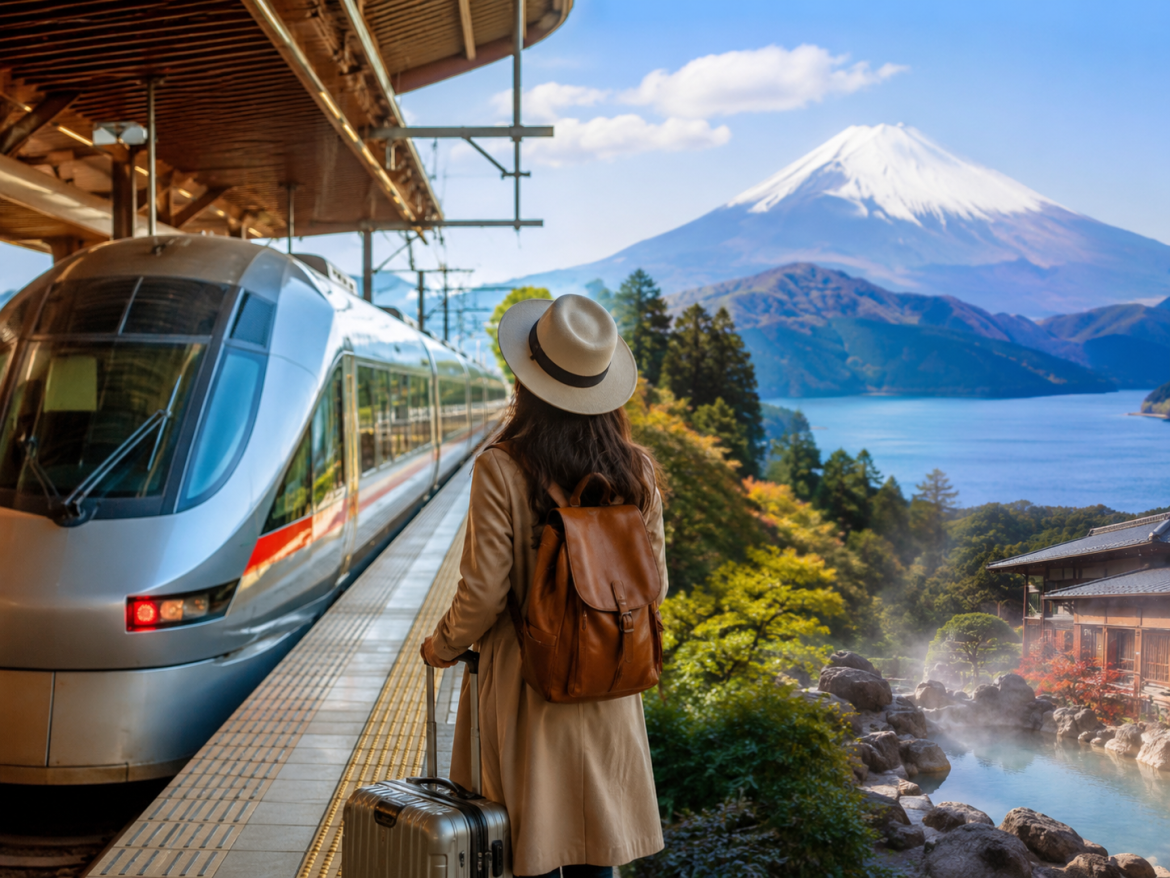

Tokyo to Hakone: choose your gateway before your ticket
Getting from Tokyo to Hakone is straightforward once you choose the correct departure station and Hakone arrival point. The mistake is treating Hakone as one compact town. It is a large mountain resort area containing Hakone-Yumoto, Gora, Owakudani, Lake Ashi, Sengokuhara and several separate hotel districts.
For most first-time visitors staying around Shinjuku, the easiest option is the Odakyu Romancecar to Hakone-Yumoto. It offers reserved seating, no change of train and an approximately 80-minute journey. Travellers staying around Tokyo Station, Ginza or Shinagawa will usually save time by taking the Tokaido Shinkansen to Odawara and transferring to local Hakone transport.
The most common ticket misunderstanding is that the Hakone Freepass does not include the Romancecar reserved seat. The Shinjuku version covers the basic Odakyu fare, but a separate limited-express ticket is still required. Travellers using the Shinkansen should normally buy the Hakone-area version of the pass rather than paying for unnecessary Shinjuku coverage.
Hakone is worth visiting as a full-day trip, but it is not a relaxed half-day excursion if you want to complete the train, cable car, ropeway, Lake Ashi cruise and shrine route. Leave Tokyo early, check the same-day transport status and allow additional time for mountain traffic and transfers.
Before choosing a route, decide whether your first priority is Hakone-Yumoto and Gora, Lake Ashi and Hakone Shrine, or Sengokuhara and Togendai. For more help planning the city portion of your trip, see the Tokyo travel guide.
Tokyo to Hakone 2026 Quick Answer and Route Comparison
Our recommendation is simple: use the Romancecar from Shinjuku, but use the Shinkansen from Tokyo Station or Shinagawa. Choose the highway bus only when your first destination is Sengokuhara, Togendai or accommodation on the north side of Lake Ashi.
| Route | Approximate journey | Adult cost | Transfers | Best for | Main disadvantage |
|---|---|---|---|---|---|
| Romancecar from Shinjuku | About 80 minutes to Hakone-Yumoto | JPY 2,470 one way without a pass | None on a direct service | First-time visitors, couples, families and travellers with luggage | Reserved-seat surcharge is separate from the Hakone Freepass |
| Shinkansen from Tokyo | About 35 minutes to Odawara, then about 15 minutes to Hakone-Yumoto | Shinkansen fare plus local Hakone fare | One at Odawara | Tokyo Station, Ginza, Marunouchi and eastern Tokyo | Higher cost and a station transfer |
| Shinkansen from Shinagawa | About 30 minutes to Odawara, then local transport | Shinkansen fare plus local Hakone fare | One at Odawara | Shinagawa, Haneda Airport access and southern Tokyo | Not every Shinkansen stops at Odawara |
| Regular Odakyu train | Approximately two hours | JPY 1,270 one way | Normally one at Odawara | Budget travellers departing from Shinjuku | Slower and seating is not guaranteed |
| JR Tokaido Line | Approximately 80–95 minutes to Odawara, then local transport | Ordinary JR fare plus local Hakone fare | One at Odawara | Budget travellers near Tokyo or Shinagawa | Longer conventional-train journey |
| Highway bus from Shinjuku | About 2.5 hours to Togendai in normal traffic | JPY 2,560 one way | None | Sengokuhara, Togendai and Lake Ashi hotels | Traffic delays and unsuitable for Hakone-Yumoto |
| Private vehicle or tour | Usually two to three hours, traffic-dependent | Varies by group and vehicle | Door-to-door | Families, seniors, groups and travellers with luggage | Higher cost and road congestion |
Best overall route
Take the Romancecar from Shinjuku to Hakone-Yumoto and add a Hakone Freepass if you plan to use the sightseeing train, cable car, ropeway, buses and Lake Ashi cruise.
Fastest route from Tokyo Station
Take a Kodama or appropriate Hikari service on the Tokaido Shinkansen to Odawara, then transfer to an Odakyu or Hakone Tozan service for Hakone-Yumoto.
Cheapest route
From Shinjuku, use a regular Odakyu service and change at Odawara. It uses the same basic fare as the Romancecar but avoids the JPY 1,200 limited-express surcharge.
Best route for Lake Ashi
From Shinjuku, the direct highway bus to Togendai is useful for the northern end of Lake Ashi. From Tokyo Station, the Shinkansen to Odawara followed by a bus to Moto-Hakone is normally more logical.
Choose the pass or bus around your actual route, rather than automatically buying both. The Freepass does not include the Romancecar limited-express supplement. Check the selected bus stop, departure and luggage rules; it does not serve every Hakone hotel.
Is Hakone Worth Visiting from Tokyo?
Hakone is one of the most worthwhile overnight escapes from Tokyo and a rewarding day trip for visitors who can leave early. Its appeal comes from the combination of mountain railways, volcanic scenery, art museums, hot springs and Lake Ashi rather than from one single landmark.
It is best suited to first-time visitors who want a varied scenic day, couples planning a ryokan stay, families who enjoy trains or museums, and travellers who want a chance of seeing Mount Fuji without making Fuji views the only purpose of the trip.
Travellers expecting a quiet, low-effort excursion may be disappointed by the number of transfers. The classic loop can involve a train, cable car, two ropeway sections, a cruise and a bus. Queues and service disruptions can turn a carefully timed day into a longer journey.
| Decision | Recommendation |
|---|---|
| Is Hakone worth visiting? | Yes, especially for scenery, transport experiences, museums and onsen |
| Minimum useful duration | One full day from Tokyo |
| Ideal duration | Two days and one night |
| Transport difficulty | Moderate because the main attractions are spread across the mountains |
| Main attraction | The combined sightseeing loop rather than one individual stop |
| Main challenge | Multiple transfers, weather and mountain traffic |
| Family suitability | Good with a simplified itinerary; tiring with the complete loop |
| Senior suitability | Good when walking and transfers are reduced |
| Is an overnight stay necessary? | No, but strongly recommended for onsen, ryokan and slower travel |
| Best season | Spring, early summer, autumn and clear winter days |
Choose the Right Hakone Arrival Point
Before buying a ticket, locate your first attraction or hotel. “Tokyo to Hakone” can mean several very different journeys.
Hakone-Yumoto
Hakone-Yumoto is the main rail gateway and the easiest destination for first-time visitors. It suits travellers staying in the hot-spring town, beginning the classic loop, visiting Gora or transferring to buses across Hakone.
Choose the Romancecar from Shinjuku or the Shinkansen to Odawara followed by a local train.
Gora and the Open-Air Museum
Reach Hakone-Yumoto first, then take the Hakone Tozan Train into the mountains. The ride from Hakone-Yumoto to Gora is scenic but relatively slow, so it must be included in your day-trip timing.
Moto-Hakone and Hakone Shrine
Moto-Hakone is on the southeastern side of Lake Ashi. From Odawara or Hakone-Yumoto, a direct Hakone Tozan Bus is often more efficient than completing the rail and ropeway loop first.
After leaving the bus at Moto-Hakone-ko, the lakeside area is immediately accessible. Hakone Shrine is farther along the shore, and the popular waterside torii gate may have a long photography queue.
Togendai
Togendai is at the northern end of Lake Ashi and connects the sightseeing cruise, Hakone Ropeway and highway buses. The direct bus from Shinjuku is useful when your hotel is near Togendai or Sengokuhara.
Sengokuhara
Sengokuhara contains museums, resorts and seasonal grassland scenery. It is not beside Hakone-Yumoto. Check the hotel’s nearest bus stop before deciding that the Romancecar is automatically the easiest route.
Latest service considerations
Check the official Hakone transport status on the morning of travel. Ropeway operations can be affected by wind, maintenance or technical conditions, while Lake Ashi cruises may be changed or suspended in strong wind or poor visibility.
The official maintenance notice schedules Owakudani–Sounzan closure for December 7–24 2026 and Togendai–Ubako–Owakudani closure for January 12–February 26 2027. Replacement buses are planned at roughly 15-minute intervals for holders of valid ropeway tickets, including the Freepass. Queues and traffic may add time; the unaffected ropeway section remains the alternative approach.
Tokyo to Hakone by Romancecar
The Odakyu Limited Express Romancecar is the easiest route from Shinjuku. Direct services travel from Odakyu Shinjuku Station to Hakone-Yumoto in approximately 80 minutes, with reserved reclining seats, restrooms and luggage space.
Tickets required
You need two components:
- A basic fare ticket, IC-card fare or Hakone Freepass.
- A separate Romancecar limited-express ticket with a reserved seat.
The basic one-way fare from Shinjuku to Hakone-Yumoto is JPY 1,270. The standard Romancecar surcharge is JPY 1,200, producing a total of JPY 2,470 without a pass. Buying the limited-express ticket through EMot Online Tickets reduces that surcharge to JPY 1,150; with a JPY 1,270 base ticket, the total is JPY 2,420.
With a Shinjuku-issued Hakone Freepass, the basic fare is already covered. Add the Romancecar supplement for each direction: normally JPY 1,200, or JPY 1,150 through EMot Online Tickets. A two-day Shinjuku pass plus two standard supplements totals JPY 9,500; two EMot supplements bring it to JPY 9,400.
How early to reserve
Romancecar tickets become available at 10:00 Japan time one month before departure. Reserve early for weekends, public holidays, autumn foliage, cherry blossom periods and observation seats on the GSE train.
All seats are reserved. You cannot board with only a Hakone Freepass and then search for an unreserved carriage.
Step-by-step route from Shinjuku
- Enter Shinjuku Station and follow signs for the Odakyu Line rather than the JR lines.
- Use your regular ticket, IC card or Hakone Freepass at the gate.
- Keep the electronic or paper Romancecar seat information available for inspection.
- Check the train name, departure time and car number on the display.
- Remain on the direct service to Hakone-Yumoto.
- At Hakone-Yumoto, follow signs for the Hakone Tozan Train, buses, taxi stand or luggage service.
Who should choose the Romancecar?
It is the best option for most travellers staying in Shinjuku, Shibuya, Ikebukuro or western Tokyo. It is particularly useful for families, travellers carrying luggage and anyone who values a guaranteed seat.
Travellers starting near Tokyo Station should compare the time needed to cross central Tokyo with the faster Shinkansen route through Odawara.
Starting from Ueno, Asakusa or Akihabara
From Ueno, take a JR service to Tokyo Station and follow signs for the Tokaido Shinkansen, then change at Odawara for Hakone-Yumoto. Allow time to cross Tokyo Station: the short Ueno–Tokyo ride is only one part of the trip. Nozomi does not stop at Odawara, and not every Hikari does.
For a cheaper route, compare a suitable Ueno–Tokyo Line service toward Odawara, changing where required, rather than automatically crossing Tokyo to Shinjuku. Going to Shinjuku still makes sense when you specifically want the Romancecar or the Shinjuku Freepass return. From Asakusa, compare the hotel-to-station journey before deciding.
Shinkansen from Tokyo Station or Shinagawa
The Tokaido Shinkansen is the fastest approach to Odawara and usually the best choice for travellers staying around Tokyo Station, Marunouchi, Ginza, Nihombashi or Shinagawa.
Route from Tokyo Station
- Enter the Tokaido Shinkansen area at Tokyo Station.
- Board a Kodama or a Hikari service that is scheduled to stop at Odawara.
- Travel approximately 35 minutes to Odawara.
- At Odawara, follow signs for the Odakyu and Hakone Tozan lines.
- Allow approximately 10–15 minutes for an unfamiliar transfer.
- Take a local service approximately 15 minutes to Hakone-Yumoto.
Do not board a Nozomi train. Nozomi services do not stop at Odawara.
Route from Shinagawa
Use the same Tokaido Shinkansen route from Shinagawa to Odawara. This is especially practical for travellers staying around Shinagawa or arriving from Haneda Airport via the Keikyu Line.
Standard Shinkansen fares
Tokyo–Odawara costs JPY 3,280 in an ordinary non-reserved car; Shinagawa–Odawara costs JPY 3,100. SmartEX Hikari/Kodama ordinary reserved seats in regular season cost JPY 3,610 and JPY 3,430 respectively. Reserved fares vary by season. Compare the same departure station and seat type; the Odawara–Hakone-Yumoto connection is extra unless covered by your pass.
SmartEX advance fare
EX Hayatoku 1 costs JPY 2,960 from Tokyo to Odawara or JPY 2,780 from Shinagawa. Book from six days before travel until 23:30 Japan time the day before; inventory and excluded peak dates apply. It is an ordinary non-reserved Hikari/Kodama ticket, so a seat is not guaranteed. It excludes the local journey before or after the Shinkansen.
Using a Japan Rail Pass
A valid nationwide Japan Rail Pass can cover the JR journey to Odawara on an eligible Shinkansen service. It does not cover the Odakyu Line, Hakone Tozan Railway, cable car, Hakone Ropeway, sightseeing cruise or most local buses.
JR Pass holders completing the sightseeing loop should consider the Hakone-area Freepass after reaching Odawara.
Regional passes are not interchangeable: JR EAST PASS and JR TOKYO Wide Pass do not cover the Tokaido Shinkansen, which is operated by JR Central. Verify the exact pass and train rather than relying on the letters “JR”.
Is the Shinkansen genuinely faster?
It is faster from Tokyo Station or Shinagawa, but not automatically faster from a Shinjuku hotel. Include travel to the Shinkansen station, time finding the correct platform, the Odawara transfer and the local journey to your actual Hakone destination.
Cheapest Train and Direct Bus Options
Regular Odakyu train from Shinjuku
The least expensive rail route from Shinjuku uses regular Odakyu services. The basic fare to Hakone-Yumoto is JPY 1,270. Most journeys require a change at Odawara and take approximately two hours.
This option suits budget travellers who are comfortable without a reserved seat. It is less attractive during busy commuting periods or when travelling with large suitcases.
JR Tokaido Line from Tokyo or Shinagawa
Conventional JR Tokaido Line services reach Odawara without a Shinkansen surcharge. The journey from Tokyo usually takes around 80–95 minutes before the local connection to Hakone-Yumoto.
This can be a reasonable compromise for travellers near Tokyo or Shinagawa who prefer a lower fare and do not mind a longer train ride.
Direct highway bus from Shinjuku to Togendai
The Odakyu highway bus travels from Busta Shinjuku to the Gotemba, Sengokuhara and Togendai side of Hakone. The current adult fare from Shinjuku to Togendai is JPY 2,560, and the scheduled journey is approximately 2.5 hours in normal conditions.
This is not the best route for Hakone-Yumoto or Gora. It is valuable when your hotel or first attraction is near Hakone Glass no Mori, Sengokuhara, Togendai or the northern shore of Lake Ashi.
Reserve your seat for the Shinjuku highway journey; luggage storage is subject to the operator’s limits. On this route, even children under six need a child-fare seat rather than travelling on an adult’s lap. Road congestion may substantially delay the service on weekends, holidays and autumn foliage days.
The bus timetable changed on June 1 2026 and the Onsen-so stop was discontinued. Use the current official timetable and stop list, especially when matching a hotel to a stop.
Which budget option is best?
| Starting point | Recommended budget route |
|---|---|
| Shinjuku | Regular Odakyu train via Odawara |
| Tokyo Station or Shinagawa | JR Tokaido Line to Odawara |
| Sengokuhara or Togendai hotel | Direct highway bus when the schedule suits |
| JR Pass holder | Eligible JR train to Odawara, then separate Hakone transport |
Hakone Freepass, Separate Tickets or JR Pass?
The Hakone Freepass is primarily a local sightseeing transport pass. The Shinjuku version also incorporates the ordinary Odakyu round trip to Odawara, while the Hakone-area version is intended for travellers reaching Odawara by JR, Shinkansen or another route.
| Pass | Adult price | Child price | Best for |
|---|---|---|---|
| Two-day Hakone Freepass from Shinjuku | JPY 7,100 | JPY 1,600 | Round trip from Shinjuku plus extensive Hakone sightseeing |
| Three-day Hakone Freepass from Shinjuku | JPY 7,500 | JPY 1,850 | Two-night Hakone stays or slower itineraries |
| Two-day Hakone-area Freepass | JPY 6,000 | JPY 1,500 | Travellers arriving at Odawara by JR or Shinkansen |
| Three-day Hakone-area Freepass | JPY 6,400 | JPY 1,750 | Longer stays arriving independently at Odawara |
What the pass covers
The pass provides unlimited use of designated Hakone transport, including the Hakone Tozan Train, cable car, Hakone Ropeway, Hakone Sightseeing Cruise and designated bus routes. It also provides discounts at participating attractions and facilities.
What the pass does not cover
- The Romancecar limited-express reserved seat.
- The Tokaido Shinkansen.
- All buses operated by every company in the region.
- Transport outside the designated coverage area.
- Premium cruise cabins or other optional upgrades.
Is the Freepass worthwhile for a day trip?
It can be worthwhile even though it is sold as a two-day pass. It is most useful when you complete much of the standard loop and use several trains, buses, ropeways and the sightseeing cruise.
Separate tickets may cost less if you only visit Hakone-Yumoto, one museum or one nearby onsen. Do not buy the pass automatically for a short single-area visit.
Digital or physical ticket?
The EMot Online Tickets group option supports up to four tickets on one smartphone, provided everyone follows the same itinerary throughout the trip. Ordinary individual digital tickets still require separate devices. This exception does not automatically apply to reseller tickets: the current Klook digital option is labelled one ticket per phone. A paper pass is another option for families.
The active Klook listing provides both digital and physical redemption choices. Review the selected package carefully because the Shinjuku and area-only versions serve different journeys.
Fuji Hakone Pass for a three-day combined trip
The Fuji Hakone Pass costs JPY 11,100 for an adult or JPY 3,600 for a child and is valid for three days. It adds designated Fuji-area transport to Hakone coverage and the specified Odakyu round trip from Shinjuku; Romancecar supplements remain extra.
It does not cover JR Shinjuku–Otsuki, the Shinjuku–Kawaguchiko highway bus or the Shinjuku–Tomei-Gotemba highway-bus section. Plan the Hakone–Gotemba–Fuji-area connections carefully and budget separately if returning directly from Kawaguchiko to Shinjuku. It is a multi-day option, not a reason to squeeze both regions into one day.
Recommended pass by traveller type
| Traveller | Recommended ticket |
|---|---|
| Shinjuku day trip completing the loop | Two-day Shinjuku Freepass plus separate Romancecar tickets |
| Tokyo Station day trip | Shinkansen tickets plus Hakone-area Freepass |
| JR Pass holder | JR to Odawara plus Hakone-area Freepass |
| Hakone-Yumoto-only visit | Compare separate fares before buying a pass |
| Direct bus to Togendai | Highway bus ticket plus separate local pass or individual fares |
| Two-night Hakone stay | Three-day version matching the Tokyo approach |
Correct First-Time Route Around Hakone
The classic Hakone loop is easiest to understand as a chain of connected transport rather than a single rail journey.
Keep the official Hakone Freepass route map open while planning: the train, cable car, ropeway, cruise and buses are separate links. Check Hakone Navi operating information on the day, then shorten or reverse the route if needed.
Recommended full-loop route
- Tokyo or Shinjuku → Hakone-Yumoto.
- Hakone-Yumoto → Gora by Hakone Tozan Train.
- Gora → Sounzan by cable car.
- Sounzan → Owakudani by Hakone Ropeway.
- Leave the ropeway at Owakudani for the volcanic viewing area.
- Owakudani → Togendai by ropeway.
- Togendai → Moto-Hakone-ko or Hakonemachi-ko by sightseeing cruise.
- Visit the lakeside, Hakone Shrine or the old checkpoint area.
- Return by Hakone Tozan Bus to Hakone-Yumoto or Odawara.
- Continue to Tokyo by Romancecar, regular Odakyu train or Shinkansen.
The route can be reversed. On crowded days, staff may recommend a direction according to queues or service conditions.
Hakone-Yumoto transfer
Hakone-Yumoto Station is compact, but the platforms and bus stops can become congested. Check whether your next destination requires the mountain train or a bus before joining a queue.
Gora transfer
At Gora, follow signs for the cable car to Sounzan. Travellers visiting the Hakone Open-Air Museum should leave the train one stop before Gora at Chokoku-no-Mori rather than travelling past it and doubling back.
Owakudani transfer
Owakudani is both an attraction and a transfer point. Most visitors leave the ropeway, explore the viewing area and then join the next queue toward Togendai or Sounzan.
Togendai transfer
The ropeway station and Lake Ashi cruise terminal are in the same complex. Check the cruise departure before spending too long at shops or restaurants, particularly late in the afternoon.
Moto-Hakone and Hakone Shrine
Moto-Hakone-ko is the more useful cruise stop for Hakone Shrine. From the port, walk along the lakeside road toward the shrine. The waterside torii gate is reached before or separately from the main worship hall, which involves a substantial stone staircase.
See the Hakone attractions, itinerary and accommodation guide for more detail on selecting museums, onsen and sightseeing stops.
Return route
Do not assume your return will be as quick as the morning journey. Buses from Lake Ashi to Hakone-Yumoto use mountain roads and may be delayed by traffic. Reserve a comfortable buffer before a fixed Romancecar departure.
Walking, Luggage, Families and Senior Travellers
How much walking is involved?
The transport loop reduces long-distance walking, but the day still involves repeated station corridors, platforms, slopes, boarding queues and attraction paths. A full trip can easily become a high-step-count day.
Hakone-Yumoto and the main transport hubs are developed, but the surrounding terrain is mountainous. Gora, shrine approaches and some museum grounds contain slopes or stairs.
Large luggage
Do not take large suitcases around the complete loop. Trains, cable cars and buses have limited space, and moving luggage through several transfers is inconvenient.
Travellers staying overnight can leave luggage at their hotel, use station lockers or use the official Hakone luggage transport counter inside Hakone-Yumoto Station. Morning drop-off is available for same-day delivery to participating accommodation.
For the Tokaido Shinkansen, luggage measuring over 160 cm and up to 250 cm in total length, width and height requires a seat with an oversized-baggage area; bags over 250 cm cannot be carried. Romancecar storage varies by train model. Leave large bags at your accommodation whenever possible.
Travelling with children
Hakone can be enjoyable for children because the transport itself feels like an attraction. The Romancecar, mountain train, ropeway and sightseeing ship provide regular changes of scenery.
The complete loop may nevertheless be too long for toddlers. A more comfortable family day combines the Open-Air Museum with Gora, or Lake Ashi with Hakone Shrine, rather than insisting on every transport section.
Strollers are possible but awkward on crowded buses and at repeated transfers. Use a compact folding stroller and consider a baby carrier for the busiest sections.
Travelling with elderly visitors
Visitors who can walk independently but prefer to avoid stairs can still enjoy Hakone by reducing the number of transfers. A direct bus to Moto-Hakone, a Lake Ashi cruise and a hotel or onsen visit can be more comfortable than the complete loop.
Do not rely on finding an immediate taxi at remote stops during busy periods. An overnight stay, hotel shuttle or pre-arranged private vehicle provides a safer schedule for groups with limited mobility.
Wheelchair considerations
Accessibility differs by station, vehicle and attraction. Confirm the exact route with the operator before travel, especially when maintenance requires a replacement bus. A theoretically step-free attraction does not guarantee that every connecting vehicle will be equally convenient.
Tokyo to Hakone Day Trip and Overnight Itineraries
The times below are planning examples rather than fixed timetables. Check the actual train, bus, ropeway and cruise schedules for your date.
Classic full-day loop
| Approximate time | Plan |
|---|---|
| 07:30 | Reach Shinjuku or Tokyo Station |
| 08:00 | Depart by Romancecar or Shinkansen |
| 09:20 | Arrive at Hakone-Yumoto and begin local transport |
| 10:00 | Visit the Open-Air Museum or continue toward Gora |
| 12:00 | Lunch around Gora or Sounzan |
| 13:00 | Cable car and ropeway to Owakudani |
| 14:00 | Explore Owakudani |
| 15:00 | Continue to Togendai and take the Lake Ashi cruise |
| 16:00 | Visit Moto-Hakone and the Hakone Shrine area |
| 17:15 | Bus toward Hakone-Yumoto or Odawara |
| 18:30–19:30 | Return toward Tokyo |
This itinerary is realistic but full. Adding a long museum visit, leisurely lunch and onsen may require removing another stop.
Relaxed Hakone-Yumoto and Gora day
| Approximate time | Plan |
|---|---|
| 08:00 | Leave Tokyo |
| 09:30 | Arrive at Hakone-Yumoto |
| 10:15 | Travel to Chokoku-no-Mori |
| 10:30–13:00 | Visit the Open-Air Museum |
| 13:15 | Lunch in Gora |
| 15:00 | Onsen, café or short local sightseeing |
| 17:00 | Return to Hakone-Yumoto |
| 18:00 | Depart for Tokyo |
This is a better plan for young children, rainy weather and travellers who dislike continuous transfers.
Lake Ashi-focused day
Travel to Odawara or Hakone-Yumoto, then take a bus directly to Moto-Hakone. Visit Hakone Shrine, take the sightseeing cruise and return by bus or continue through Togendai and the ropeway if time and service conditions permit.
Two-day, one-night itinerary
On the first day, travel from Tokyo to Hakone-Yumoto, visit the Open-Air Museum and Gora, then check into a ryokan. On the second day, continue through Sounzan, Owakudani, Togendai, Lake Ashi and Moto-Hakone before returning to Tokyo.
This arrangement allows time for an onsen and traditional dinner without turning the sightseeing loop into a race.
Guided Mount Fuji and Hakone tour
A guided coach tour is useful for travellers who want a sample of both Mount Fuji and Hakone without organising several tickets. The active tour below departs from Tokyo, runs for approximately 11.5–12.5 hours and combines the Mount Fuji 5th Station area with Lake Ashi and the Komagatake Ropeway.
It is not the same as completing the independent Hakone Tozan Train–Owakudani–pirate ship loop. Choose it for convenient multi-destination sightseeing rather than deep exploration of Hakone.
Driving, Parking and Private Transfers
Driving from Tokyo
Driving provides flexibility for hotels outside the main transport network, families carrying equipment and groups visiting Sengokuhara or Gotemba. Under good conditions, the journey from central Tokyo generally takes around two to three hours.
Weekend traffic, holiday congestion and queues around popular attractions can make driving slower than the train. Mountain roads may also be affected by fog, snow, ice or heavy rain.
Parking at Owakudani
Owakudani has paid parking, but queues can become long. The operator recommends considering parking at Togendai, Ubako or Sounzan and approaching by ropeway when services are running.
The Owakudani access road is not continuously open overnight, so drivers must check current road and parking hours.
Should you rent a car for the classic loop?
A car is not necessary for the standard Hakone loop. The train, cable car, ropeway, cruise and bus are part of the experience, while returning to a parked vehicle can complicate a one-way sightseeing route.
A car becomes more useful for remote accommodation, multiple family members, Gotemba shopping or a wider Fuji–Hakone itinerary.
Private customizable tour
A private vehicle is the easiest option for families, senior travellers and groups who want hotel pickup in Tokyo. It reduces luggage handling and allows the route to be adjusted according to weather, walking ability and traffic.
The active private tour below offers Tokyo pickup and customizable stops such as Hakone Shrine, Lake Ashi, Owakudani, the Open-Air Museum and Gotemba. Admission and activity costs may need to be paid separately depending on the selected itinerary.
Where to Stay and What to Combine with Hakone
Is an overnight stay worthwhile?
Yes. Hakone becomes much more relaxing after day trippers leave, and an overnight stay allows time for a ryokan dinner, onsen and a slower second day.
Stay overnight when:
- A traditional ryokan and hot spring are important parts of the trip.
- You want to visit two museums as well as Lake Ashi.
- Your group includes young children or elderly travellers.
- You prefer not to rush back for an evening train.
- You are continuing to Gotemba, Kawaguchiko or another Fuji-area destination.
Best area for first-time visitors
Hakone-Yumoto is the easiest base for arrival and departure. It has the simplest rail access from Tokyo and reduces the risk of becoming dependent on a long mountain bus journey on the final morning.
Best area for museums and mountain scenery
Gora is suitable for the Open-Air Museum, cable car and central mountain attractions. It works particularly well for a two-day loop.
Best area for Lake Ashi
Moto-Hakone, Hakone-machi and Togendai provide a quieter lakeside stay. Check the final bus or hotel shuttle carefully because these areas are farther from the main rail gateway.
Can you combine Hakone and Gotemba?
Yes, especially by car or highway bus, but a full Hakone loop plus substantial outlet shopping is too much for most day trips. Consider staying overnight or limiting Hakone to Sengokuhara and the Lake Ashi side.
Use the Tokyo to Gotemba transport guide when planning the shopping portion.
Can you combine Hakone and Kawaguchiko?
Technically yes, but not comfortably as an independent one-day trip from Tokyo. The two destinations are separated by regional buses and require careful connections.
Travellers deciding between the destinations should compare this trip with the Tokyo to Kawaguchiko transportation guide. For high-elevation Mount Fuji sightseeing, see the Tokyo to Mount Fuji 5th Station transport guide.
Weather alternative
Hakone remains enjoyable in light rain when museums and onsen are the priority, but severe wind can disrupt the ropeway and cruise. Travellers who prefer a lower-risk urban day trip can consider the best things to do in Yokohama.
Common Tokyo-to-Hakone Mistakes
- Choosing Shinjuku automatically: The Shinkansen is usually more logical from Tokyo Station, Ginza or Shinagawa.
- Assuming Hakone-Yumoto is beside Lake Ashi: Additional mountain transport is required.
- Boarding the Romancecar with only a Freepass: A separate reserved-seat limited-express ticket is mandatory.
- Buying the wrong Freepass version: Shinkansen users normally need the Hakone-area version rather than Shinjuku transport coverage.
- Using a JR Pass beyond Odawara: Most local Hakone transport is not operated by JR.
- Booking a tight Odawara transfer: Allow time to leave the Shinkansen area and locate the local platform.
- Trying to complete the full loop in half a day: Choose Gora or Lake Ashi rather than both.
- Starting after mid-morning: Late departures leave little protection against queues or suspensions.
- Carrying large suitcases around the loop: Use lockers, hotel storage or luggage delivery.
- Assuming Mount Fuji will be visible: Clouds frequently obscure the view even when local weather feels pleasant.
- Ignoring the final cruise and ropeway times: Mountain transport finishes earlier than Tokyo city services.
- Reserving the return Romancecar too tightly: Lake Ashi buses may be delayed by congestion.
- Forcing toddlers through every transfer: A museum-focused or lakeside itinerary is usually more enjoyable.
- Relying on taxis at remote stops: Availability may be limited during peak periods.
- Combining Hakone and Kawaguchiko casually: The regional connection is slower and less frequent than many maps suggest.
- Driving the loop without a parking strategy: A one-way sightseeing route may leave you far from the car.
- Not checking same-day service status: Wind, fog, maintenance and technical issues can change the ropeway or cruise route.
Tokyo to Hakone 2026 Frequently Asked Questions
Does the Hakone Freepass include the Romancecar?
The appropriate Shinjuku version includes the basic Odakyu round trip, but the Romancecar limited-express ticket is extra. All seats are reserved; add JPY 1,200 each way, or JPY 1,150 through EMot Online Tickets.
Which Freepass version should I buy?
Shinjuku for an Odakyu round trip, or the Hakone-area version if reaching Odawara independently. Two days means consecutive operating days, not a rolling 48 hours. A short Hakone-Yumoto-only visit may cost less with separate fares.
Can a family share one phone?
EMot Online Tickets offers a group option for up to four tickets when everyone stays together. Ordinary individual and reseller digital tickets can have different device rules; Klook’s current digital package is one ticket per phone. Check the exact option or choose paper tickets.
Does a JR pass cover the whole trip?
A nationwide Japan Rail Pass covers eligible JR services to Odawara. Regional JR East passes do not cover the Tokaido Shinkansen, and local Hakone transport is mainly non-JR.
Can I complete the loop in a day?
Yes with an early start and operating services, but allow six to eight hours within Hakone plus travel from Tokyo. Maintenance, queues or bad weather can require a shorter route. An overnight stay is easier for ryokan dining and a slower pace.
Can I travel from Haneda or Narita?
From Haneda, compare Keikyu to Shinagawa and the Shinkansen to Odawara. From Narita, travel via Tokyo, Shinagawa or Shinjuku. Allow immigration, baggage and transfer time; a late international arrival is a poor starting point for a full sightseeing loop.
Can I add Kawaguchiko?
Prefer a separate day or a multi-day trip. The Fuji Hakone Pass covers designated local routes but excludes the direct Shinjuku–Kawaguchiko highway bus, so check the actual return path before buying.
Final Route Recommendation
For most first-time visitors staying in western Tokyo, the Romancecar from Shinjuku is the best balance of simplicity, comfort and travel time. Reserve the seat in advance and remember that the limited-express ticket is separate from the Hakone Freepass.
Travellers based near Tokyo Station, Ginza or Shinagawa should normally use the Tokaido Shinkansen to Odawara. Buy the Hakone-area Freepass if you intend to use several local trains, buses, ropeways and the Lake Ashi cruise.
The highway bus is a specialist option rather than the universal best route. Choose it when your first destination is Sengokuhara, Togendai or a hotel on the northern Lake Ashi side.
Allow a complete day for the classic Hakone loop. Leave Tokyo by approximately 08:00, avoid carrying large luggage and keep additional time before your return reservation.
Families and elderly travellers should prioritise comfort over completing every attraction. A museum-and-Gora day, a Lake Ashi-focused route or an overnight stay can provide a better experience than rushing through six different transport stages.
Hakone is most rewarding when the journey itself is treated as part of the attraction. Choose the correct Tokyo departure station, buy the correct version of the pass and check the ropeway and cruise status before leaving.