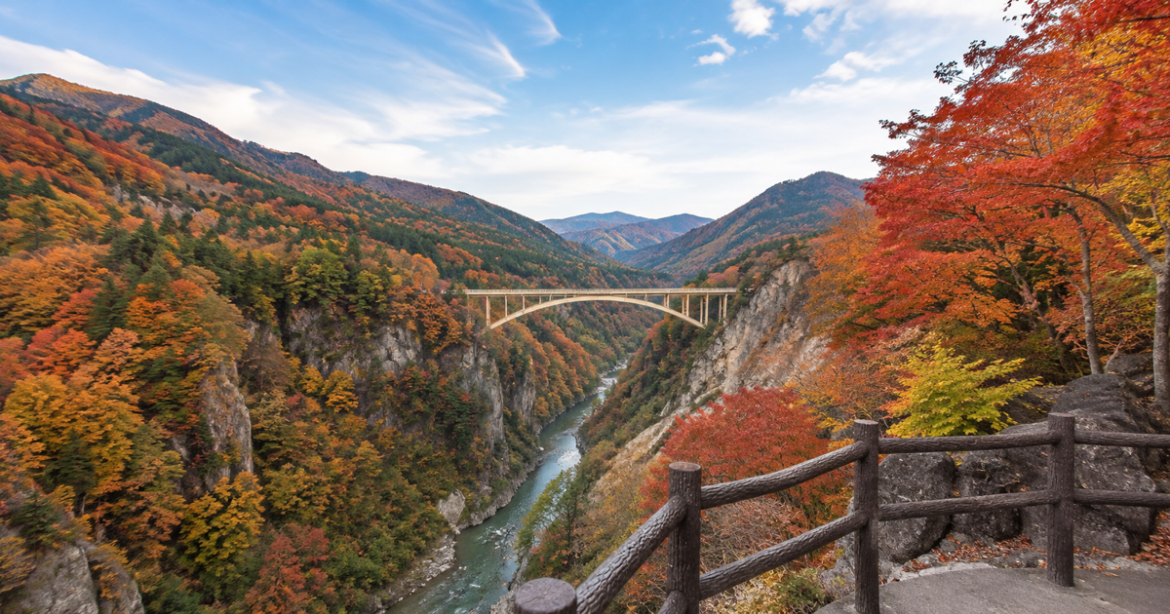
Naruko Gorge is worth a dedicated stop on an autumn trip through Miyagi. From the viewpoints beside Naruko Gorge Rest House, you can see a roughly 100-metre-deep valley, cliffs, the Ofukazawa Bridge and a mixture of red, orange, yellow and evergreen trees. You do not have to complete a long hike to enjoy the signature view.
The more important planning questions are which paths are open and how you will reach them. The gorge-floor path is not a through route: the Nakayamadaira side goes about 350 metres to Kaiko Bridge and back, while the Naruko side is a separate 230-metre out-and-back section. The 2.2-kilometre Ofukazawa loop is another trail altogether.
Rail services between Naruko-Onsen and Shinjo remain suspended following the 2024 heavy-rain damage. Replacement buses serve that section, including Nakayamadaira-Onsen; you cannot simply catch a normal train one stop farther west from Naruko-Onsen. Suica and other transport IC cards cannot be used directly on these JR replacement buses.
The seasonal Koyogo bus is confirmed for 26 October–8 November 2026, every day. Naruko-Onsen to Narukokyo Nakayamadairaguchi costs ¥450 one way, cash only with exact change. Rest House parking is charged from 10 October to 30 November, at ¥500 for an ordinary car.
For a first visit, begin at the Rest House viewpoint, decide whether the 350-metre descent suits your group, then add the Ofukazawa loop only if time and energy allow. Finish with time in Naruko Onsen. Tohoku itinerary

Is Naruko Gorge worth visiting?
| Planning point | What to expect |
|---|---|
| Best fit | Autumn scenery, photography and an onsen break |
| Typical colour season | Broadly mid-October to mid-November; late October to early November is a useful historical planning window, not a 2026 guarantee |
| Admission | No separate admission ticket for the scenery and open walking trails; parking and transport cost extra |
| Time to allow | Viewpoints only: 30–60 minutes; with a short gorge walk: around 1.5–2 hours; with a longer walk: around 2–3 hours |
| Main complications | Seasonal congestion, disconnected gorge paths and the suspended western rail section |
| Children and older visitors | The upper viewpoint can be the main experience; choose steps and slopes according to ability |
| Strollers | Keep to the upper viewing area rather than the stepped Nakayamadaira descent |
| Rain | Weather can close trails without notice; shorten the visit if surfaces are slippery |
| Overnight stay | Not essential from Sendai, but useful for a slower onsen visit |
The view beside the Rest House is a destination in its own right. Families, visitors with limited time and people who do not want a climb can enjoy the gorge without treating walking distance as a measure of success.
These are transport and tour options, not gorge admission tickets. Compare your full route, departure date, meeting point, language and cancellation conditions before booking; do not assume a rail pass covers Koyogo.
The 2026 trail layout: three routes, not one continuous walk
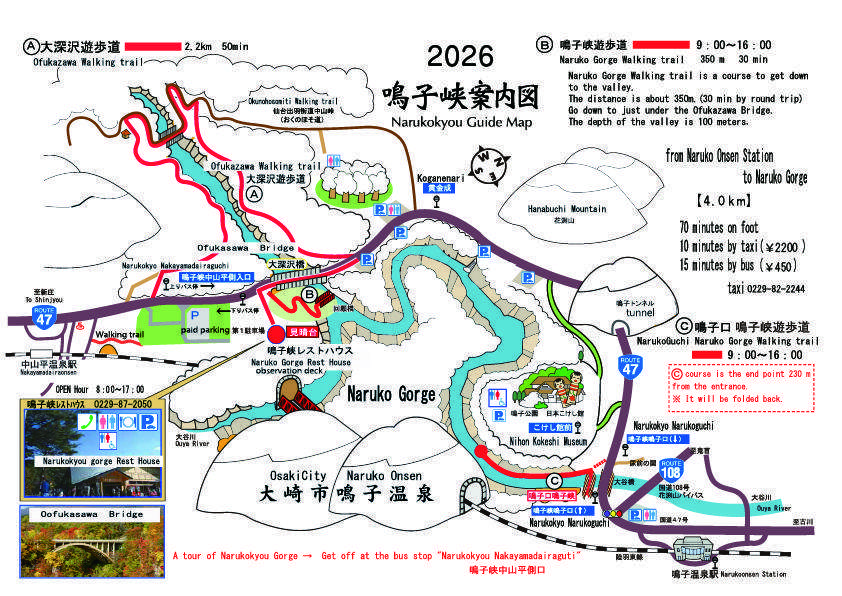
Seasonal opening runs from 28 April until late November 2026, subject to unannounced weather closures. Distinguish the two short gorge sections from the separate forest loop before choosing a bus stop.
| Route | Distance and access | Hours | Practical difficulty |
|---|---|---|---|
| Nakayamadaira entrance near the Rest House to Kaiko Bridge | About 350 m each way; return the way you came | 09:00–16:00 | Many steps and a substantial descent followed by a climb |
| Naruko entrance near Otani Bridge | About 230 m each way; return the same way | 09:00–16:00 | Less elevation change than the Nakayamadaira side |
| Ofukazawa walking trail | Separate loop of about 2.2 km from the Rest House | Seasonally open throughout the day, weather permitting | Forest walk; allow roughly 50 minutes as a planning estimate |
| Through the gorge between both entrances | Closed middle section; no through access | Not available | Do not join the 350 m and 230 m distances into a route |
Use the Osaki City gorge page for trail opening and parking, and the official 2026 map and transport guide for entrance and stop locations. Identify Nakayamadairaguchi, Narukoguchi and the Ofukazawa entrance first; they are not interchangeable names for one entrance.
When to go for autumn colour
Osaki City describes a broad colour season from mid-October to mid-November. Late October to early November is commonly used as the more concentrated historical viewing window. These are planning ranges rather than a booking promise: species and locations do not all turn together.
The Koyogo service dates and the parking-charge period are operating arrangements, not the peak-leaf forecast. Check the Naruko tourism association near your visit and be willing to shorten or extend the walk according to actual colour and weather.
| Time | Who it suits | Watch for |
|---|---|---|
| Around 09:00 | Drivers, photographers and visitors wanting an early start | Gorge-floor paths open at 09:00; use the upper viewpoints beforehand |
| Morning | First-time visitors and public-transport day trips | Leaves useful time for the return journey and a bath |
| Midday | Tours and a leisurely viewpoint visit | Road and parking congestion may be heavier |
| Afternoon | A shorter upper-viewpoint stop | Do not begin a gorge descent close to 16:00 |
| Wet weather | A brief stop if conditions allow | Reduced visibility, wet leaves and possible closures |
Four places to understand before you arrive
1. The viewpoint beside Naruko Gorge Rest House
Make this the first stop. The classic valley-and-bridge view does not require reaching the end of a hiking trail. It combines the gorge, cliffs and Ofukazawa Bridge, so it is a good main plan for families or anyone skipping the descent.
2. Ofukazawa Bridge
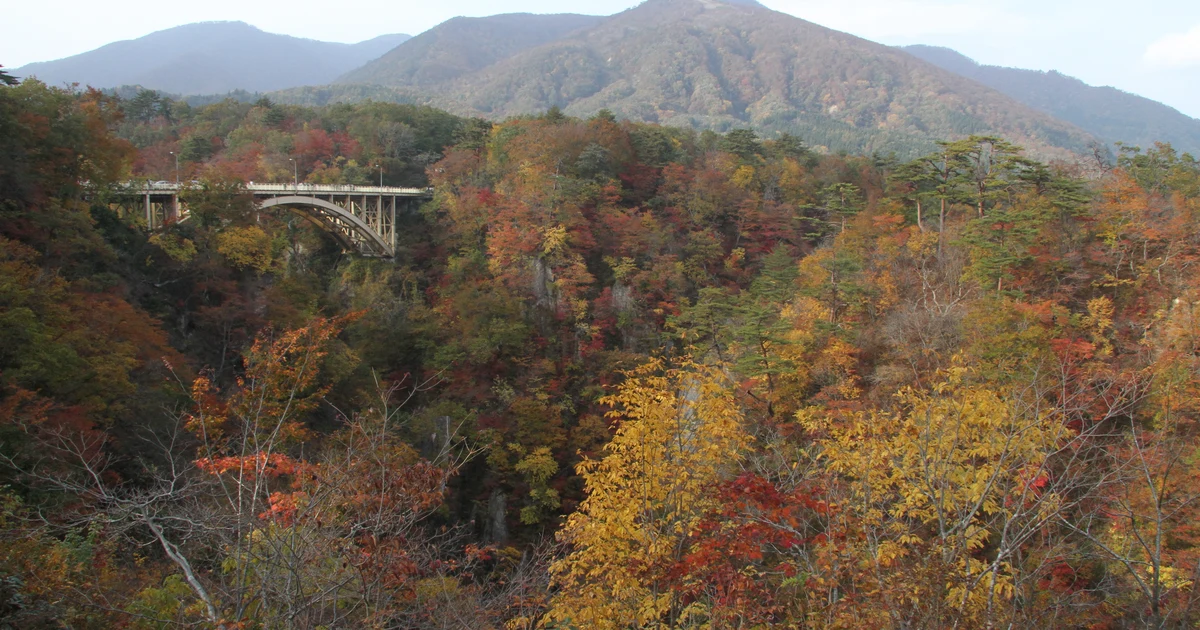
The bridge gives another elevated angle into the valley. Older photographs often include a Rikuu East Line train emerging from a tunnel. With Naruko-Onsen–Shinjo rail service suspended, that passing-train composition is not currently available. Waiting longer for a train will not solve the problem.
3. The Nakayamadaira descent and Kaiko Bridge
From near the Rest House, the path descends to Kaiko Bridge, about 350 metres one way, then returns uphill. The short horizontal distance can be misleading: the zigzag path runs down the steep gorge side. Think about the climb back before starting down.
4. The Ofukazawa loop
If you enjoy woodland walking, this separate 2.2-kilometre route adds another layer to the visit. Around 50 minutes is a useful walking estimate, with more time for photos, rests and conditions. It does not mean the closed gorge-floor route has reopened.
Walking difficulty: short does not always mean easy
| Plan | Effort | Best suited to |
|---|---|---|
| Rest House viewpoint only | Low | Limited time, young children or avoiding steps |
| Naruko-side 230 m return walk | Low to moderate | A short trail with less climbing |
| Nakayamadaira 350 m to Kaiko Bridge and back | Moderate, with steps | Visitors comfortable descending and climbing back |
| Ofukazawa 2.2 km loop | Moderate | Woodland walkers with enough time |
| Gorge descent plus forest loop | Higher combined effort | Making Naruko Gorge the day’s main activity |
The return climb is the demanding part of the Nakayamadaira path. Wet leaves and steps can make a short descent harder on balance and knees than a much longer flat walk. Wear walking shoes with grip; smooth-soled shoes or fashion platforms are a poor match for this route.
Children, strollers and older relatives
Young children
You can enjoy Naruko Gorge without taking children to the bottom. Start at the upper viewpoint and decide from their energy and stair confidence. Turning back before Kaiko Bridge is a sensible choice, not a failed visit.
Strollers
Do not plan to push a stroller down the stepped Nakayamadaira gorge path. Keep the main visit around the Rest House viewing area, then use Naruko Onsen town for a more flexible outing. This does not imply every upper surface is step-free; assess the route on arrival.
Older visitors
If walking on ordinary ground is comfortable but stairs are not, choose the viewpoint and a short stroll. The Naruko-side path has less height change, but it is a different entrance and still needs an appropriate access plan. Avoid choosing the 350-metre descent solely because the distance looks small.
Rain
Light rain does not automatically make the whole gorge inaccessible, but weather may close either trail. With young children, uncertain footing or unsuitable shoes, skip the descent and spend more time in the onsen town.
Getting there in 2026: understand the rail interruption
From Sendai
The straightforward rail approach is Sendai → Furukawa by Tohoku Shinkansen → Naruko-Onsen by Rikuu East Line train. Continue by taxi, an appropriate walk, or Koyogo during 26 October–8 November.
The line is not completely closed: trains still serve the Furukawa–Naruko-Onsen side. The suspended section is west of Naruko-Onsen toward Shinjo. Check actual train connections before setting your sightseeing schedule.
From Naruko-Onsen Station
Allow roughly 10–13 minutes by taxi in normal traffic, with an indicative fare around ¥2,200 rather than a fixed quote. Congestion on Route 47 can lengthen both time and metered cost.
Walking to the Rest House/Nakayamadaira entrance is roughly 4 km or 60–70 minutes. Do not plan this with large suitcases, and remember that the walk is additional to any gorge steps.
From Nakayamadaira-Onsen Station
This station is closer to the Rest House, roughly 2.2 km or 30 minutes on foot, but it lies inside the suspended rail section. Access currently involves JR replacement buses rather than a normal train from Naruko-Onsen. Check the return service before committing to the walk.
JR replacement-bus essentials
JR revised part of the replacement timetable and stopping pattern from 1 April 2026. Read the JR East notice and timetable and check for later changes before travel. The bus is a substitute for the railway, not the seasonal sightseeing shuttle.
- Use a valid eligible rail ticket according to JR’s rules, or prepare cash if you have not purchased a ticket
- Suica and other transport IC cards cannot be used directly on this replacement service
- Bring small cash amounts rather than relying on a card alone
- Some services skip specified stations; check the actual service you intend to take
- Build the visit around a feasible return bus and rail connection rather than assuming city-bus frequency
The seasonal Koyogo: dates, fare and the right stop
Koyogo runs every day from 26 October to 8 November 2026. Naruko-Onsen Station to Narukokyo Nakayamadairaguchi is ¥450 one way; continuing all the way to Nakayamadaira-Onsen Station is ¥550. It is cash only, with exact change; only ¥1,000 notes can be changed on board.
For the Rest House, main viewpoint, Ofukazawa trail and bridge, get off at Narukokyo Nakayamadairaguchi (鳴子峡中山平口). Narukokyo Narukoguchi is a different stop serving the other side. The seasonal shuttle and JR replacement bus have different routes and purposes.
| Direction | Scheduled departures in the 2026 announcement | What this means |
|---|---|---|
| Naruko-Onsen Station → Nakayamadairaguchi | 08:30, 10:15, 11:10, 12:10, 13:30, 14:20, 15:50 | Scheduled journey 13 minutes; the 15:50 bus arrives 16:03, after the gorge path closes |
| Nakayamadairaguchi → Naruko-Onsen Station | 09:04, 10:44, 11:39, 12:44, 13:32, 14:59, 16:34 | Scheduled journey 14 minutes; leave a buffer before your train |
These are selected stops from the official 2026 timetable. Traffic can delay the bus. For example, the 10:15 departure is scheduled to reach the gorge at 10:28, leaving time for a viewpoint and short walk before lunch. Whether to add the forest loop depends on actual arrival and the return you choose. The 15:50 departure is only suitable for a brief upper-viewpoint visit, not a new gorge descent.
From Tokyo or Sendai Airport
From Tokyo, take the Tohoku Shinkansen to Furukawa and change for Naruko-Onsen; you do not have to detour into central Sendai first.
From Sendai Airport, reach Sendai Station and continue via Furukawa. With transfers and autumn congestion, leave large luggage at your accommodation rather than taking it straight to the gorge on arrival day.
Driving and 2026 parking charges
The normal estimate from Furukawa Interchange is around an hour on Route 47 toward Yamagata; Naruko Onsen town is roughly 10 minutes away without congestion. The same road carries taxis, buses and private cars, so driving does not remove peak-season delays.
The Nakayamadaira-side parking area is seasonally open, broadly from mid-April to late November, with 253 car spaces and 12 bus spaces. The 2026 charge period is 10 October–30 November, subject to change. Ordinary cars, including kei cars, cost ¥500; medium vehicles ¥1,000; large vehicles ¥1,500; motorcycles and mopeds ¥200. This is a parking charge, not a gorge admission ticket.
Keep time in reserve before a meal booking, another stop or a return train. Compare a rental car using the whole day’s route, parking and return arrangements, not just the short transfer from Naruko Onsen.
Should you buy JR EAST PASS for Naruko Gorge?
A Sendai–Naruko day alone is not a reason to buy a regional pass without doing the arithmetic. Compare the price with all eligible journeys on the trip, especially if you also visit Tokyo, Morioka or Aomori.
Check the pass currently sold, its coverage, validity and eligibility, and how its ticket is accepted on the replacement bus. A rail pass does not automatically pay for the Koyogo sightseeing shuttle.
A tour from Sendai: when is it useful?
Public transport is possible, but the mix of regular trains, replacement buses, a two-week seasonal shuttle and road delays takes planning. A tour can simplify transfers if you are based in Sendai and have one day, although its pace and stopping time may be less flexible.
Naruko Onsen and gorge small-group product
Select a bookable departure date first; a tour is not necessarily available every autumn day. Confirm the chosen date, meeting point, language, actual group arrangement, gorge stop and cancellation terms before paying.
Naruko Gorge with Ginzan Onsen
A vehicle-based day tour is generally more practical than trying to join the two places independently through the interrupted railway. Select your date and option to check departure availability. No operator can guarantee peak colour on a particular day.
Compare meeting arrangements, guiding language and cancellation terms for the date you choose. Historical train photographs on a tour page do not override the railway suspension.
A half-day plan if you are staying in Naruko
The following is a flexible taxi or driving outline, not the Koyogo timetable. If you use the shuttle, move these activities around the actual departures above.
| Approximate time | Plan |
|---|---|
| Around 09:00 | Leave Naruko Onsen for the Rest House |
| 09:30 | Enjoy the upper viewpoints and bridge view |
| 10:00 | Take the Nakayamadaira descent only if it suits the group |
| 10:45 onward | Add Ofukazawa if you have time and energy, or rest instead |
| Around noon | Return toward Naruko Onsen |
| Afternoon | Town walk and a day-use bath, subject to the chosen bath’s hours |
The value of this plan is the space between activities. Peak-colour days can involve slower roads, queues and more photography time. Dropping an optional walk is often better than rushing through everything.
A Sendai day trip
| Part of day | Suggested outline |
|---|---|
| Morning | Sendai → Furukawa → Naruko-Onsen |
| Late morning | Gorge viewpoints and an optional short trail |
| Lunch | Rest House area or Naruko Onsen |
| Afternoon | Onsen town and a bath if the return schedule allows |
| Before evening | Return via Furukawa to Sendai |
Find the return train first, then decide how long to bathe. The outline does not promise that every train connects with every Koyogo service. A realistic connection matters more than adding one extra stop.
Nearby places that genuinely fit the day
Naruko Onsen
The natural pairing is the gorge in the morning and Naruko Onsen later. An overnight stay is optional, but makes sense if a leisurely bath is a main reason for the trip.
Katanuma
The crater lake near Naruko is easier to add by car or taxi. For a public-transport visitor, do not sacrifice a workable return connection just to add another location. Seasonal road and access conditions need a separate check.
Japan Kokeshi Museum area
Naruko’s kokeshi craft tradition adds a cultural option when the group does not want a long walk. Check current opening and admission arrangements rather than assuming it is open whenever the gorge is.
Ginzan Onsen
Independent travel across Miyagi and Yamagata is especially cumbersome with the suspended rail section. If both places are essential in one day, compare a suitable vehicle tour; if you want proper time for foliage, bathing and the Ginzan streets, split them across two days.
How to adjust for rain
Do not begin with an assumption that a trail will remain open. Both the gorge paths and Ofukazawa can close for weather. If the upper viewpoint is safely accessible, a brief stop may still offer mist and autumn colours, but wet steps require a different judgement from a dry-day walk.
For children, older relatives or anyone without suitable footwear, skip the 350-metre descent when footing is doubtful and return to the onsen town. Finishing a checklist is not a reason to walk a slippery route.
Food and the Rest House
The Rest House has shopping and food facilities. The 2026 tourism notice gives autumn opening hours of 08:00–17:00, but food service and last orders may differ. Do not assume an immediate table at peak times.
Bring a small snack if connections make lunch time uncertain, or have the main meal in Naruko Onsen. If you plan the steep descent, it can be more comfortable to walk first and eat a leisurely meal afterward.
Do you need to stay overnight?
No: a Sendai day trip is feasible. Staying in Naruko is more attractive if you want an early start, a proper onsen stay, less pressure on older companions, or separate time for Katanuma and local crafts. It also reduces the need to keep checking the last useful train.
For a first car-free visit, staying around Naruko-Onsen Station is usually easier to organise. Nakayamadaira is closer to the gorge but requires coordination with replacement buses or a confirmed accommodation transfer. Choose Sendai for a wider rail-based trip, or Naruko for more time in the onsen town.
Twelve mistakes to avoid
- Joining the 350 m and 230 m paths into an imaginary through route
- Following an old train itinerary directly to Nakayamadaira-Onsen
- Bringing only Suica and no cash or valid ticket alternative
- Using a past year’s Koyogo timetable or expecting it outside 26 October–8 November 2026
- Budgeting last year’s parking fee instead of the 2026 ¥500 ordinary-car charge
- Treating the 350 m descent as a flat park stroll
- Waiting for a train photograph while the rail section is suspended
- Scheduling Route 47 transfers with no congestion buffer
- Starting a gorge descent near the 16:00 closing time
- Insisting on the full route in heavy rain or despite a closure
- Dragging large luggage on the hour-long walk from Naruko-Onsen
- Forcing Naruko, Ginzan and a Sendai return into an independent public-transport day with no recovery time
Naruko Gorge autumn 2026 FAQ
1. Is there an admission fee?
The scenery and open ordinary trails do not require an attraction ticket. Parking and transport are separate costs.
2. Are the trails open in 2026?
The seasonal opening period is 28 April to late November 2026, with possible unannounced weather closures.
3. Has the whole gorge path reopened?
No. Nakayamadaira is about 350 m to Kaiko Bridge and back; the Naruko side is about 230 m and back.
4. Why can I not walk between the two entrances?
The middle section remains closed. The current opening notice only permits the two separate return routes.
5. Is Ofukazawa the 350 m gorge trail?
No. It is a separate approximately 2.2 km loop from the Rest House.
6. When is the usual autumn window?
Late October to early November is a useful historical window; the broader colour season can extend from mid-October to mid-November.
7. Is there a fixed 2026 peak date?
No reliable date applies to every tree. Check current foliage close to travel rather than treating bus dates as a colour guarantee.
8. How long is the walk from Naruko-Onsen?
About 4 km or 60–70 minutes to the Rest House/Nakayamadaira side, before any gorge walking.
9. How long does a taxi take?
Allow roughly 10–13 minutes in normal traffic. Autumn congestion can make it longer; around ¥2,200 is an indicative fare, not a fixed quote.
10. Is Nakayamadaira-Onsen closer?
Yes, about 2.2 km or 30 minutes on foot, but it is on the suspended rail section.
11. Can I take a normal train there from Naruko-Onsen?
Not currently. JR replacement buses serve the Naruko-Onsen–Shinjo section.
12. Can I use Suica on the replacement bus?
No. JR says transport IC cards cannot be used directly; prepare an eligible valid ticket or cash.
13. When does Koyogo run in 2026?
Daily 26 October–8 November. Naruko-Onsen to Nakayamadairaguchi is ¥450 one way, cash only with exact change.
14. Can I drive to the gorge?
Yes, but Route 47 congestion affects cars as well as buses and taxis.
15. How much parking is available?
The Nakayamadaira-side area has 253 car spaces and 12 bus spaces.
16. What are the 2026 parking fees?
During 10 October–30 November: ordinary car ¥500, medium vehicle ¥1,000, large vehicle ¥1,500, motorcycle/moped ¥200. The charging period may change.
17. Is it suitable for young children?
The upper viewpoint is a good main plan. Decide separately whether the child can manage the stepped descent.
18. Can I take a stroller down the gorge path?
The steep, stepped Nakayamadaira path is not a sensible stroller route. Concentrate on the upper area.
19. Can older visitors enjoy it?
Yes. The viewpoint needs much less effort than the descent; avoid the steep route if stairs are difficult.
20. Is a rainy visit worthwhile?
A short safe viewpoint stop may be, but trails can close and steps become slippery. Adjust to conditions.
21. How long should I stay?
Allow 30–60 minutes for viewpoints, around 1.5–2 hours with a short trail, or 2–3 hours with more walking, plus transport buffers.
22. Can I photograph a train in the gorge now?
Not while the Naruko-Onsen–Shinjo rail section remains suspended. Historical train photos do not indicate current service.
23. Can I visit from Sendai in a day?
Yes. Travel via Furukawa and Naruko-Onsen, check return connections first and keep the afternoon flexible.
24. Can I combine Ginzan Onsen in one day?
A suitable vehicle tour is more practical than a tightly linked independent transit plan. Two days give more time at both places.
25. Should I book an overnight stay?
It is optional, but worthwhile for a slower onsen visit, an earlier start or less pressure on family members.
Putting the day together
Begin with the viewpoint and the current transport plan. Keep the two gorge sections separate from the Ofukazawa loop, and add distance only when your group, weather and return connection allow. During 26 October–8 November 2026, Koyogo provides direct access to the useful Nakayamadairaguchi stop; outside that period, arrange another approach.
Expect autumn woodland, a deep gorge and the bridge rather than the old passing-train photograph. A morning at the gorge followed by time in Naruko Onsen is a complete day without forcing in another distant destination.