
Fares, direct trains and the right arrival station
Ordinary adult single fares are ¥420 from JR Osaka to Sannomiya, ¥330 from Hankyu or Hanshin Osaka-Umeda to Kobe-Sannomiya, and ¥420 from Hanshin Osaka-Namba to Kobe-Sannomiya. Add any Metro journey from your hotel. Ordinary Special Rapid, Hankyu Limited Express and Hanshin Rapid Express cars need no express supplement or reservation; JR paid A-seat service is separate.
JR Special Rapid trains do not stop at Motomachi. Change at Sannomiya to a stopping service, or use Hanshin for Motomachi. Suitable JR Special Rapid trains run directly from Shin-Osaka to Sannomiya, so changing at Osaka is not compulsory. From Osaka-Namba, choose a Rapid Express marked Kobe-Sannomiya for a direct ride; other departures may require a change at Amagasaki. Continuing to Motomachi commonly requires another train at Kobe-Sannomiya.
Travelling from Osaka to Kobe is one of the easiest city-to-city trips in the Kansai region. The fastest practical route from central Osaka takes only around 20 minutes, while cheaper private railways connect the same two city centres without requiring a reservation.
The important decision is not simply which train is fastest. It is which Osaka station is closest to your hotel and which part of Kobe you want to visit first.
If you are staying around Osaka Station or Umeda, the JR Special Rapid is generally the simplest choice. Hankyu and Hanshin cost slightly less and are still direct. If you are staying around Namba, Hanshin becomes particularly useful because trains can run directly from Osaka-Namba toward Kobe-Sannomiya without making you travel north to Umeda first.
Most first-time visitors should aim for Sannomiya, not the station named simply “Kobe Station.” Sannomiya is Kobe’s main downtown transport hub and provides the easiest access to Kitano, Nankinmachi Chinatown, central shopping streets and the waterfront.
Kobe is close enough to Osaka for either a half-day or full-day trip. A relaxed first visit can combine Kitano or Nunobiki in the morning, Kobe beef or Chinatown for lunch, and Meriken Park and Harborland in the late afternoon or evening.
If you are still deciding where to base yourself in Kansai, see the Osaka Travel Guide. Travellers staying in southern Osaka can also compare the practical differences between the Namba stations in our Namba hotel guide.
Osaka to Kobe: Quick Answer
| Route | Typical journey | Adult fare | Best for |
|---|---|---|---|
| JR Osaka → Sannomiya | About 20–25 min | ¥420 | Fastest practical route from Osaka/Umeda |
| Hankyu Osaka-Umeda → Kobe-Sannomiya | About 25–30 min | ¥330 | Lower fare from Umeda; Kitano/Rokko side |
| Hanshin Osaka-Umeda → Kobe-Sannomiya | About 30 min | ¥330 | Lower fare from Umeda |
| Hanshin Osaka-Namba → Kobe-Sannomiya | About 45 min | ¥420 | Namba, Dotonbori and Shinsaibashi hotels |
| Shin-Osaka → Shin-Kobe by Shinkansen | Under 15 min on the train | Higher than ordinary rail | Travellers already at Shin-Osaka or visiting Nunobiki first |
Editor’s recommendation: use JR from Osaka Station when speed and simplicity matter most. Use Hankyu or Hanshin from Umeda when saving money matters more than saving several minutes. From Namba, use Hanshin rather than travelling to Umeda solely to catch JR.
Which Osaka to Kobe Train Should You Take?
JR Special Rapid: Best All-Round Choice from Osaka Station
The JR Kobe Line Special Rapid is the easiest option for most travellers staying around Osaka Station, Umeda, Fukushima or other areas with convenient JR access.
Travel directly from JR Osaka Station to JR Sannomiya Station. The ride takes roughly 20 minutes and the ordinary one-way fare is ¥420.
You do not need a seat reservation for the normal Special Rapid service. Tap in with a compatible IC card such as ICOCA, Suica or PASMO, or buy a normal ticket.
This route is especially practical if you already hold a JR pass that covers the journey.
Hankyu: Cheaper from Umeda and Useful for Northern Kobe
Hankyu operates direct trains from Osaka-Umeda Station to Kobe-Sannomiya Station. The adult fare is ¥330, making it cheaper than JR.
Journey times vary by service, but a limited express generally takes around 25–30 minutes.
Hankyu is a sensible choice when your Osaka hotel is already close to Hankyu Osaka-Umeda or when your Kobe itinerary concentrates on Kitano, Sannomiya or the Rokko side of the city.
The trade-off is simple: you save ¥90 compared with JR but usually spend a few additional minutes on the train.
Hanshin from Osaka-Umeda: Another ¥330 Direct Option
Hanshin also links Osaka-Umeda directly with Kobe-Sannomiya. The adult fare is ¥330 and the journey normally takes around half an hour.
There is little reason to walk across Umeda specifically to find Hanshin if you are already standing beside JR or Hankyu. The advantage appears when Hanshin is already the most convenient railway from your hotel or when your later itinerary uses the Hanshin network.
Hanshin from Osaka-Namba: Best Direct Route from Namba
This is the route many first-time visitors overlook.
If you are staying around Namba, Dotonbori, Shinsaibashi or Nipponbashi, you do not need to travel to Osaka Station first.
Use Osaka-Namba Station on the Hanshin/Kintetsu network and travel toward Kobe-Sannomiya. The ordinary adult fare is ¥420, and a suitable rapid service can complete the journey in roughly 45 minutes.
The train journey itself is slower than JR from Osaka Station, but the door-to-door journey may be easier because you avoid crossing Osaka just to begin the intercity leg.
Be careful with the station name: Osaka-Namba, Nankai Namba, JR Namba and Osaka Metro Namba are different stations within the same wider district.
Shinkansen from Shin-Osaka: Fast on Paper, Not Always Faster Overall
The Sanyo Shinkansen connects Shin-Osaka with Shin-Kobe in under 15 minutes.
That sounds dramatically faster, but neither station is the main downtown station of its city. From central Osaka you first need to reach Shin-Osaka; after arriving at Shin-Kobe, you may still need the subway or another form of transport to reach Sannomiya and the waterfront.
For an ordinary Osaka-to-central-Kobe sightseeing trip, the JR Special Rapid is usually more practical.
The Shinkansen becomes more attractive when:
- You are already staying beside Shin-Osaka.
- Your first Kobe destination is Nunobiki Herb Gardens or the Shin-Kobe area.
- Your rail pass covers the Shinkansen service you intend to use.
- You are arriving at Shin-Osaka from another city and continuing directly to Kobe.
Sannomiya, Kobe Station or Shin-Kobe: Where Should You Arrive?
| Station | Use it for | Main advantage | Main drawback |
|---|---|---|---|
| Sannomiya | Most first-time sightseeing | Main downtown hub | Several operators use slightly different station buildings |
| JR Kobe Station | Harborland | Closer to western waterfront | Less useful for Kitano and central Sannomiya |
| Shin-Kobe | Nunobiki and Shinkansen | Very close to ropeway base area | North of the main downtown district |
Sannomiya Is the Default
Sannomiya is where JR, Hankyu, Hanshin, Kobe Municipal Subway and the Port Liner converge. For most visitors it is the best place to start.
From here you can walk uphill toward Kitano, travel one subway stop to Shin-Kobe, or head southwest toward Motomachi, Chinatown and the harbor.
Kobe Station Is Better for Harborland
JR Kobe Station is useful when Harborland is your immediate destination. It should not automatically be selected just because the station name says “Kobe.”
If your day begins in Kitano, Nunobiki or Sannomiya, arriving at Kobe Station places you too far west.
Shin-Kobe Is Best for Nunobiki
Shin-Kobe is useful if you want to begin at Kobe Nunobiki Herb Gardens. The ropeway bottom station is only a short walk from the Shinkansen/subway station area.
After visiting the gardens, descend toward Kitano and Sannomiya rather than returning north again later.
Important 2026 Sannomiya Construction Warning
Sannomiya is undergoing major redevelopment. Some pedestrian routes around the station, Flower Road and nearby underground passages may be temporarily closed or diverted.
This matters because a route shown as the shortest line on a map may not correspond to the currently usable walking route.
Allow several additional minutes when:
- Changing between different Sannomiya railway operators.
- Walking south from the station toward the Former Foreign Settlement.
- Travelling with luggage.
- Using a stroller or wheelchair.
- Following an older travel blog or old station map.
The construction does not prevent a normal Osaka-to-Kobe day trip, but first-time visitors should follow current station signage rather than insisting on an older mapped shortcut.
Do You Need to Buy Osaka to Kobe Train Tickets in Advance?
No advance reservation is required for the ordinary JR Special Rapid, Hankyu or Hanshin routes.
For most visitors, a compatible IC card is the easiest solution. Tap through the gate in Osaka and tap out in Kobe.
A normal paper ticket works equally well.
Do not buy an expensive regional rail pass solely for one Osaka-to-Kobe return trip. The normal return fare is too low for most multi-day passes to make financial sense by itself.
WEST QR or an existing JR pass for Osaka to Kobe?
A simple Kobe return alone does not justify a regional pass.
The current WEST QR Kansai Area Pass can be compared for a larger covered JR itinerary. Legacy paper Kansai Area Pass sales have ended; use an already-held paper pass only within its original validity.
Add up all covered rides before comparing WEST QR or another current regional product.
If your only rail journey is Osaka → Kobe → Osaka, simply buy normal tickets or use an IC card.
A simple JR Osaka–Sannomiya return costs ¥840, so a regional pass is unnecessary for that journey alone. Legacy paper Kansai Area Pass sales ended on September 30, 2026; existing purchases keep their stated validity. The distinct WEST QR Kansai Area Pass may suit a larger covered itinerary, but it does not include Shinkansen trains. Compare the actual product and all planned rides before buying.
Is the Kobe 1-Day Transport Pass Worth Buying?
The 2026 Hanshin-expanded Kobe sightseeing 1-day coupon includes Hanshin trains plus participating local Kobe transport. It can make sense for a transport-heavy sightseeing day.
It is not automatically good value for someone who simply takes a ¥330 train from Umeda to Kobe, walks around central Kobe and then returns to Osaka.
Calculate your planned local rides first. Kobe’s central sightseeing districts are close enough that many travellers end up walking far more than they initially expect.
Osaka to Kobe from Different Hotel Areas
From Umeda or Osaka Station
Best simple route: JR Osaka → Sannomiya.
Choose JR when your hotel is close to Osaka Station and you want to minimise travel time.
Choose Hankyu or Hanshin instead when their platforms are closer to your hotel or you prefer the lower ¥330 fare.
From Namba or Dotonbori
Best direct route: Osaka-Namba → Kobe-Sannomiya on Hanshin.
This avoids taking Osaka Metro to Umeda before beginning the Kobe journey.
See our Best Hotels in Namba Osaka guide if you are deciding between Nankai Namba, Osaka-Namba, JR Namba and the Metro side.
From Shinsaibashi
You have two reasonable strategies.
- Take Osaka Metro to Umeda and use JR/Hankyu/Hanshin.
- Travel one stop south to Namba and use Hanshin from Osaka-Namba.
Choose according to which station entrance is closer to your hotel rather than assuming one is always faster.
From Shin-Osaka
For Sannomiya, check for a direct JR Special Rapid from Shin-Osaka. A change at Osaka is only needed if the departure you choose requires it.
If your first destination is Nunobiki Herb Gardens, the Shinkansen to Shin-Kobe can become more logical because the ropeway is located close to Shin-Kobe.
From Universal Studios Japan
USJ and Kobe on the same sightseeing day is possible but generally not a good first-time plan. A proper USJ visit already consumes most of a day.
If transferring between a Universal City hotel and Kobe accommodation, travel by JR via Nishikujo and Osaka rather than treating it as a sightseeing combination.
Is Kobe Worth a Day Trip from Osaka?
| Question | Practical answer |
|---|---|
| Worth visiting? | Yes for food, waterfront scenery, architecture and an easy low-stress excursion |
| Minimum time | About half a day for central Kobe |
| Better duration | One full day |
| Best arrival | Sannomiya for most visitors |
| Main strength | Very short journey from Osaka with varied city scenery |
| Main difficulty | Hills around Kitano/Nunobiki and more walking than the compact map suggests |
| Families | Good if the itinerary is limited to two or three areas |
| Older travellers | Good with buses/subway and reduced uphill walking |
| Overnight required? | No |
Kobe is particularly worthwhile when you want a break from Osaka’s dense shopping and entertainment districts without committing to another temple-heavy day.
The city gives you mountains, hillside streets, historic Western architecture, Chinatown and a modern waterfront within a relatively compact central area.
Travellers with only two days in Osaka may prefer to prioritise Osaka itself. With three or more Osaka nights, Kobe becomes very easy to justify as a half-day or full-day excursion.
Best First-Time Kobe Route
The most efficient first-time route generally moves from the higher northern part of the city downhill toward the sea:
Shin-Kobe or Sannomiya → Nunobiki / Kitano → Sannomiya → Nankinmachi → Meriken Park → Harborland
This order reduces unnecessary uphill backtracking and puts the waterfront toward the end of the day, when evening light and illumination improve the atmosphere.
Option 1: Start at Kobe Nunobiki Herb Gardens
Take the subway from Sannomiya to Shin-Kobe, or arrive directly at Shin-Kobe if that suits your Osaka route.
The ropeway bottom station is approximately five minutes on foot from Shin-Kobe Station.
The regular adult round-trip ropeway ticket including Herb Gardens admission is ¥2,500. The November 7–December 28, 2026 Christmas season has special pricing. Check seasonal hours and the date-specific fare; strong wind or thunderstorms can suspend the ropeway.
The attraction works particularly well at the start of a full Kobe day because you can enjoy the elevated views and then continue downhill toward Kitano rather than climbing back later.
Option 2: Start in Kitano
If you do not want to pay for the ropeway, start from Sannomiya and walk toward Kitano.
The main difficulty is the slope. Kitano is uphill from Sannomiya, so allow more time than the map distance suggests, particularly in summer or with children.
After Kitano, walk downhill toward Sannomiya for lunch.
Kobe Beef Lunch or Chinatown?
For a first Kobe visit, decide whether food is the main purpose of the trip.
Kobe Beef
If a Kobe beef meal is a priority, lunch often fits the itinerary better than dinner. You can eat around Sannomiya after finishing the hillside portion of the day and then continue toward the waterfront.
For a particular restaurant, reserve directly when reservations are offered. Do not assume every restaurant displaying the words “Kobe beef” provides the same grade, cut or course.
Nankinmachi Chinatown
Nankinmachi is better when you want an informal stop with several snacks rather than a long sit-down meal.
It sits naturally between the Motomachi shopping area and Meriken Park, making it easy to include without detouring.
For families, Chinatown can also be easier than scheduling a lengthy teppanyaki lunch during the middle of the sightseeing day.
Meriken Park and Kobe Port Tower
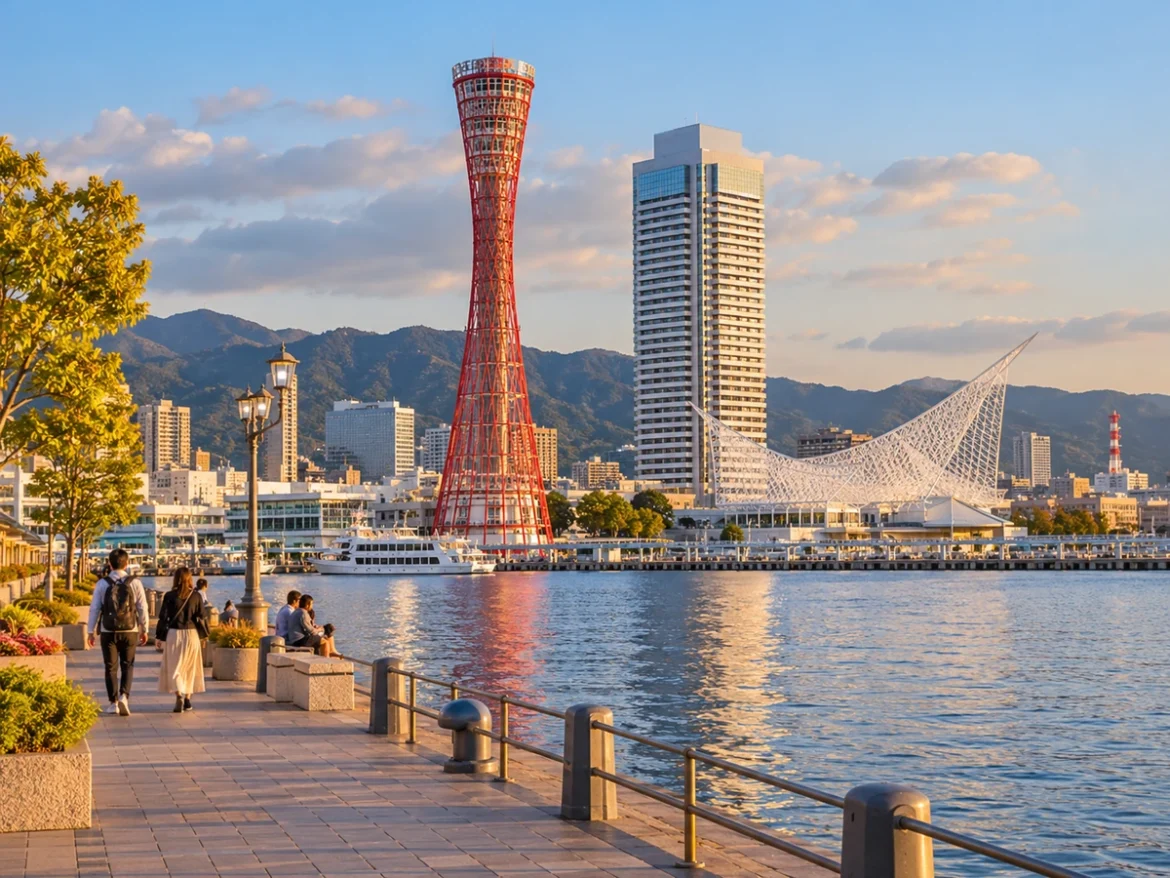
Meriken Park is one of the easiest places to experience Kobe’s waterfront identity. The park itself is free to enter and contains Kobe Port Tower, the Maritime Museum area and broad harbour views.
Kobe Port Tower currently operates its observation areas from 9:00 to 23:00, with last admission at 22:30. Date-and-time-specific admission is required for the paid observation areas.
Current standard admission is:
| Ticket | Adult | Elementary / junior-high student |
|---|---|---|
| Observation Area | ¥1,000 | ¥400 |
| Observation Area + Rooftop | ¥1,200 | ¥500 |
Preschool-age children enter free.
If your schedule reaches the waterfront near sunset, the tower becomes more worthwhile because the same visit can include daylight, dusk and city illumination.
Harborland: Best Final Stop
Continue west from Meriken Park into Harborland.
This is one of the easiest parts of Kobe to enjoy without a strict timetable. The waterfront contains restaurants, shopping, illuminated buildings and views back toward Port Tower.
Finishing here also gives you two departure choices: walk or take local transport back toward Sannomiya, or use JR Kobe Station if that is more convenient for your return route.
Half-Day Osaka to Kobe Itinerary
A half-day works best when you do not try to visit the mountains and waterfront at the same time.
Afternoon Waterfront Route
- 13:00 – Leave Osaka
- 13:30 – Arrive around Sannomiya
- 13:30–14:30 – Lunch around Sannomiya or Motomachi
- 14:30–15:30 – Nankinmachi and Motomachi
- 15:30–17:00 – Meriken Park
- 17:00–18:00 – Kobe Port Tower
- 18:00–19:30 – Harborland and dinner
- After 19:30 – Return to Osaka
This is the easiest Kobe plan for visitors who want food and harbour scenery without climbing hills.
Complete One-Day Osaka to Kobe Itinerary
- 08:30 – Leave Osaka
- 09:00 – Arrive in Kobe
- 09:15–11:30 – Nunobiki Herb Gardens or Kitano
- 11:30–12:30 – Walk downhill toward Sannomiya
- 12:30–14:00 – Kobe beef lunch
- 14:00–15:00 – Motomachi and Nankinmachi
- 15:00–16:30 – Former Foreign Settlement or waterfront walk
- 16:30–18:00 – Meriken Park and Kobe Port Tower
- 18:00–20:00 – Harborland, sunset/night view and dinner
- 20:00 onward – Return to Osaka
This sequence works because the day generally moves downhill and southwest rather than repeatedly returning to Sannomiya.
Can You Add Arima Onsen or Mount Rokko?
Yes, but that changes the trip considerably.
Central Kobe alone is easy and flexible. Adding Arima Onsen or Mount Rokko introduces more local transport, fixed connections and significantly more travel time.
For a first visit, choose one of these approaches:
- Central Kobe day: Nunobiki/Kitano + Chinatown + waterfront.
- Mountain day: Mount Rokko + Arima Onsen with fewer central Kobe stops.
- Guided day: useful when you want several geographically separated locations without organising every connection yourself.
An organised-tour option combines Kobe sights, Arima Onsen and Mount Rokko with transport from Osaka; confirm current dates, stops and inclusions in the selected package.
Osaka to Kobe with Children
Kobe is a relatively easy Kansai day trip for families because the intercity train journey is short.
The difficulty begins after arrival. A full Nunobiki → Kitano → Chinatown → waterfront itinerary can involve substantial walking.
For younger children, reduce the day to two main zones:
- Nunobiki + Kitano, or
- Chinatown + Meriken Park + Harborland.
Harborland works well late in the day because food, shopping and indoor facilities are available if the weather deteriorates.
With a stroller, avoid building an itinerary around continuous uphill walking through Kitano. Use the subway or tourist buses where practical.
Osaka to Kobe for Older Travellers
The train journey itself is straightforward. The main concern is walking distance and slope.
A comfortable itinerary would skip the long uphill walk from Sannomiya to Kitano and instead use local transport toward Shin-Kobe or the upper sightseeing districts.
Later, continue downhill toward Motomachi and the waterfront.
Allow extra time around Sannomiya because current redevelopment work can require pedestrian detours.
How Much Walking Is Involved?
Kobe looks compact on a map, but the central sightseeing route can easily become a substantial walking day.
The main physical factors are:
- Kitano is uphill from Sannomiya.
- Nunobiki involves garden walking even though the ropeway removes the main climb.
- Sannomiya to Motomachi is easy but adds distance.
- Nankinmachi to Meriken Park is walkable.
- Meriken Park itself is spacious.
- Continuing through Harborland adds another long waterfront section.
Travellers who normally struggle with 10,000–15,000-step sightseeing days should use local transport for at least one section.
What to Do with Large Luggage
Do not drag large luggage through Kitano or across the waterfront if Kobe is only a day trip.
Store bags in Osaka whenever possible.
If you are changing hotels, use station lockers or luggage facilities where available and begin sightseeing after leaving the bag behind.
Sannomiya is generally the most practical area for this because it is the main transport hub, but locker availability is never guaranteed during busy periods.
Best Time to Travel from Osaka to Kobe
| Departure | Best for | Trade-off |
|---|---|---|
| Before 09:00 | Full Nunobiki + central Kobe day | Osaka commuter period can be busy |
| 09:00–10:00 | Most first-time day trips | Major sights already becoming busier |
| Around midday | Kobe beef + waterfront half-day | Too late for a relaxed full sightseeing route |
| Afternoon | Chinatown, sunset and Harborland | Skip Nunobiki/Kitano if time is short |
Kobe is one of the few major Osaka day trips that still works well with a late start. If your main interests are food, Port Tower and Harborland, an afternoon departure can be perfectly reasonable.
Should You Stay Overnight in Kobe?
Most visitors do not need to.
Central Osaka and central Kobe are so close that returning to Osaka after dinner is normally simple.
An overnight stay becomes more worthwhile when:
- You want Mount Rokko at night.
- You plan to visit Arima Onsen slowly.
- You want a late waterfront dinner without thinking about the return train.
- You are continuing west toward Himeji the next morning.
- You prefer a slower Kobe itinerary with less walking in one day.
If your wider itinerary is still based around Osaka, keeping the same hotel is normally easier than moving luggage for one night.
Osaka to Kobe vs Osaka to Kyoto or Nara
Kobe serves a different purpose from Kyoto and Nara.
| Destination | Best for | Typical style |
|---|---|---|
| Kobe | Food, waterfront, city scenery | Relaxed half or full day |
| Kyoto | Temples, shrines, historic streets | Full day with careful area planning |
| Nara | Temples, deer, heritage | Half or full day |
If cultural landmarks are your priority, use our Osaka to Kyoto transport guide or Osaka to Nara guide.
Kobe is the stronger choice when you want a less demanding day with good food, open waterfront space and a very short intercity journey.
First-Time Mistakes to Avoid
- Going to Kobe Station simply because it says “Kobe.” Sannomiya is usually the more useful city-centre station.
- Taking the Shinkansen because it has the shortest train time. Shin-Osaka and Shin-Kobe can add extra transfers.
- Travelling from Namba to Umeda unnecessarily. Hanshin provides a direct Namba–Kobe option.
- Confusing Osaka-Namba with Nankai Namba. They are different railway stations.
- Buying a rail pass for one cheap return journey. Normal tickets are often cheaper.
- Planning Nunobiki, Kitano, Rokko, Arima and the harbour in one relaxed day. Kobe is compact, but these areas are not all beside each other.
- Underestimating Kitano’s slopes. Walking uphill becomes tiring in hot weather.
- Ignoring current Sannomiya construction. Some pedestrian routes require detours.
- Leaving Kobe beef restaurant planning until peak lunch time. Popular restaurants may have queues or limited seating.
- Assuming Port Tower is always walk-in. Observation-area admission uses specific dates and times.
- Visiting Nunobiki too late. Ropeway and garden closing times vary by season and day.
- Dragging luggage around the sightseeing route. Store it first.
- Walking everywhere with small children. Use local transport to remove at least one long section.
- Fixating on a permanent “last train” time. Check the current timetable for the actual travel date.
Osaka to Kobe FAQ
Q: How long does Osaka to Kobe take?
A: JR Special Rapid trains from Osaka Station to Sannomiya take roughly 20 minutes. Hankyu and Hanshin generally take around 25–30 minutes from Umeda.
Q: How much is the JR train from Osaka to Kobe?
A: The current ordinary fare from Osaka Station to Sannomiya is ¥420 one way.
Q: What is the cheapest train from Osaka to Kobe?
A: Hankyu and Hanshin from Osaka-Umeda currently cost ¥330 one way to Kobe-Sannomiya.
Q: What is the best train from Osaka to Kobe?
A: JR Special Rapid is the easiest default from Osaka Station. From Namba, Hanshin is often more practical.
Q: Can I travel directly from Namba to Kobe?
A: Yes. Hanshin services connect Osaka-Namba with Kobe-Sannomiya. The standard fare is ¥420.
Q: Should I go to Sannomiya or Kobe Station?
A: Choose Sannomiya for most sightseeing. Choose JR Kobe Station when Harborland is your immediate destination.
Q: Is Shin-Kobe the main station in Kobe?
A: It is the Shinkansen station, but Sannomiya is the main downtown transport hub.
Q: Is the Shinkansen worth taking from Osaka to Kobe?
A: Usually not for a central-city trip. It makes more sense if you are already at Shin-Osaka or want to visit Nunobiki first.
Q: Can I use ICOCA from Osaka to Kobe?
A: Yes, compatible IC cards are convenient for ordinary JR, Hankyu and Hanshin journeys.
Q: Is Osaka to Kobe covered by the JR Pass?
A: JR services within the pass coverage can be used, subject to the rules of the specific pass. Hankyu and Hanshin are private railways and are not JR.
Q: Should I buy WEST QR Kansai Area Pass just for Kobe?
A: No. A single Osaka–Kobe return journey is too inexpensive to justify the pass by itself.
Q: Is Kobe possible as a half-day trip?
A: Yes. Focus on Sannomiya, Chinatown, Meriken Park and Harborland, or choose Kitano/Nunobiki instead.
Q: How long should I spend in Kobe?
A: Allow half a day for the central highlights or one full day for a more complete first visit.
Q: Is Kobe good with children?
A: Yes, but reduce the number of districts and avoid excessive uphill walking.
Q: Is Kobe suitable for older travellers?
A: Yes. Use the subway or buses for the steeper northern sections and allow extra time around Sannomiya.
Q: Is Kitano walkable from Sannomiya?
A: Yes, but the route is uphill and can feel tiring in hot weather.
Q: How far is Nunobiki Herb Gardens from Shin-Kobe?
A: The ropeway bottom station is approximately five minutes on foot from Shin-Kobe Station.
Q: How much is Nunobiki Herb Gardens?
A: The regular adult round-trip ropeway ticket including garden admission is currently ¥2,500. Seasonal special pricing can apply.
Q: Do I need advance tickets for Kobe Port Tower?
A: The paid observation areas use date-and-time-specific admission, so reserving a suitable time is sensible when your schedule is fixed.
Q: Can I visit Arima Onsen and central Kobe in one day?
A: Yes, but the day becomes transport-heavy. Reduce the number of central Kobe attractions.
Q: Can I visit Mount Rokko and Kobe in one day?
A: Yes, particularly if the night view is the priority, but do not also expect a relaxed full tour of every central attraction.
Q: Do I need to stay overnight in Kobe?
A: No for an ordinary city visit. Stay overnight for a slower trip, late Mount Rokko views, Arima Onsen or onward travel west.
Q: Are there current construction works around Sannomiya?
A: Yes. Major redevelopment is affecting some pedestrian routes, so follow current local signage.
Q: What is the easiest first-time Kobe itinerary?
A: Start around Nunobiki or Kitano, move downhill through Sannomiya and Motomachi, then finish at Meriken Park and Harborland.
Final Verdict: Which Osaka to Kobe Route Should You Choose?
For most travellers staying near Osaka Station or Umeda, the JR Special Rapid from Osaka Station to Sannomiya is the easiest overall choice. It is direct, fast and puts you in the centre of Kobe.
If you are already close to Hankyu or Hanshin Osaka-Umeda, paying ¥330 instead of ¥420 is perfectly sensible. The small increase in journey time is rarely important on a full sightseeing day.
If you are staying in Namba, do not automatically travel north to Osaka Station. Hanshin from Osaka-Namba to Kobe-Sannomiya is the route to check first.
The Shinkansen is useful in more specific situations: staying beside Shin-Osaka, arriving from another Shinkansen city, or beginning at Nunobiki near Shin-Kobe.
For a first Kobe visit, allow a full day if possible. Start with Nunobiki or Kitano, eat around Sannomiya or Chinatown, then move toward Meriken Park and Harborland for late-afternoon and evening views.
Most visitors do not need a special rail pass and do not need to stay overnight. An IC card, a direct train to Sannomiya and a geographically sensible sightseeing route are enough to make Kobe one of the simplest excursions from Osaka.
If you are planning several Kansai day trips rather than Kobe alone, compare this route with our Osaka to Kyoto guide, Osaka to Nara guide and complete Osaka travel guide before deciding whether a regional rail pass is worthwhile.
Compare the return fare before buying a pass
A simple Umeda–Kobe-Sannomiya return on Hankyu or Hanshin costs ¥660; JR Osaka–Sannomiya and Hanshin Namba–Kobe-Sannomiya each cost ¥840 return. A ¥1,300 Hankyu digital one-day pass or ¥1,600 Hankyu–Hanshin one-day pass therefore needs additional covered rides. The Hankyu-only pass excludes Kobe Kosoku. The combined pass includes Hankyu, Hanshin and Kobe Kosoku, but does not thereby include JR, Kobe subway or sightseeing buses.
The existing Hankyu product now lists a digital one-day option; its old one-/two-day URL does not establish a current two-day ticket. The existing Hanshin product currently lists a 24-hour pass bundled with the Koshien museum. Compare the selected package rather than treating a bundle price as a simple Kobe rail fare.
Legacy paper Kansai Area Pass sales ended on September 30, 2026; existing purchases retain their stated validity. The current WEST QR Kansai Area Pass is a distinct product. Neither WEST QR nor Kansai Mini includes the Shin-Osaka–Shin-Kobe Shinkansen. A pass such as Kansai WIDE may cover that Sanyo Shinkansen section, subject to its train and seating conditions.
Current LITE costs ¥5,200 for two consecutive days or ¥6,500 for three consecutive days. Its current sales season runs October 1, 2026–March 31, 2027, with purchase-age and activation deadlines. It excludes JR, Kyoto City Subway, Randen, Keihan Otsu lines and all buses; paid reserved seating is extra. Arima and Rokko trips still require a segment-by-segment check of railway, bus, cable-car and ropeway coverage.
Luggage, children and accessible transfers
Ordinary commuter trains do not guarantee a seat or a luggage rack beside you. Secure bags and keep doors clear. Leave large cases at your Osaka hotel when practical, and check step-free station exits or staffed storage without assuming a large locker will be free. Child fares and free travel depend on age, accompanied-child limits and whether a separate reserved seat is used.
Kitano and Nunobiki involve hills; even the flatter waterfront adds substantial distance from Sannomiya to Harborland. Families or less-mobile visitors can choose two areas and use local transport between them. During Sannomiya redevelopment, pedestrian diversions may differ from a map’s shortest route. Allow extra transfer time and follow current signs.
Check official routes before departure
- JR timetable and fare search
- Hankyu Kobe-Sannomiya timetable and station map
- Hanshin main-route fares
- Current LITE conditions and map
- WEST QR Kansai Area Pass
- Kobe Port Tower tickets and hours
- Nunobiki hours and seasonal fares