
Tsukiji Outer Market is still one of Tokyo’s most enjoyable places to build a morning around food, but it is important to understand what Tsukiji is today. The wholesale market and famous tuna auctions moved to Toyosu in 2018. The narrow streets of seafood shops, food specialists, restaurants and kitchen-related businesses around Tsukiji, however, remain very much active.
For a first visit, the biggest mistake is arriving extremely early because an old guide says “Tsukiji starts before sunrise.” Some businesses do begin work early, but this is still a working food district. Professional buyers take priority before 9:00 a.m., and the market itself recommends that ordinary visitors come later.
The most practical first-time window is therefore roughly 9:00 a.m. to late morning. You will find far more businesses operating than in the late afternoon while avoiding the professional purchasing period when carts, deliveries and serious buying activity take priority.
Tsukiji is also not a conventional attraction with a ticket gate. There is no general admission ticket, no fixed route and no single closing time applying to every shop. Think of it as a compact food district that works best when you arrive with two or three priorities rather than a list of twenty famous stalls.
If you are still planning the rest of the city, use our things to do in Tokyo guide to decide where Tsukiji fits among Ginza, Asakusa, Shibuya and other major areas.

Is Tsukiji Outer Market Worth Visiting?
Swipe to compare →
| Planning question | Practical answer |
|---|---|
| Worth visiting? | Yes if Japanese food, seafood, specialist ingredients or traditional market streets interest you |
| Admission | Free; individual food, shopping and tour costs apply |
| Best time | From around 9:00 a.m. through late morning |
| Recommended duration | About 1.5–3 hours for most first-time visitors |
| Main appeal | Browsing food specialists, eating breakfast or early lunch and seeing an active historic food district |
| Main misunderstanding | The tuna auction and wholesale market are no longer here |
| Nearest convenient station | Tsukiji Station or Tsukijishijo Station |
| Families | Possible, but narrow crowded lanes make large strollers inconvenient |
| Older travellers | Physically easy compared with many Tokyo attractions, but crowding and wet surfaces require care |
| Best nearby combination | Ginza |
Tsukiji is most worthwhile for travellers who enjoy exploring food districts rather than checking off a single landmark. Seafood is the obvious draw, but the market also makes sense for tamagoyaki, dried seafood, tea, seaweed, pickles, kitchen tools and ingredients that are difficult to appreciate in an ordinary shopping centre.
It may be less rewarding if your only objective is to see a large working wholesale operation or a tuna auction. Those functions moved to Toyosu. In that case, Toyosu should be the priority.
Do not give Tsukiji an entire day unless food is a major focus of the trip. For most visitors, a concentrated morning followed by Ginza or another central Tokyo district is a better use of time.
Entry to the Outer Market is free. These are optional paid tours or activities, not market admission tickets.
Tsukiji Outer Market Essential Information
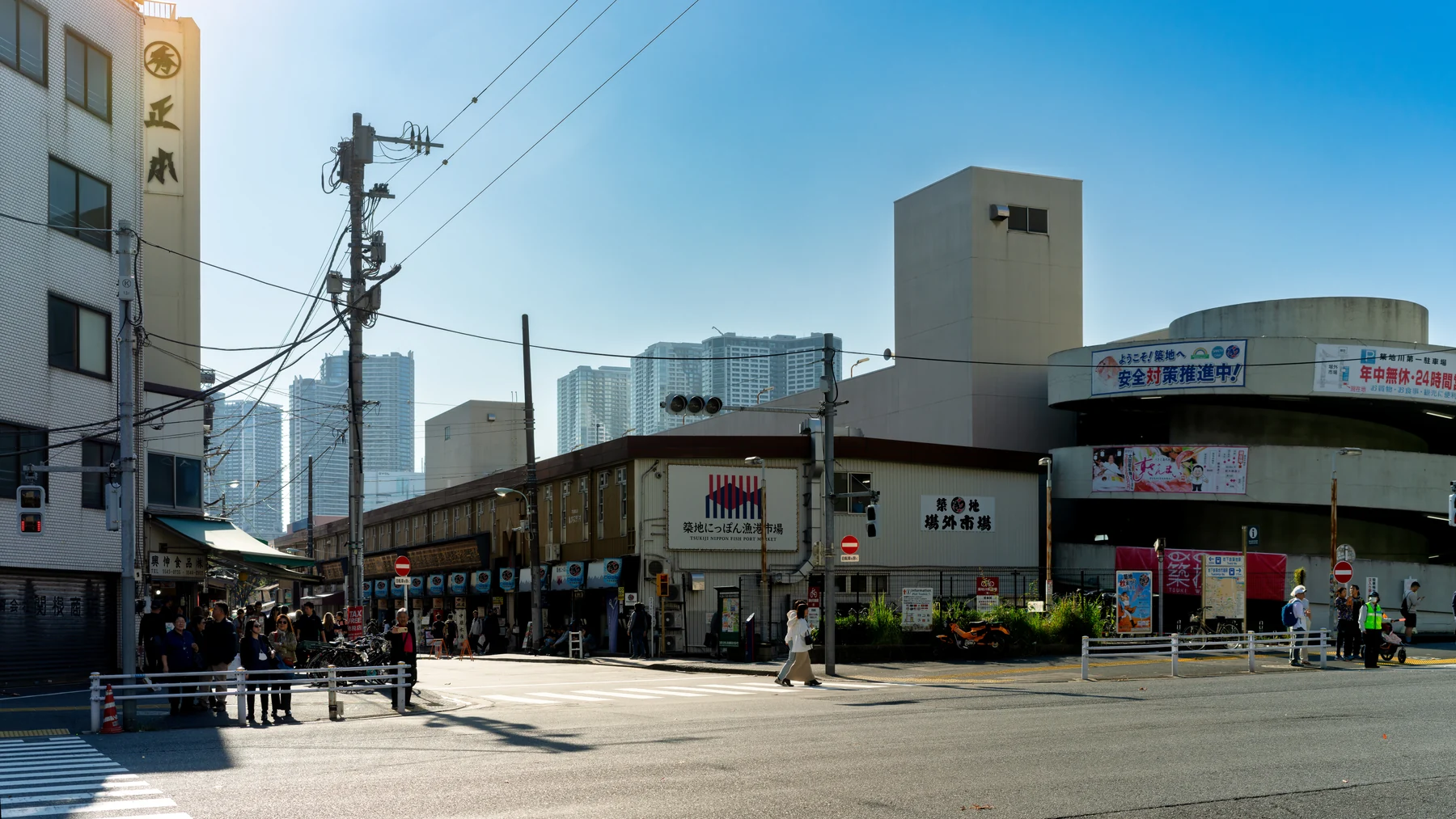
Swipe to compare →
| Item | Details |
|---|---|
| Official English name | Tsukiji Outer Market |
| Japanese name | 築地場外市場 |
| Area | Tsukiji, Chuo City, Tokyo |
| General admission | Free |
| Professional purchasing period | Approximately 6:00–9:00 a.m. |
| Normal visitor shopping period | Approximately 9:00 a.m.–2:00 p.m. |
| After 2:00 p.m. | Individual businesses follow their own hours |
| Common closure pattern | Many shops close on Sundays, national holidays and selected Wednesdays |
| Recommended visit length | 1.5–3 hours |
| Closest subway | Tsukiji Station, Hibiya Line |
| Alternative subway | Tsukijishijo Station, Oedo Line |
There is no universal opening time for every restaurant and retailer. The market-wide schedule is useful for planning the general visit, but individual businesses can open later, close earlier or take additional holidays.
Before visiting on a Wednesday, Sunday or national holiday, check the official Tsukiji calendar and then check any specific restaurant you consider essential.
Current Opening Status and Calendar Checks
The Outer Market is a collection of independent businesses, so check the shops you want to visit rather than assuming one opening calendar covers the entire district.
Plat Tsukiji has announced information-centre closures on October 21 and 28, 2026. These are not market-wide closure dates: the shops and restaurants have their own calendars.
Plat Tsukiji provides maps and visitor guidance. If you need a particular service, check its current opening and availability separately from the shops you want to visit.
Tsukiji or Toyosu: Which One Should You Visit?
Swipe to compare →
| Tsukiji Outer Market | Toyosu Market | |
|---|---|---|
| Main reason to visit | Eating, browsing small shops, ingredients and old-market atmosphere | Modern wholesale-market facilities and observing market activity from designated visitor areas |
| Tuna auction | No | Yes, in Toyosu |
| Street atmosphere | Strong | More controlled indoor market environment |
| Best for first-time food browsing | Usually Tsukiji | Better for travellers specifically interested in wholesale-market functions |
| Easy Ginza combination | Yes | No; Toyosu fits better with the waterfront |
Choose Tsukiji when the experience you want is food, narrow market lanes and an easy central-Tokyo morning. Choose Toyosu when seeing the modern wholesale-market system or tuna auction is the main objective.
Visiting both is possible, but it is rarely necessary for an ordinary first trip. They solve different interests rather than representing two halves of one attraction.
Best Time to Visit Tsukiji Outer Market
Swipe to compare →
| Time | What it is like | Recommendation |
|---|---|---|
| Before 7:00 a.m. | Some businesses operate, but the district is still strongly oriented toward professional work | Not necessary for most tourists |
| 7:00–9:00 a.m. | Breakfast options exist, but professional buyers still have priority | Visit only if you have a specific early restaurant plan |
| 9:00–11:00 a.m. | Visitor-friendly period with strong shop availability | Best overall first-time window |
| 11:00 a.m.–1:00 p.m. | Excellent for lunch but busier around famous food stalls and restaurants | Good if lunch is the priority |
| 1:00–2:00 p.m. | Still usable, but some businesses begin winding down | Acceptable for a short visit |
| After 2:00 p.m. | Operating patterns become increasingly shop-specific | Do not build your first visit around late afternoon |
The sweet spot is around 9:00 a.m. This timing respects the working market, gives you more choice than a late visit and still leaves most of the day free.
If one specific sushi restaurant is the entire purpose of your visit, its own opening hours may justify arriving earlier. That is different from wandering through Tsukiji simply because an old article says the market is an early-morning destination.
How to Visit Tsukiji the Right Way for the First Time
A simple first-time route works better than zigzagging between social-media-famous stalls.
- Arrive at Tsukiji Station around 8:50–9:00 a.m.
- Walk into the Outer Market and browse the central lanes before committing to a large meal.
- Try one or two small foods rather than buying everything immediately.
- Visit Tsukiji Uogashi after 9:00 a.m.
- Choose a seated sushi, seafood or other lunch if you still want a full meal.
- Finish with dry goods, tea, kitchenware or takeaway items.
- Walk toward Ginza rather than lingering until most market businesses close.
This sequence prevents one common problem: eating a huge seafood bowl at the first shop and then discovering that the market is full of smaller foods you also wanted to try.
Tsukiji Uogashi: What Is It?
Before 9:00 a.m., access to the wholesale shopping area is restricted to authorised buyers. For an ordinary visit, enter after 9:00 and keep clear of deliveries. The broader Outer Market also asks visitors to give working buyers priority. Eat only in permitted dining areas; the sales floor is not a standing seafood bar.
Tsukiji Uogashi is an important part of the modern Outer Market but should not be confused with the former giant Tsukiji wholesale complex.
The facility contains professional food businesses and retailers in the Odawarabashi and Kaikobashi buildings. The published facility schedule follows Tokyo Metropolitan Central Wholesale Market business days, with professional purchasing taking priority in the early morning.
Ordinary visitors are specifically encouraged to enter after 9:00 a.m. That makes it an excellent second stop after a short browse of the surrounding market streets.
Eating is restricted on the first-floor sales area. Use designated rest areas or the restaurant facilities rather than opening food in the middle of a professional retail floor.
What to Eat at Tsukiji Outer Market
Cooked food and a manageable tasting plan
For cooked dishes, compare Kitsuneya and the chicken meals at Torito Bunten; Marutoyo is another option for food shopping. Choose by what you want to eat and confirm the shop’s own hours rather than promising yourself every famous stop in one morning.
You do not need to eat raw fish to enjoy Tsukiji. Look for cooked dishes, rice balls, noodles and chicken as well as seafood. A practical morning combines one seated main meal with two or three small purchases, leaving room to browse seaweed, bonito flakes, knives and kitchenware. Choose your one must-try shop in advance; if its queue is too long, keep the rest of the meal flexible.
1. Sushi
Sushi remains the obvious Tsukiji meal, but there is no need to believe that the restaurant with the longest tourist queue is automatically the right one.
If sushi is your main meal, sit down rather than trying to assemble an entire breakfast from takeaway pieces in crowded lanes. A restaurant also gives you a much calmer break from the market streets.
2. Kaisen-don
A seafood rice bowl works well when you want a substantial meal without committing to a longer sushi course. Check the actual toppings and portion before ordering rather than choosing purely from an oversized photo.
3. Tamagoyaki
Japanese rolled omelette is one of the easiest small foods to add to a market visit. It is particularly useful if your group does not want every stop to involve raw seafood.
4. Grilled Seafood
Scallops, shellfish and other cooked seafood give non-sushi eaters more choice. Eat only where the shop provides an appropriate eating position rather than walking through the market with food in your hands.
5. Dried Seafood, Seaweed and Tea
Tsukiji makes more sense when you look beyond ready-to-eat snacks. Dried fish, bonito-related products, seaweed and Japanese tea are easier to transport than fresh seafood and can make more practical souvenirs.
6. Kitchen Tools
The district also retains shops connected with professional food preparation. Travellers interested in Japanese cooking should leave enough time to browse knives, cookware, tableware and related equipment instead of treating the market only as an outdoor food court.
Important Tsukiji Market Rules
Tsukiji remains a working food district, and giving working buyers space matters more here than at a conventional sightseeing attraction.
Do Not Eat While Walking
Food should be eaten inside the shop, in front of the shop where permitted or in a designated eating space. Walking through narrow lanes while eating obstructs other visitors and working businesses.
Professional Buyers Come First Before 9:00 a.m.
If you arrive early, do not block shop entrances, delivery routes or workers moving products through the market.
Leave Large Luggage Elsewhere
Suitcases make the narrow streets significantly harder to navigate. Limited lockers exist, but arriving directly from the airport with every bag is a poor plan.
If Tsukiji is your first stop after landing, leave luggage at the hotel or another appropriate storage facility first. Our Haneda Airport to Tokyo transport guide can help plan the arrival before adding sightseeing.
Ask Before Photographing Shops
Do not assume every seafood display, fishmonger or kitchen can be photographed. Ask first, especially when staff are working directly in front of you.
Do Not Touch Displayed Food
Fresh products are merchandise, not museum exhibits. Ask the shopkeeper if you need help identifying an item.
Do Not Bargain
Price negotiation is not part of the normal Tsukiji shopping experience.
Cash, Credit Cards and Payments
Payment methods vary by shop. Some businesses accept cards or transport IC payments, while others remain much easier to use with Japanese yen.
Carry some cash rather than assuming every stall accepts the same payment methods as a department store in Ginza.
Do not withdraw a large amount of cash purely for Tsukiji, but having enough yen for several snacks and a small shop that does not accept your card prevents unnecessary detours.
Tsukiji with Large Luggage
Large luggage is one of the clearest cases where technically possible does not mean sensible.
The market lanes can be narrow, wet and crowded. Suitcases obstruct pedestrians and workers, and locker capacity around the market is limited.
Tsukijishijo Station itself has coin lockers, including some large lockers, but availability cannot be guaranteed when you arrive. Hotel luggage storage or a major-station locker is more dependable if you are carrying several bags.
Tsukiji with a Stroller
Plat Tsukiji’s published services list temporary stroller storage at ¥500 per stroller. Its information counter normally opens 08:00–14:00 on weekdays and Saturdays, and 10:00–14:00 on Sundays, national holidays and market closure days. The public lounge has different hours; neither schedule overrides an announced temporary centre closure.
A stroller can physically enter the area, but the busiest lanes are not particularly stroller-friendly. The issue is not stairs throughout the market; it is crowd density, narrow passages and frequent stops in front of small businesses.
For a baby who can use a carrier comfortably, a carrier is usually easier during the market portion of the morning.
Plat Tsukiji normally offers temporary stroller storage for a fee. Check that the information centre is operating on your date before planning around this service.
Families with Children
Tsukiji can work well for families when the visit is short and food-led. Children who enjoy seafood, omelette, fruit, snacks or watching food preparation may find it far more engaging than a long museum morning.
The main difficulty is crowd movement. Keep young children close because delivery activity and other pedestrians continue around the market.
Do not plan five or six separate queues with a toddler. Choose one seated meal, one or two snacks and a short browse, then continue to a more spacious part of Tokyo.
Older Travellers and Limited Mobility
Tsukiji is physically easier than temples with long staircases or hilltop viewpoints because the sightseeing itself is largely at street level.
The challenge is the environment rather than elevation. Wet surfaces, narrow lanes and lunchtime crowding can be more difficult for someone with reduced balance or slower walking speed.
Tokyo Metro Tsukiji Station has elevators to street level at both Exit 1 and Exit 2. That makes Tsukiji Station a particularly straightforward choice when avoiding stairs matters.
Plan a seated breakfast or lunch into the visit rather than expecting an older traveller to stand through multiple food queues.
What to Wear
Closed shoes with good grip are a better choice than sandals or high heels. Market floors can become wet, and workers, bicycles and carts continue moving through the area.
This matters even more on rainy mornings. Tsukiji is not one fully enclosed building, so expect to move between covered and exposed areas.
How to Get to Tsukiji Outer Market
The station-to-market access information estimates about one minute from Tsukijishijo A1 or Tsukiji exits 1/2, and about five minutes from Higashi-ginza exits 5/6. These are street walks, excluding station circulation and accessible-route detours.
From Tsukiji Station
Use Tokyo Metro’s accessibility page and current lift-maintenance schedule to choose the route for your platform. The short street-walk estimate does not include station circulation or an accessible detour.
Tokyo Metro Hibiya Line → Tsukiji Station → Exit 1 or Exit 2 → approximately one minute to the Outer Market area.
Both exits are listed with elevators to street level, making this the easiest default for many first-time visitors.
From Tsukijishijo Station
Toei Oedo Line → Tsukijishijo Station → A1 Exit → approximately one minute to the market.
This route is especially useful when travelling directly on the Oedo Line from districts such as Shinjuku.
From Higashi-ginza Station
Tokyo Metro Hibiya Line or Toei Asakusa Line → Higashi-ginza → Exit 5 or 6 → approximately five minutes on foot.
This is useful for travellers staying around Ginza or arriving on an appropriate Toei Asakusa Line service.
From Tokyo Station
A straightforward railway route is:
Tokyo Station → Tokyo Metro Marunouchi Line → Ginza → transfer to Hibiya Line → Tsukiji → Exit 1 or 2 → Outer Market.
If your hotel is already around Yaesu, Kyobashi or Ginza, walking or using a short subway connection can make more sense than returning through Tokyo Station. Travellers choosing a base can compare the station sides in our hotels near Tokyo Station guide.
From Shinjuku
Shinjuku → Toei Oedo Line → Tsukijishijo → A1 Exit → Outer Market.
This is one of the simplest long-distance city-centre routes because it avoids a subway transfer.
From Ginza
Ginza and Tsukiji are close enough that many visitors should treat them as one sightseeing area.
You can take the Hibiya Line one stop or simply walk depending on where you are in Ginza. Starting at Tsukiji in the morning and moving toward Ginza later is more logical than doing the order in reverse because the market finishes much earlier than Ginza shops.
Best Guided Tsukiji Food Tour
You do not need a tour to enter Tsukiji. Independent visitors can browse the market freely and buy whatever food interests them.
A guide becomes useful when you want explanations of ingredients, market history and food culture rather than simply ordering from whichever stall looks appealing. It can also reduce the amount of time spent deciding where to eat.
One current option combines a guided Tsukiji visit with several food tastings and offers morning and late-morning departures.
For independent food-focused travellers who are comfortable ordering and navigating Tokyo, paying for a guide is not essential. Spend that money on the meal instead.
Tsukiji Sushi and Bento Experience
The linked two-hour product currently lists no overall age limit, free participation for ages 0–2, and accompaniment by a paying adult for ages 3–9. Infants still count in the booking headcount. Confirm the selected package, ingredient restrictions and any allergy accommodation before paying; a cooking activity cannot be assumed to handle every dietary requirement.
If watching the market is not enough and you want a structured activity, a small-group market visit combined with sushi and bento preparation creates a more hands-on morning.
This type of experience makes more sense for repeat visitors, families with older children or travellers who want to learn something rather than simply photograph food displays.
90-Minute Tsukiji Itinerary
Swipe to compare →
| Time | Plan |
|---|---|
| 09:00 | Arrive from Tsukiji Station |
| 09:05–09:30 | Browse the main Outer Market lanes |
| 09:30–09:50 | Tamagoyaki or another small food stop |
| 09:50–10:15 | Tsukiji Uogashi |
| 10:15–10:30 | Tea, dried food or kitchen-related shopping |
This is enough when Tsukiji is one stop in a very busy Tokyo day.
Best Half-Day Tsukiji Itinerary
Swipe to compare →
| Time | Plan |
|---|---|
| 08:40 | Arrive in Tsukiji and briefly visit Tsukiji Honganji |
| 09:00 | Enter the Outer Market after the professional-priority period |
| 09:00–10:15 | Browse food shops and try one or two small items |
| 10:15–10:45 | Visit Tsukiji Uogashi |
| 10:45–11:45 | Early sushi or seafood lunch |
| 11:45 | Walk toward Ginza |
| 12:15 onward | Ginza shopping, architecture, cafés or department stores |
This is the strongest first-time plan because Tsukiji receives the part of the day when it is most active, while Ginza receives the afternoon when its shops are fully open.
Full-Day Tsukiji and Central Tokyo Itinerary
Swipe to compare →
| Time | Plan |
|---|---|
| 09:00 | Tsukiji Outer Market |
| 10:30 | Tsukiji Uogashi and final food shopping |
| 11:15 | Early lunch |
| 12:15 | Tsukiji Honganji |
| 13:00 | Walk into Ginza |
| 13:30–16:30 | Ginza shops, department stores and cafés |
| 17:00 onward | Continue toward Yurakucho, Marunouchi or Tokyo Station |
Do not return to Tsukiji late in the afternoon expecting the same atmosphere you saw at 9:30 a.m. Build the day in one direction.
Tsukiji and Ginza
Tsukiji plus Ginza is the most natural combination.
Visit Tsukiji first because the market is morning-oriented. Continue to Ginza after lunch because retail, cafés and department stores remain active much later.
This combination works particularly well for first-time visitors because it produces two very different Tokyo experiences without wasting time on a cross-city transfer.
If staying nearby appeals to you, compare station locations in our best hotels in Ginza guide. The Tsukiji edge of Ginza is particularly useful when you want an early market morning without giving up easy access to central shopping areas.
Tsukiji and Asakusa
Tsukiji in the morning followed by Asakusa in the afternoon is possible, but it involves more transport than the Ginza combination.
This route works when your Tokyo itinerary is short and you want food in the morning followed by traditional sightseeing around Sensoji.
It is less elegant than Tsukiji plus Ginza because you leave central Tokyo for the northeast, but the two experiences are different enough to justify the journey.
Travellers staying on that side of Tokyo can also compare accommodation in our Asakusa hotel guide.
Tsukiji and Toyosu in One Day
Technically possible, but not necessary for everyone.
Choose this only when markets and Japanese food culture are a major interest. Otherwise you are spending a substantial part of the morning looking at two locations connected by the same history rather than experiencing another side of Tokyo.
If you want the tuna auction or modern wholesale-market environment, prioritise Toyosu. If you want eating and browsing, prioritise Tsukiji.
Visiting Tsukiji in Rain
Rain does not make a Tsukiji visit impossible, but the area is not one fully enclosed shopping arcade.
Some sections are sheltered while others require outdoor walking. The more important concern is the ground: market surfaces may be wet and slippery even on an ordinary working morning.
Use closed shoes with reliable grip and avoid trying to hold an umbrella, phone, food and shopping bag simultaneously in the narrowest lanes.
Where to Stay for Tsukiji Outer Market
Ginza
Ginza is the easiest high-comfort base. You can walk or take a very short subway journey to Tsukiji in the morning while retaining excellent evening dining and shopping.
Tsukiji
Staying directly around Tsukiji makes sense when an early market visit is genuinely important or when you prefer quieter evenings to central Ginza.
Tokyo Station
Tokyo Station is stronger when Tsukiji is only one part of a broader Japan itinerary involving Shinkansen travel, Narita Airport or several day trips.
For a broader neighbourhood comparison, see our where to stay in Tokyo guide.
An overnight stay is not required specifically for Tsukiji. Its central location makes it easy to reach from most major Tokyo neighbourhoods.
First-Time Mistakes to Avoid at Tsukiji
1. Going to Tsukiji for the tuna auction
The wholesale market and tuna auction moved to Toyosu in 2018.
2. Arriving at 5:00 a.m. without a specific reason
An extremely early start is unnecessary for most tourists, and professional buyers have priority before 9:00 a.m.
3. Visiting late in the afternoon
Many market businesses are morning-oriented and may already be closing.
4. Assuming every Wednesday is normal
Selected Wednesdays are market closure days, and individual businesses can follow their own schedules.
5. Eating while walking
Use the shopfront or designated eating space instead.
6. Bringing large suitcases
Narrow lanes and limited locker capacity make this unnecessarily difficult.
7. Treating the market as one giant restaurant
Leave time for ingredients, tea, seaweed, dried food and kitchen-related businesses.
8. Queuing at the first famous stall you recognise
Walk through the market before committing your entire morning to one queue.
9. Assuming all shops accept cards
Carry some Japanese yen because payment methods differ.
10. Photographing workers without asking
Tsukiji is a workplace, not only a sightseeing set.
11. Touching seafood displays
These are products for sale. Ask the shopkeeper if you need information.
12. Wearing slippery sandals
Wet market surfaces make stable closed footwear more sensible.
13. Giving Tsukiji an entire sightseeing day
For most people, two or three hours followed by Ginza is enough.
Tsukiji Outer Market FAQ
Q: Is Tsukiji Outer Market still open?
Yes. The Outer Market remains active. It was the wholesale inner market that relocated to Toyosu.
Q: When did the Tsukiji wholesale market move?
The wholesale market relocated to Toyosu in 2018.
Q: Can I see the tuna auction at Tsukiji?
No. Travellers interested in the tuna auction need Toyosu Market.
Q: Is Tsukiji Outer Market free?
Yes. There is no general entrance fee.
Q: What is the best time to visit Tsukiji?
For most tourists, around 9:00 a.m. through late morning is the strongest window.
Q: Why not visit before 9:00 a.m.?
Professional purchasers have priority before 9:00 a.m. The market remains a working food district.
Q: What time does Tsukiji close?
There is no single closing time for every shop. The general normal retail period runs until around 2:00 p.m., after which individual businesses follow their own hours.
Q: Is Tsukiji open on Sunday?
Some businesses may operate, but many shops close on Sundays. A Sunday should not be your default day if Tsukiji is an important part of the trip.
Q: Is Tsukiji closed on Wednesdays?
Some Wednesdays are market closure days and many businesses follow that schedule. Check the official calendar for your date.
Q: How long should I spend at Tsukiji?
About 1.5–3 hours is enough for most visitors, including browsing and a meal.
Q: Which station is best for Tsukiji Outer Market?
Tsukiji Station on the Hibiya Line is the easiest default. Tsukijishijo Station on the Oedo Line is also extremely close.
Q: Does Tsukiji Station have an elevator?
Yes. Tokyo Metro lists street-level elevators for both Exit 1 and Exit 2.
Q: Is Tsukiji suitable for wheelchair users?
The area is largely street-level and nearby stations have accessible facilities, but narrow crowded lanes and wet surfaces can make movement slower.
Q: Is Tsukiji good with a stroller?
Possible, but not ideal during crowded periods. A baby carrier is easier in the narrowest lanes.
Q: Can I bring a suitcase to Tsukiji?
Avoid it. Large baggage obstructs the market lanes, and locker capacity is limited.
Q: Can I eat while walking at Tsukiji?
No. The market asks visitors to eat inside the shop, in front of the shop where permitted or in designated areas.
Q: Can I photograph the shops?
Ask the shopkeeper first. Some businesses prohibit photography.
Q: Do Tsukiji shops accept credit cards?
Some do, but payment methods vary. Carry some Japanese yen.
Q: Is Tsukiji Uogashi open to tourists?
Yes, but ordinary visitors are encouraged to use it after 9:00 a.m. because professional purchasing takes priority earlier.
Q: Do I need a food tour?
No. Independent visiting is easy. A tour is most useful when you want explanations, organised tastings and market context.
Q: Can I visit Tsukiji and Ginza together?
Yes. It is one of the most efficient central-Tokyo combinations: Tsukiji in the morning, Ginza from late morning onward.
Q: Should I visit Tsukiji or Toyosu?
Choose Tsukiji for food, shopping and historic market streets. Choose Toyosu for the modern wholesale market and tuna auction.
Q: Is Tsukiji good in the rain?
Yes, but not every lane is enclosed. Wear shoes with good grip because market surfaces can become slippery.
Q: Where should I stay for an early Tsukiji visit?
Tsukiji or Ginza is easiest. Tokyo Station is also practical when the wider trip includes Shinkansen travel.
Final Verdict: Should You Visit Tsukiji Outer Market?
Tsukiji Outer Market is still worth visiting when food is part of how you want to experience Tokyo. Its appeal today is not a giant wholesale auction floor but the dense collection of seafood businesses, restaurants, specialist ingredients and food-related shops that survived the move to Toyosu.
The best first visit begins around 9:00 a.m., not before sunrise. That timing respects professional buying activity while giving you enough time to explore before businesses begin winding down later in the day.
Allow roughly two to three hours if you want to browse, eat and visit Tsukiji Uogashi. Ninety minutes is enough when Tsukiji is only one stop in a very full itinerary.
Do not bring a suitcase, do not walk through the lanes while eating and ask before photographing shop staff. These small decisions make the visit noticeably easier for both travellers and the people actually working in the market.
For most first-time Tokyo itineraries, the strongest sequence is Tsukiji in the morning followed by Ginza. It uses the natural operating hours of both neighbourhoods and avoids wasting half the day on cross-city transport.
No entrance ticket is required. Book a guided food tour only if you value explanations and organised tastings; otherwise, independent exploration is entirely practical.
Most importantly, decide what you actually want from “Tsukiji.” If the answer is sushi, food shopping and market atmosphere, stay here. If the answer is the tuna auction, go to Toyosu instead.