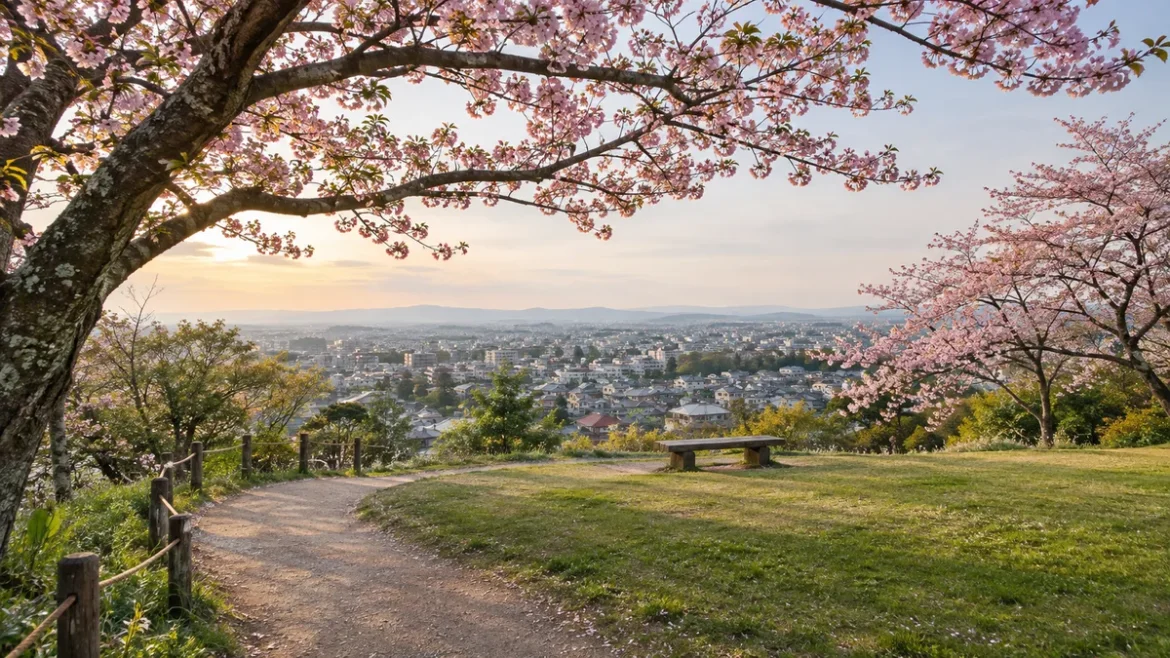
Utatsuyama Park adds a hillside blossom walk and city views to a Kanazawa trip. It is a broad municipal park with roads, viewpoints and gardens spread across the slopes, rather than one compact garden that can be covered immediately after arrival. Choose the area you want before choosing the transport.
Search for 卯辰山公園. Oku-Utatsuyama Kenmin Park is a separate park. The Four-Hundred-Year Forest, 四百年の森, is a separately named cherry grove within Utatsuyama Park, not an alternative name for the entire mountain park.

Plan your visit at a glance
- Navigate to Utatsuyama Park, not the separate Oku-Utatsuyama Kenmin Park.
- Locate the Four-Hundred-Year Forest and Bokodai separately before choosing a route.
- Early to mid-April is the usual blossom window, not a guaranteed peak for your travel date.
- The March 2026 Route 90 timetable has no weekend or public-holiday service; recheck before spring 2027.
- Choose a manageable blossom section and viewpoint, allowing for slopes and the return journey.
Choose a blossom route for early to mid-April
Early to mid-April is the usual cherry season. Blossom routes include the roads through the Kosaka Shrine, Bokodai, sports-ground and Senjukaku area, as well as the Four-Hundred-Year Forest. Use the flower calendar to distinguish the seasons of different flowers.
These places are spread out. A photograph of one flowering tree does not describe the whole park. For a flower-focused visit, choose a manageable road section and perhaps one viewpoint rather than trying to cover every named area.
For 2027, use the park map and facility locations to choose a route. The azalea and iris gardens have their own seasons. Later azaleas and early-summer irises or hydrangeas should not be promised as simultaneous companions to the cherries.
The short Bokodai walk applies locally
Allow about one minute from the Bokodai bus stop to the nearby viewpoint. That describes access around the viewpoint; it does not put the Four-Hundred-Year Forest or every other park feature one minute away.
For city views, a stop around Bokodai can stand on its own. For a concentrated cherry grove, locate the forest specifically and check its approach. Both can be included in one outing, but they are not the same destination within the park.
Families and older visitors should choose exact arrival and departure points. Straight-line map distances can hide gradients, winding roads and the effort needed after reaching the hillside.
Check the weekday-only bus carefully
Under the March 2026 timetable, Hokutetsu route 90, the Utatsuyama Line, does not run on Saturdays, Sundays or public holidays. Even on weekdays, only certain departures serve Bokodai and the hilltop stops. A bus bound for Senjukaku does not necessarily follow the same approach as every other departure.
Open the Utatsuyama Line from the operator’s timetable page, then check your date, actual stops and return service. Timetables may change before a future spring visit, so check again rather than relying indefinitely on a saved copy.
If no suitable bus runs, compare a taxi or a walking approach in advance. Consider cost, return arrangements and fitness. A stroll through the lower tea-house district is not equivalent to completing the hillside park, especially near dusk.
One viewpoint can be enough
Bokodai is known for views over the city towards Kahoku Lagoon and the Sea of Japan. Other named viewpoints, including Chobo-no-Oka and Miharashidai, offer different directions and foregrounds. Choosing the one that fits your route is often more satisfying than collecting them all.
Cloud and visibility determine how much of the distance can be seen. If the horizon disappears, nearby flowers and the layered cityscape still offer interest. Do not sacrifice a reliable return journey while waiting for the weather to clear.
Allow roughly an hour and a half to two hours for a selected blossom section and one viewpoint, adding transport and a buffer for the gradients. This is a suggested outing, not a promise that the entire park can be completed in that time.
Parking and walking need a precise destination
Park admission is free, while parking areas are distributed around individual facilities. Drivers should navigate to the area they actually want, not assume a park-wide capacity guarantees space beside every attraction.
Check the area-specific parking guidance for the busy Four-Hundred-Year Forest in blossom season. Follow signs for that area and avoid roadside parking elsewhere. Some blossom routes follow roads, so remain aware of traffic and keep photographs out of the carriageway.
Anyone needing a wheelchair-friendly route or fewer steps should confirm the specific section with the city. A comfortable Utatsuyama visit leaves enough time for both the ascent and descent, rather than adding the park as an unplanned final stop after an already full city day.
Utatsuyama Park cherry-blossom questions
Is the Four-Hundred-Year Forest another name for the whole park?
No. It is a named cherry grove within Utatsuyama Park. Oku-Utatsuyama Kenmin Park is a separate park.
Can I use Route 90 on a weekend?
The timetable dated March 2026 lists no Saturday, Sunday or public-holiday service. Check for revisions before a 2027 visit and compare alternatives if no suitable service runs.
Does the one-minute walk from Bokodai apply to the forest too?
No. It describes access near the viewpoint. The forest and other areas need their own approach and gradient checks.
How long should I allow for blossoms and a viewpoint?
Roughly one and a half to two hours is a starting allowance for a selected route and viewpoint, plus transport and hill-walking buffers. It does not cover the entire park.