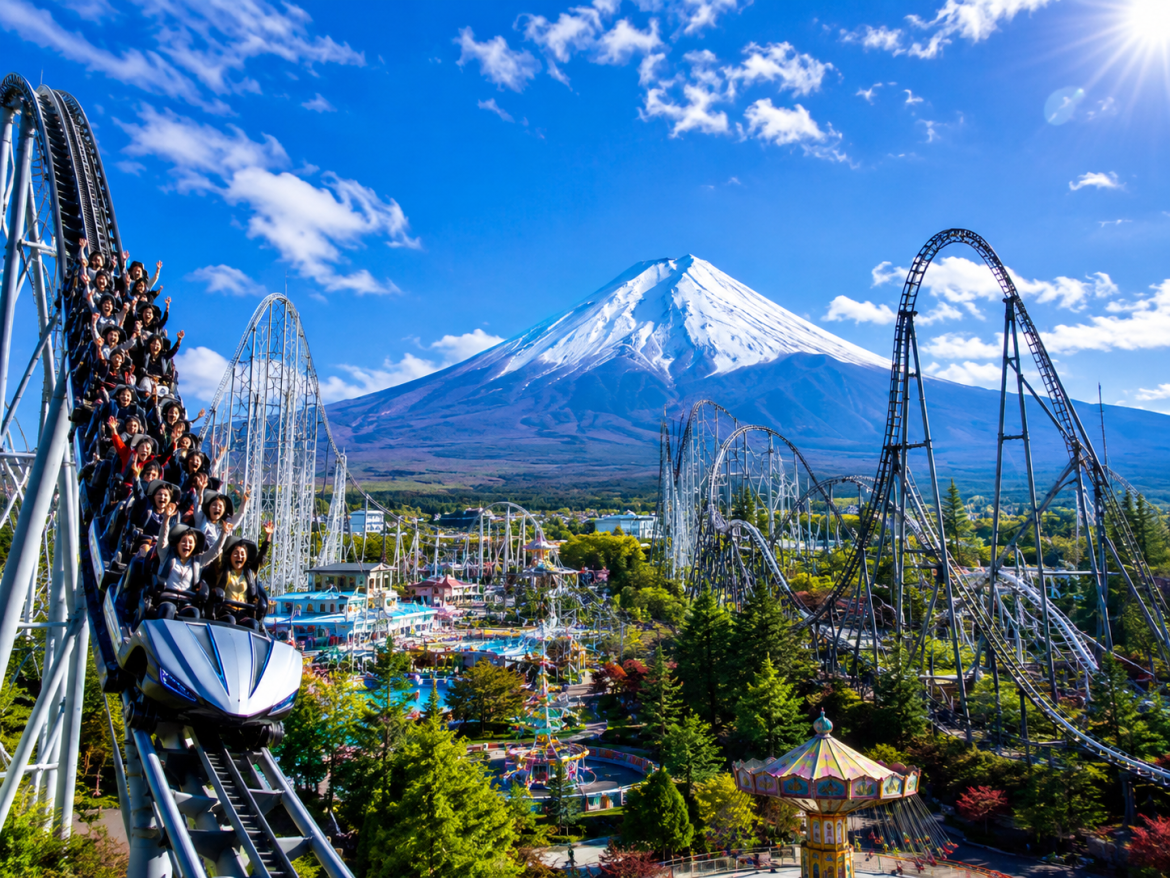
Fuji-Q Highland is worth visiting when extreme roller coasters are one of the main reasons for your Japan trip. Its strongest appeal is not simply the number of rides: it is the chance to experience some unusually intense coasters with Mount Fuji rising behind the park on a clear day.
The park is less convincing as a casual two-hour stop. Queues, weather-related suspensions and strict ride restrictions mean that visitors who arrive late without a plan may pay for a full-day pass but complete only a few headline attractions. For a first visit, treat Fuji-Q as either a full thrill-ride day, a dedicated Thomas Land family day or a carefully chosen afternoon visit—not as a minor stop between several Fuji Five Lakes attractions.
The most important current update is that Red Tower remains suspended for the time being because of demolition work affecting the surrounding area. Other attractions also have scheduled maintenance dates, and outdoor rides may stop because of wind, rain, lightning or low temperatures. Check both the monthly operating calendar and the live ride-status page before travelling.
Fuji-Q Highland itself has free admission, but free entry does not mean free rides. Visitors must obtain a free admission ticket and then purchase individual ride tickets, an afternoon pass, a Thomas Land Pass or a one-day unlimited-ride pass. Travellers who prefer an English booking interface can compare the current Fuji-Q Highland ticket and transport packages before choosing a date.
From Tokyo, the simplest independent route is normally a direct highway bus from Shinjuku, while the Fuji Excursion train is more predictable when expressway congestion is a concern. The two methods arrive at different sides of the park, so read the complete Tokyo to Fuji-Q Highland transportation guide before choosing a hotel or booking a return journey.
For most thrill-seekers, the smoothest plan is to arrive at least 30 minutes before the published opening time, enter through the gate serving your transport method, ride the highest-priority coaster immediately and use the official app to reorganize the rest of the day around live waits and suspensions.

Is Fuji-Q Highland Worth Visiting?
| Planning question | Editor’s assessment |
|---|---|
| Is it worth visiting? | Yes for serious coaster fans, anime attraction fans and families specifically interested in Thomas Land. It is less essential for travellers who dislike thrill rides. |
| Best suited to | Teenagers, adults who enjoy intense rides, groups of friends, and families planning a dedicated character-themed day. |
| Who may prefer to skip it? | Travellers with motion sickness, visitors unable to meet ride restrictions, and first-time Mount Fuji visitors who mainly want lakeside scenery. |
| Recommended duration | Seven to ten hours for a thrill-ride day; four to six hours for Thomas Land and family attractions; at least four hours for an afternoon visit. |
| Main highlight | A collection of distinctive high-intensity coasters, including FUJIYAMA, ZOKKON, Takabisha and Eejanaika. |
| Main disadvantage | Long and unpredictable waits combined with weather-sensitive outdoor rides. |
| Transport difficulty | Moderate. Direct buses are simple, while rail travel is more reliable but may cost more or require a transfer. |
| Children | Very suitable when the day is centred on Thomas Land and family rides. Less suitable when adults want to spend the entire day queueing for major coasters. |
| Older travellers | Possible as a family outing, but many headline rides have maximum-age, health and mobility criteria. |
| Accessibility | Park services are available, but each attraction has individual transfer, evacuation and companion requirements. |
| Overnight stay | Not necessary for a simple Tokyo day trip. Helpful for early entry, young children, a full opening-to-closing day or a second day around Lake Kawaguchiko. |
| Best time | A non-holiday weekday, arriving before opening. Clear, calm weather is more important than choosing a particular season. |
Fuji-Q should receive a full day in your itinerary when riding three or four major coasters is a priority. It is technically possible to combine the park with Lake Kawaguchiko, but doing so usually means sacrificing either morning ride capacity or relaxed lakeside sightseeing.
Visitors who want only one or two rides should take advantage of free park admission and buy individual tickets. A full one-day pass is most useful when you arrive early, meet the ride restrictions and intend to use multiple covered attractions.
Check whether your selected ticket package already includes a return bus before buying separate transport. Tickets, scheduled buses and private transfers are different products; choose the transport that fits your party. Verify the Fuji-Q stop, return time, age/height/health rules and ride closures. Priority access is not automatically included.
Essential Fuji-Q Highland Information
| Item | Current information |
|---|---|
| Official name | Fuji-Q Highland |
| Japanese name | 富士急ハイランド |
| Address | 5-6-1 Shinnishihara, Fujiyoshida, Yamanashi |
| Park admission | Free, but a free admission ticket must still be issued online or at the park. |
| Adult one-day pass | ¥6,000–¥7,900 depending on the visit date. |
| Adult afternoon pass | ¥4,100–¥6,000; valid from 1:00 PM. |
| Opening hours | Vary by date. Check the official monthly calendar rather than relying on generic hours. |
| Closed days | Irregular. Individual attractions also have separate scheduled closures. |
| Nearest railway station | Fuji-Q Highland Station on the Fujikyu Railway Line, beside Entrance 2. |
| Highway-bus arrival | The bus terminal beside Highland Resort Hotel & Spa, close to Entrance 1. |
| Recommended duration | Full day for major coasters; half day for selected family attractions or a limited ride plan. |
| Parking | Official paid parking is available. Charges vary by date, and vehicle-height rules differ between parking areas. |
| Lockers | Approximately 700 lockers, with different sizes and cash or cashless units available. |
| Stroller and wheelchair rental | Available from Entrances 1 and 2. A ¥1,000 cash deposit is collected and ¥500 is returned when the equipment is returned. |
The day-specific price is more important than the headline price range. A weekend or peak-season pass may cost considerably more than a quieter weekday pass, while the number of rides completed can be lower because of queues.
Latest Opening Status and Ride Closures
Red Tower remains suspended
Red Tower is suspended for the time being because of work connected with the demolition of the former Cool Japan facility. Do not include it in your ride plan until the park announces a reopening.
Major coasters have scheduled maintenance dates
The monthly operating calendar frequently assigns separate closure dates to FUJIYAMA, ZOKKON, Takabisha, Eejanaika and other attractions. A park operating day does not mean every major coaster will be available.
Before buying a non-refundable ticket, complete this three-step check:
- Confirm the park’s opening and closing time for your date.
- Read the scheduled ride-closure list for the same date.
- Check the live operating page again on the morning of the visit.
Weather can change the ride plan after arrival
Outdoor attractions may stop because of wind, rain, lightning, snow, ice or other operating conditions. A one-day pass is not normally refunded simply because one or more attractions are suspended.
This makes a flexible ride order essential. Do not spend an hour waiting for a coaster that has not begun operating when another priority ride already has a manageable queue.
Fuji-Q Highland Tickets: Which Option Should You Buy?
| Ticket option | What it includes | Best suited to | Main advantage | Main limitation |
|---|---|---|---|---|
| Free admission ticket | Entry to the park only | Non-riders, companions and visitors trying one or two attractions | No entrance fee | Every ride must be purchased separately |
| Individual ride tickets | One use of the selected attraction | Visitors planning no more than a few rides | Avoids paying for an unlimited pass that will not be used | Major attractions can cost around ¥2,000 each |
| One-day pass | Unlimited use of eligible attractions for the day | Early-arriving thrill-seekers and full-day family visitors | Best potential value for repeated rides | Some attractions and timed experiences are excluded |
| Afternoon pass | Eligible attractions from 1:00 PM | Overnight guests, shorter visits and days with late closing | Lower price than the full-day pass | Poor value when the park closes early or queues are long |
| Thomas Land Pass | A specified group of Thomas Land attractions | Families concentrating on the children’s area | Avoids paying for a park-wide pass that parents may not use | Not designed for a mixed coaster-and-Thomas itinerary |
| Early-admission one-day pass | One-day pass plus entry before general opening under the selected conditions | Visitors determined to complete several major coasters | Creates a valuable first-ride advantage | Availability, eligible rides and entry time vary |
| Priority ride ticket | Timed or accelerated access to one selected attraction | Peak-date visitors and travellers with only one day | Protects time for a must-ride attraction | Additional cost and limited availability |
| Ticket and bus package | Selected ride entitlement plus fixed round-trip transport | Tokyo day-trippers who want one booking | Reduces separate reservation work | Fixed bus times may not match changing park hours |
Best choice for a serious coaster day
Buy a one-day pass and arrive before opening. An early-admission package can be worthwhile on a busy date, particularly when several headline rides are operating and the additional cost is acceptable.
Best choice for one or two rides
Use free admission and purchase individual ride tickets. At approximately ¥2,000 for several major coasters, three or four individual rides can approach the cost of a lower-tier one-day pass, so calculate the total before entering.
Best choice for a family using Thomas Land
Compare the Thomas Land Pass with separate tickets based on the child’s height, age and likely stamina. A park-wide one-day pass may be unnecessary when the adults are not riding major attractions.
Best choice for an afternoon visit
The afternoon pass begins at 1:00 PM. It works best on a late-closing day when you already know which rides are operating. Do not buy it solely because an older guide says entry begins at 2:00 PM.
How priority tickets work
Online priority and timed tickets are normally released from 6:00 PM three days before the visit. Remaining inventory may be sold on the day near the attraction or at park information counters.
The haunted attraction, FUJIYAMA Walk and FUJIYAMA Slider use separate timed-ticket arrangements and should not be treated as automatically included in a standard unlimited-ride plan.
For an English-language overview of the currently selectable admission, afternoon, early-entry and transport packages, check the product conditions before choosing your date.
Best Time to Visit Fuji-Q Highland
| Arrival period | Crowd and ride conditions | Recommendation |
|---|---|---|
| 30–45 minutes before opening | Best chance of entering in the first wave | Recommended for anyone prioritizing major coasters |
| Opening to 11:00 AM | Most productive ride period | Complete one or two priority rides before browsing shops or eating |
| 11:00 AM–2:00 PM | Queues often build and restaurants become busier | Use live waits to decide whether to eat early or ride through lunch |
| After 1:00 PM | Afternoon-pass holders enter | Suitable only with a focused route and sufficiently late closing time |
| Final two hours | Some queues may shorten, but ride reception can close early | Useful for a final priority ride, but never rely on joining at the published closing time |
A non-holiday weekday is normally the safest choice. Nevertheless, weather and maintenance can matter more than weekday versus weekend. A calm but moderately busy day may deliver more completed coasters than a quiet day with strong wind.
Clear mornings offer the best chance of seeing Mount Fuji before cloud develops. The mountain view is a bonus, not a guarantee; plan the day around ride operations rather than waiting for perfect visibility.
The Correct First-Time Route
Step 1: Enter through the correct gate
- Highway-bus passengers normally arrive near Entrance 1 beside Highland Resort Hotel & Spa.
- Fujikyu Railway passengers arrive beside Entrance 2 at Fuji-Q Highland Station.
- Do not walk around the perimeter looking for the other entrance unless your ticket instructions specifically require it.
Step 2: Ride your highest-priority coaster first
Choose one must-ride attraction before entering. Do not begin by photographing the entrance, browsing shops or studying the entire map. On most days, the first hour has a larger effect on the final ride count than any later queue tactic.
A useful priority order for extreme-ride fans is:
- Eejanaika or ZOKKON
- Takabisha
- FUJIYAMA
- The remaining major coaster with the best live wait
- Haunted, challenge or indoor attractions during peak outdoor queues
This is not a fixed rule. If one coaster has a delayed opening, immediately switch to another rather than waiting beside a closed entrance.
Step 3: Check the app after the first ride
Use the official app to compare live waits and operating status. Walking across the park for a ride that has just suspended wastes more time than choosing a slightly less important attraction nearby.
Step 4: Eat outside the normal lunch peak
Eat before noon or after approximately 1:30 PM when practical. The middle of the day is also a good time for indoor attractions, character areas, shopping or a longer meal if the headline queues are already excessive.
Step 5: Protect the final ride
Ride reception may close before the park’s published closing time when the queue already extends beyond the operating period. Join the last essential queue well before the final hour.
Main Rides and Attractions
ZOKKON
ZOKKON uses motorcycle-style seating and multiple acceleration sections rather than relying only on one large first drop. It is a useful first priority because it is one of the park’s newer headline coasters and can develop a long queue quickly.
The current basic criteria include a height range of 120–195 centimetres and an age ceiling of 64. Additional health and evacuation requirements apply.
FUJIYAMA
FUJIYAMA is the classic large-scale coaster associated with the park. Its long layout, exposed height and potential Mount Fuji views make it more than a simple speed ride.
The minimum height is 110 centimetres, and riders must be 64 or younger. A child meeting the height requirement may still require an eligible companion.
Takabisha
Takabisha combines a launch, inversions and an unusually steep drop. The suspended pause before the main descent makes it feel different from a conventional launch coaster.
The minimum height is 125 centimetres, and the maximum eligible age is 54. This lower age ceiling is easy to miss when a multigenerational group buys passes together.
Eejanaika
Eejanaika is the most disorienting of the main coasters because the seats rotate while the train follows its own inversions. Travellers who are comfortable with ordinary roller coasters may still find this attraction significantly more intense.
Riders must generally be 125–200 centimetres tall and no older than 54. Secure every loose item exactly as instructed.
Labyrinth of Fear
The park’s large haunted-hospital attraction is a substantial experience rather than a brief dark ride. It requires a separate timed ticket and is not covered like an ordinary one-day-pass attraction.
Allow enough time before the selected entry slot and do not schedule a major coaster priority ticket immediately before or after it.
FUJIYAMA Tower
FUJIYAMA Tower gives non-coaster riders a way to experience elevated views, although access and operating conditions differ from the roller coaster. Certain tower activities have separate timed tickets and physical requirements.
Thomas Land
Thomas Land is the main reason Fuji-Q can work as a young-family destination. It contains multiple children’s rides, character scenery, dining and family facilities in a relatively concentrated area.
Families should still measure children before buying passes. Some attractions require an eligible companion, and a toddler may not be able to use every ride simply because it is inside the children’s area.
Anime and Character Areas
Naruto × Boruto Fuji Hidden Leaf Village, San-X Paradise and other character attractions give non-coaster visitors more to do. They are particularly useful when outdoor rides are suspended or different members of the group want separate experiences.
Walking, Queues and Physical Difficulty
Fuji-Q is not especially difficult because of steep terrain, but a full visit involves repeated walking between widely separated rides and long periods of standing in queues. The physical burden comes from duration rather than a continuous climb.
- Rail passengers have an extremely short walk from Fuji-Q Highland Station to Entrance 2.
- Highway-bus passengers arrive beside the Entrance 1 side of the park.
- Large luggage should be stored before joining a queue.
- Approximately 700 lockers are distributed around the entrances and park.
- Some rides require guests to transfer independently, brace themselves or follow a specific emergency-evacuation procedure.
- Summer heat can make exposed queues tiring even when the air temperature is lower than central Tokyo.
- Winter wind and ice can affect both comfort and outdoor ride operations.
Wear secure shoes. Loose sandals, high heels and footwear that cannot remain safely attached are a poor choice for an extreme-ride day.
Families, Older Travellers and Accessibility
Families with young children
Fuji-Q is family-friendly when the itinerary is built around Thomas Land rather than expecting children to wait while adults spend several hours in coaster queues.
- Stroller rental is available from Entrances 1 and 2.
- The rental stroller is a non-reclining B-type model intended for children from approximately seven months who can sit independently.
- Nursing rooms, diaper-changing facilities and children’s toilets are available.
- The Child Switch Plus system may help eligible families take turns using selected attractions without repeating the full process, subject to current conditions.
- Preschool children using many attractions require an eligible companion aged at least 12 who also meets the ride criteria.
A practical family plan is to spend the morning in Thomas Land, eat before the main lunch period and use one or two gentle attractions outside the area only if the child still has energy.
Older travellers
Older family members can enter free and enjoy character areas, dining, views and selected gentler attractions without purchasing a full pass. Do not buy every family member the same ticket automatically.
Several major attractions cap eligibility at age 64, while Takabisha and Eejanaika have a maximum age of 54. Health, body support and emergency-evacuation criteria may further restrict use even when the age rule is met.
Travellers with limited mobility
Wheelchair rental is available, and selected theatre-style attractions have designated wheelchair areas. However, each ride has separate transfer and evacuation requirements, and some elevated facilities include steps or emergency-stair conditions.
Visitors holding an eligible disability certificate can purchase a discounted one-day pass for themselves and one accompanying person at the entrance. This ticket is not sold online.
Groups needing door-to-door transport can compare a private transfer between Tokyo and Fuji-Q Highland. It is expensive for one or two passengers, but the cost becomes easier to justify for a group carrying luggage or mobility equipment.
How to Get to Fuji-Q Highland
| Method | Typical journey | Transfers | Reservation | Best advantage | Main disadvantage |
|---|---|---|---|---|---|
| Highway bus from Shinjuku | Approximately 1 hour 40 minutes under normal traffic | None | Strongly recommended | Direct arrival near Entrance 1 | Expressway congestion can delay both arrival and return |
| Fuji Excursion train | Approximately 1 hour 55 minutes from Shinjuku | Direct on selected services | Reserved seating required | More predictable than road transport | Higher fare and limited direct services |
| JR train plus Fujikyu Railway | Usually around 2.5 hours | Change at Otsuki | Not normally required for ordinary services | More departure flexibility | Transfer with luggage and separate non-JR fare |
| From Kawaguchiko Station | Only a few minutes by Fujikyu Railway | None after boarding | Not normally required | Easy for overnight Fuji Five Lakes visitors | Requires reaching Kawaguchiko first |
| Private transfer | Door-to-door from a Tokyo pickup point | None | Required | Best for luggage, children and groups | High cost and still affected by traffic |
| Self-drive | Approximately two hours or more from central Tokyo | None | Car booking recommended | Useful for a wider Fuji Five Lakes itinerary | Tolls, parking costs and severe holiday congestion |
Highway bus from Shinjuku
The direct highway bus is normally the easiest option for a one-day visit. Services leave Shinjuku Expressway Bus Terminal and stop at the Fuji-Q Highland bus terminal beside Highland Resort Hotel & Spa.
The bus delivers passengers close to Entrance 1, removing the need for a local transfer. The weakness is traffic: weekends, public holidays and peak travel periods can delay the journey and reduce the first hour of park time.
Reserved bus products are available through an English booking interface. Check the confirmed voucher carefully because departure point, stop name and schedule may differ between packages.
Compare current departure points and seat availability for the Tokyo–Mt. Fuji highway bus.
Fuji Excursion from Shinjuku
The Fuji Excursion limited express provides a direct railway journey from Shinjuku to Fuji-Q Highland Station on selected services. It arrives beside Entrance 2.
This route is more predictable than the highway bus during heavy traffic, but the train has reserved seating and limited direct departures. Book both directions rather than assuming a convenient return seat will remain available.
JR Chuo Line and Fujikyu Railway via Otsuki
Take the JR Chuo Line from Shinjuku toward Otsuki, then transfer to the Fujikyu Railway for Fuji-Q Highland Station.
The nationwide Japan Rail Pass covers only the eligible JR section, not the Fujikyu Railway sector. Do not describe this as a fully JR-covered journey.
From Lake Kawaguchiko
Fuji-Q Highland Station is only a short Fujikyu Railway journey from Kawaguchiko Station. This is the simplest arrangement for visitors staying overnight around the lake.
Use the Tokyo to Lake Kawaguchiko transportation comparison when deciding whether to base the entire Fuji-area trip around Kawaguchiko rather than returning to Tokyo after the park.
Self-driving
The park is close to the Kawaguchiko interchange and has several official parking areas. Parking charges change according to the date, and the Eejanaika-side parking area has a lower vehicle-height limit than the main FUJIYAMA parking areas.
Self-driving works best when Fuji-Q is part of a two-day Fuji Five Lakes itinerary. It is less attractive for a simple Tokyo return trip on a holiday because expressway congestion can erase the time saved by driving.
Realistic Fuji-Q Highland Itineraries
Full-Day Thrill-Ride Itinerary
Best for adults and teenagers who meet the major ride criteria.
- Arrive 30–45 minutes before opening.
- Enter and go directly to Eejanaika or ZOKKON.
- Check live waits and ride Takabisha or FUJIYAMA.
- Eat an early lunch before noon.
- Use an indoor or timed attraction during the longest midday queues.
- Complete the remaining headline coaster in mid-afternoon.
- Revisit the best ride or use FUJIYAMA Tower near the end of the day.
- Join the final essential queue well before reception closes.
Do not pre-plan every ride by clock time. One weather suspension can make the schedule obsolete; prioritize by live operating status instead.
Family and Thomas Land Itinerary
Best for preschool and elementary-school children.
- Enter near opening and go directly to Thomas Land.
- Complete the child’s two most anticipated rides first.
- Use character-photo and playground periods between rides.
- Eat before the main lunch rush.
- Return to Thomas Land for remaining age-appropriate attractions.
- Add the Ferris wheel, character areas or a gentle park attraction if energy permits.
- Leave before the child becomes overtired rather than forcing a closing-time finish.
Afternoon-Pass Itinerary
Best for overnight visitors entering from 1:00 PM on a late-closing day.
- Check live ride status before buying the pass.
- Enter at 1:00 PM and ride the shortest-wait headline attraction.
- Use one indoor attraction during the busiest period.
- Target two additional priority rides in late afternoon.
- Join the final queue before early reception closure becomes possible.
This plan is not recommended when the park closes early, a must-ride coaster is scheduled to close, or several outdoor attractions are already suspended.
Two-Day Fuji-Q and Kawaguchiko Itinerary
Day 1: Travel from Tokyo to Kawaguchiko, visit the lakeside area and stay near Kawaguchiko Station or Fuji-Q Highland.
Day 2: Enter Fuji-Q before opening, spend the full day in the park and return to Tokyo in the evening or stay a second night.
This is the least stressful arrangement for families and travellers who want both lake scenery and a proper coaster day.
Nearby Attractions and Sensible Combinations
Lake Kawaguchiko
Lake Kawaguchiko is the most logical nearby destination, but it deserves at least half a day. Combine it with Fuji-Q only when you are using an afternoon pass, staying overnight or visiting the park mainly for Thomas Land and a few selected attractions.
A full coaster day followed by a rushed lake visit usually produces the worst version of both experiences.
Chureito Pagoda
Chureito Pagoda is reachable through Shimoyoshida Station, but the climb to the viewpoint adds significant physical effort. It belongs on a separate morning or on the non-park day of an overnight itinerary.
Mount Fuji 5th Station
Mount Fuji 5th Station is not beside Fuji-Q Highland despite the similar destination wording. It requires separate road transport and is best scheduled on another day.
Use the Tokyo to Mount Fuji 5th Station transportation guide to avoid confusing Fuji-Q Highland Station, Fujisan Station and the mountain’s 5th Station.
Mount Fuji day tours
Most general Mount Fuji coach tours do not provide enough time for a meaningful Fuji-Q visit. Compare the best Mount Fuji day tours from Tokyo only when your priority is sightseeing rather than riding several coasters.
Is the Mt. Fuji Pass worthwhile?
The regional Mt. Fuji Pass can make sense when the itinerary includes Fujikyu Railway journeys, sightseeing buses and several listed Fuji Five Lakes attractions in addition to Fuji-Q.
It is normally unnecessary for a single direct Tokyo–Fuji-Q day trip. Check the exact duration, Fuji-Q entitlement and included transport before comparing it with a standalone park pass.
Travellers building a multi-day regional itinerary can review the current Mt. Fuji Pass inclusions.
Seasonal and Weather Planning
Spring
Spring can provide comfortable temperatures and clear scenery, but school holidays and public-holiday periods increase demand. Mountain weather remains cooler than central Tokyo, especially in the morning and evening.
Summer
Summer brings long operating days on selected dates, but exposed queues can be hot. Carry water, use sun protection and take indoor breaks. Afternoon thunderstorms can temporarily stop outdoor attractions.
Autumn
Autumn often combines cooler temperatures with Fuji-area scenery. Weekends during the foliage period can produce heavy road congestion around Kawaguchiko, so railway travel becomes more attractive.
Winter
Winter can provide clear Mount Fuji views, but wind, ice, snow and low temperatures may affect ride operations. Wear layers that remain secure on rides rather than carrying loose scarves and accessories.
Rain and strong wind
Do not assume that every attraction closes in light rain. Indoor rides, theatres, character facilities and selected covered attractions may continue operating.
Nevertheless, the park does not generally refund a one-day pass simply because outdoor rides stop. When the forecast is poor and the major coasters are your only reason to visit, changing the date before buying a non-refundable ticket is safer than hoping conditions improve.
Food and Meal Strategy
Fuji-Q has restaurants, cafés, food stands and themed dining areas. The best meal time depends on the ride queues rather than a fixed restaurant recommendation.
- Eat before noon when the park is busy.
- Use the lunch period for indoor attractions when coaster waits peak.
- Carry a small snack for long queues, but follow ride rules about food and loose belongings.
- Families using Thomas Land should eat near the children’s area instead of crossing the entire park during a tired period.
- Do not schedule a heavy meal immediately before Eejanaika or another highly disorienting attraction.
For a regional meal outside the park, hōtō noodles are a practical Yamanashi choice. Eating after leaving the park is easier for overnight visitors than for travellers rushing to a reserved Tokyo bus.
Should You Stay Overnight?
An overnight stay is not essential when taking an early direct bus or reserved train from Tokyo and returning after a standard full day.
Staying overnight improves the trip when:
- You want to use an afternoon pass on arrival day.
- You are travelling with young children.
- You want early admission without leaving Tokyo before dawn.
- You plan to visit Lake Kawaguchiko on a separate half day.
- You want a second chance for clear Mount Fuji views.
- Your group wants to avoid a two-hour return journey after an exhausting ride day.
Highland Resort Hotel & Spa is the most convenient choice for the Entrance 1 and highway-bus side. Hotels around Fuji-Q Highland Station suit railway passengers, while Kawaguchiko Station provides a better balance of restaurants, local buses and lake sightseeing.
A private vehicle becomes more attractive for a larger group staying overnight. A private customizable Fuji-Q Highland trip from Tokyo can reduce transfer work, but admission is not automatically included and the high price rarely makes sense for solo travellers.
First-Time Mistakes to Avoid
1. Assuming free admission includes rides
The park has no entrance fee, but every attraction requires an individual ticket or valid pass.
2. Buying a one-day pass for a non-rider
Companions can use free admission while paying only for any attractions they decide to try.
3. Following the old 2:00 PM afternoon-pass rule
The current afternoon pass begins at 1:00 PM.
4. Ignoring the scheduled ride-closure calendar
A major coaster may be closed for maintenance even though the park itself is open.
5. Arriving at the wrong entrance
Highway buses use the Entrance 1 side, while Fuji-Q Highland Station connects with Entrance 2.
6. Arriving at the published opening time
By the time entry procedures are complete, the first major coaster queue may already be substantial.
7. Assuming every unlimited pass covers every attraction
The haunted attraction and several timed experiences require separate tickets.
8. Ignoring maximum ages
Takabisha and Eejanaika have an age ceiling of 54, while several other major rides permit riders through age 64.
9. Carrying large luggage around the park
Use the lockers near the entrances before entering long queues.
10. Treating Lake Kawaguchiko as a quick extra stop
A proper lake visit requires several hours. Combining it with a full coaster day creates an unnecessarily rushed itinerary.
11. Booking only the outbound transport
Return buses and reserved trains can sell out. Secure the complete journey before finalizing the park ticket.
12. Expecting a refund after weather closures
Outdoor ride suspensions do not normally produce a general one-day-pass refund.
Fuji-Q Highland FAQ
Is Fuji-Q Highland admission free?
Yes. You must still obtain a free admission ticket, and rides require separate tickets or a valid pass.
How much is the adult one-day pass?
The current adult range is ¥6,000–¥7,900 depending on the selected date.
What time does the afternoon pass begin?
It is valid from 1:00 PM.
Should I buy tickets in advance?
Advance booking is recommended for weekends, holidays, early admission, transport packages and any visit built around limited priority tickets.
Can I buy tickets at the entrance?
Yes, standard passes and individual tickets are normally available on site, subject to operating conditions and availability.
Are all attractions included in the one-day pass?
No. The haunted attraction and certain timed experiences require separate tickets, and other exclusions may apply.
How long should I spend at Fuji-Q Highland?
Allow a full day for major coasters and four to six hours for a family-focused Thomas Land visit.
What is the best ride to visit first?
Choose either Eejanaika or ZOKKON based on live operating status and which one matters more to your group.
Is Fuji-Q suitable for young children?
Yes when the visit is centred on Thomas Land and gentler attractions. Measure the child and check companion rules before buying a pass.
Can I bring a stroller?
Yes. Strollers can also be rented from Entrances 1 and 2, although the rental model is non-reclining.
Is Fuji-Q suitable for older travellers?
It can be enjoyable as a family outing, but many thrill rides have maximum-age and health restrictions.
Is Fuji-Q wheelchair accessible?
General park services and selected wheelchair areas are available, but each attraction has separate transfer and evacuation criteria.
Are wheelchairs available to rent?
Yes. Rental is available at Entrances 1 and 2 with a cash deposit.
Can I store a suitcase?
Yes. The park has approximately 700 lockers in several sizes, although very large luggage may exceed the available dimensions.
What station should I use?
Use Fuji-Q Highland Station on the Fujikyu Railway Line. Do not confuse it with Fujisan Station or Mount Fuji 5th Station.
Is the highway bus or train better?
The highway bus is simpler and usually cheaper. The train is preferable when traffic reliability is more important.
Can Fuji-Q and Lake Kawaguchiko be visited on the same day?
Yes, but only as a limited park visit or an overnight itinerary. A full coaster day and a proper lake visit should normally be separated.
Do rides operate in rain?
Some indoor and weather-resistant attractions may continue, while outdoor coasters can suspend operation.
Will I receive a refund when rides close?
Do not expect a general one-day-pass refund because individual attractions stop for weather or operational reasons.
Is parking available?
Yes. Official parking is available, with charges varying by date and vehicle restrictions differing between lots.
Is the Mt. Fuji Pass worth buying?
Only when combining Fuji-Q with enough covered regional transport and Fuji Five Lakes attractions. It is rarely necessary for a single Tokyo return trip.
Is Fuji-Q possible as a day trip from Tokyo?
Yes. Reserve an early direct bus or train and secure the return journey before travelling.
Final Recommendation
Fuji-Q Highland is one of the strongest theme-park choices in Japan for travellers who deliberately want extreme roller coasters. FUJIYAMA, ZOKKON, Takabisha and Eejanaika provide sufficiently different experiences to justify a dedicated day rather than a brief visit.
The park is also worthwhile for families when expectations are reset around Thomas Land, character attractions and gentler rides. Parents should not build a child’s day around waiting for adults to complete every major coaster.
The most important planning step is checking the date-specific operating calendar. Red Tower remains suspended, other major attractions rotate through scheduled maintenance, and outdoor rides may stop after arrival because of weather.
For a first visit from Tokyo, reserve a direct highway bus when simplicity matters or the Fuji Excursion when road-delay risk is the greater concern. Arrive before opening, use the entrance serving your transport and select one must-ride attraction before entering.
A one-day pass is the correct choice for an early, full-day ride plan. Individual tickets are better for one or two rides, while the 1:00 PM afternoon pass is useful only on a sufficiently long operating day.
Visitors continuing to Lake Kawaguchiko should stay overnight rather than compressing both experiences into a rushed day. For broader Tokyo planning, compare this visit with the best day trips from Tokyo and the complete Tokyo travel guide before committing an entire day.
Book in advance when travelling on a weekend, during a holiday, using early admission, reserving a direct bus or depending on a specific priority ride. On quieter dates, standard admission is straightforward—but checking closures before payment remains essential.