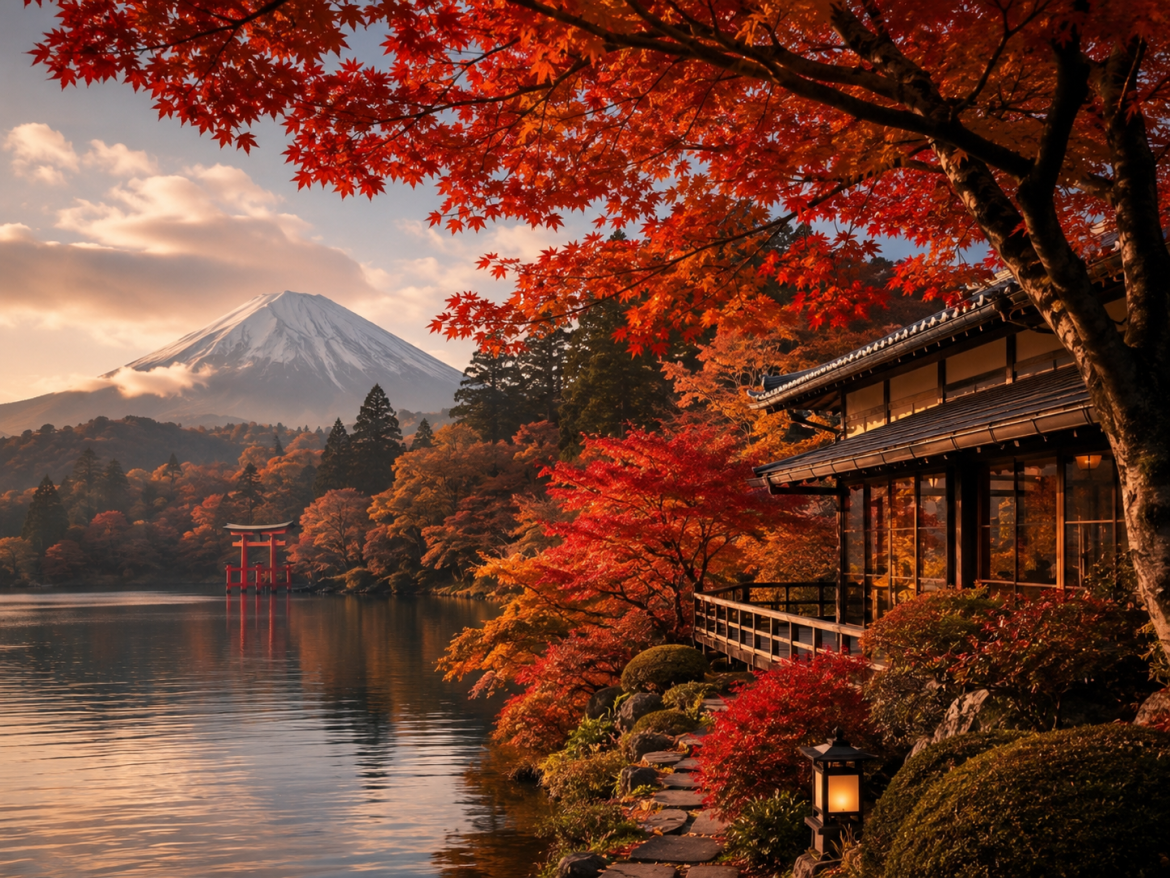
Hakone is worth an autumn trip if you want mountain scenery, hot springs and distinctive transport in the same journey. The attraction is the combination: a climbing railway, garden maples, the volcanic landscape of Owakudani, a ropeway and a cruise on Lake Ashi. It is a whole region rather than a single foliage park beside a station.
For a first visit, reserve a full day and choose at most one garden or museum alongside the main loop. An overnight stay is more comfortable for families, older travellers, photography or a proper onsen break. Two or three spare hours from Tokyo are not enough for the complete route. Any seven-to-nine-hour local sightseeing allowance below is a suggested sightseeing allowance, not a transport promise.

What changes for autumn 2026?
Hakone Museum of Art is fully closed through 29 October 2026. The museum has confirmed a partial reopening on 30 October, including the new café and annex exhibition room; the renovated main exhibition building opens on 23 December. Do not read the October date as a full reopening. Online tickets for the partial-opening period went on sale on 1 October: adults ¥1,000, high-school/university students ¥500, junior-high-school children and younger free. Check the garden areas and opening calendar for your actual date.
Museum partial-opening and ticket notice · Renovation and phased reopening
The Hakone Ropeway’s normal published hours are 09:00–17:00 from February to November and 09:00–16:15 in December and January. Weather, volcanic-gas conditions and maintenance can affect service. These are operating hours, not a suggestion to begin the whole route just before closing. Check operations in the morning and the final cruise and onward connection again during the afternoon.
Official ropeway hours · Current service status
When to see autumn leaves in Hakone
Hakone’s seasonal overview describes an overall early-November to early-December season, progressing from Lake Ashi and Sengokuhara toward lower Hakone-Yumoto. Higher slopes may begin changing in late October. These are broad historical planning windows, not confirmed peak dates for every stop in 2026. Different elevations and tree species make a single “best day” misleading.
Swipe to compare →
| Planning period | Area to watch | How to use it |
|---|---|---|
| Late October | Higher slopes, Sounzan and the Lake Ashi area | Look for early colour; do not assume full peak |
| Early to mid-November | Lake Ashi, Sengokuhara and Gora | Compare current reports before choosing lake or garden priority |
| Mid to late November | Gora, Miyanoshita and railway-side valleys | A garden and railway day may be a good fit |
| Late November to early December | Tonosawa, Hakone-Yumoto and lower valleys | Keep plans flexible as leaves may already have fallen elsewhere |
A weekday in November is a reasonable starting point for planning, but check the date on the leaf-condition report itself. A live-looking page can still contain last season’s images. Avoid treating a city specimen-tree forecast for Tokyo as a forecast for Hakone’s mountains. Wind and heavy rain can change the view quickly.
Official Hakone leaf-condition reports · Official seasonal overview
Tickets, reservations and the Hakone Freepass
There is no single admission ticket for “Hakone autumn leaves”. Public lakeside and mountain scenery can be enjoyed without a foliage-event ticket, while trains, cable cars, the ropeway, cruises, paid gardens, museums and onsen each have their own charges. Reserve the long-distance train and accommodation first; a transport pass does not reserve a seat on every local service.
The Hakone Freepass covers designated transport including the Hakone Tozan railway and cable car, Hakone Ropeway, Hakone Sightseeing Cruise pirate ships and specified bus routes. It does not cover every bus company or every cruise on Lake Ashi. The Odakyu section outside the free-travel area is one return journey, while the designated local area permits repeated rides. The Romancecar limited-express supplement is extra.
Swipe to compare →
| Starting point | 2 days, adult | 3 days, adult | Best fit |
|---|---|---|---|
| Shinjuku | ¥7,100 | ¥7,500 | Returning to Shinjuku via Odakyu |
| Odawara | ¥6,000 | ¥6,400 | Arriving by JR or Shinkansen separately |
These fares took effect on 1 October 2025. A day-tripper can use the two-day version, but convenience is not the same as guaranteed savings. If you only visit Yumoto and Gora, compare ordinary fares. If you ride the ropeway, pirate ship and several other covered services, compare the complete day’s cost. Attraction discounts do not mean all museums are free.
Official Freepass coverage and fares · Compare the Hakone Freepass option
Getting to Hakone from Tokyo and the airports
From Shinjuku
A direct Odakyu Romancecar to Hakone-Yumoto avoids changing trains and is convenient for travellers based around Shinjuku. Pick a service that actually goes to Hakone-Yumoto, rather than assuming every Romancecar does. The journey is broadly around 80–100 minutes depending on the train. You need the underlying fare or valid pass plus the reserved limited-express ticket; check both parts when buying.
From Tokyo Station or Shinagawa
Use a Tokaido Shinkansen that stops at Odawara, then transfer toward Hakone-Yumoto. This can be more logical than travelling across Tokyo to Shinjuku if you are staying near Tokyo Station or Shinagawa. The Shinkansen portion is separate from the Hakone Freepass. If using a JR pass, verify the exact pass and permitted train; do not assume the local Hakone railway is included.
From Haneda or Narita
From Haneda, travelling via Shinagawa and Odawara is one practical rail approach. Narita requires a longer journey into Tokyo before the onward transfer. If your flight arrives around midday or later, make arrival at the hotel the objective and begin the loop the following morning. Immigration, luggage and a mountain transfer are enough without trying to catch every afternoon attraction.
The Golden Course and its seven main foliage stops
The classic sequence is Hakone-Yumoto → mountain railway to Gora → cable car to Sounzan → ropeway via Owakudani to Togendai → pirate ship to Hakonemachi or Motohakone → bus back toward Yumoto. You can reverse it, but that is not a guaranteed crowd shortcut: a busy road, cruise queue or ropeway delay can affect either direction. Check the official route map before deciding.
1. The mountain railway to Gora
The climbing railway is part of the experience: woodland, valleys, short tunnels and mountain stations create changing views from the carriage. A particular side of the train cannot guarantee the best foliage, and at busy times you may stand. Keep doors clear, and photograph only from safe public station areas; never enter the tracks or stop in a road for a train shot.
2. Gora’s gardens and museums
Gora Park combines a fountain garden, seasonal plants, tea and craft activities. Wheelchairs and strollers cannot be used inside because of steep slopes and steps. If you rely on them, choose an alternative with confirmed accessible routes. Koen-Shimo is useful for the main gate; Koen-Kami serves the higher side and is also convenient for Hakone Museum of Art. Confirm which gate is open rather than assuming every route is step-free.
For autumn 2026, Gora Park’s published March–November hours are 09:00–17:00, last entry 16:30. Ordinary adult admission is ¥650, while a valid Hakone Freepass gives free admission. Paid craft activities and refreshments are separate. Hakone Museum of Art’s moss-and-maple composition is a different attraction: use the partial-reopening details above and allow a proper garden visit rather than treating it as a quick photo outside the gate.
3. The ropeway from Sounzan
The ropeway provides a broader view of slopes and volcanic terrain than the gardens. Transfer at Owakudani for the Togendai section. On a clear day there may be views toward Mount Fuji and Lake Ashi, but cloud can erase them completely. Do not block fellow passengers while taking photographs through reflective glass. Bring a wind-resistant outer layer even if central Tokyo feels warm.
4. Owakudani
Owakudani is most distinctive for pale volcanic ground, steam and autumn hillsides rather than a close-up maple tunnel. Allow roughly 45–60 minutes if you want viewpoints, toilets, a snack or the famous black eggs; this is a planning suggestion and queues can change it. Follow the marked public areas and operator restrictions. In low visibility, a shorter stop may leave more useful time for a garden or the lake.
5. Togendai and the Lake Ashi pirate ship

Togendai is the ropeway-to-cruise transfer point. The pirate-ship journey to Hakonemachi or Motohakone is roughly 25–40 minutes depending on the port and sailing. Pick the correct destination before joining the queue. Ordinary-class travel is sufficient for the lake scenery; a special cabin upgrade is a separate choice, not necessary for autumn viewing. The open deck can be cold and windy, so families need not remain outside throughout.
The Hakone Sightseeing Cruise pirate-ship regular ticket is for travel between these ports. It is not the separate Lake Ashinoko Pleasure Cruise product. If you already hold a valid Freepass, check the included ordinary-class sailing before buying a second ticket. A boat ticket alone does not include the ropeway or access to Owakudani.
6. Motohakone and Hakone Shrine
The lakeshore around Motohakone gives you space to pause after the transport-heavy part of the loop. Hakone Shrine involves walking and stone steps, which can be slippery after rain. The photograph queue for the lakeside Peace Torii is different from visiting the shrine itself; you do not have to join it simply to pay your respects. Keep worship and pedestrian routes clear. If the line is long, choose a different lakeside view instead of sacrificing the return bus.
7. Hakone-Yumoto and Tonosawa
The lower valleys often provide later colour than the lake and high slopes. Yumoto and Tonosawa suit a shorter trip focused on riverside views, a hot-spring visit, cafés and shopping. This is also a reasonable reduced plan if the weather prevents a full loop. Choose a particular onsen’s opening and admission conditions first rather than assuming every ryokan accepts day visitors.
Gora Park hours and access limitations · Separate Hakone Ropeway ticket · Pirate-ship regular-class ticket
Half-day, full-day and overnight itineraries
A Gora half-day if you are already in Hakone
From Yumoto, travel to Gora, choose Gora Park and one museum if time and opening arrangements permit, then leave room for a café or onsen before returning. Roughly four to five local hours is a suggested allowance. You are deliberately leaving out Owakudani and the lake, which reduces transfers. A half-day starting in Tokyo leaves much less sightseeing time and should not be advertised as a relaxed full Hakone visit.
A first-visit Golden Course day
Swipe to compare →
| Part of day | Plan | Decision point |
|---|---|---|
| Early morning | Travel from Tokyo to Hakone-Yumoto | Reserve a suitable train; store luggage |
| Morning | Mountain railway → Gora; at most one garden/museum | If delayed, shorten or omit the added attraction |
| Late morning / lunch | Sounzan → Owakudani | Check ropeway status before continuing |
| Early afternoon | Togendai → pirate ship → Motohakone or Hakonemachi | Match the actual sailing and destination |
| Later afternoon | Short lakeside walk; shrine only if time remains | Protect the bus-to-train transfer buffer |
This is a sequence, not a timetable. Choose actual services from the operator’s schedule and do not reserve dinner or another time-critical activity immediately after the expected Tokyo arrival. If the main goal is maple photography, a Gora-focused day may be more rewarding than completing every form of transport. A reverse loop starts with a bus to the lake, but it still needs the same weather and last-service checks.
Two days with an onsen stay
Day 1: Tokyo → Yumoto → Gora → one garden or museum → your accommodation. Day 2: Sounzan → Owakudani → Togendai → Lake Ashi cruise → a short Motohakone walk → Yumoto → Tokyo. This separates the transport-heavy sections and creates room to adjust for weather. If your hotel is beside the lake or in Sengokuhara, rearrange the order around its actual bus stop rather than travelling back to Gora just to follow the example.
Check hotel dinner times and the last shuttle before committing to late photography. A room in “Gora” is not automatically a level walk from the station, and an onsen area name does not guarantee frequent evening buses. Send luggage ahead only after confirming the service’s acceptance time and the hotel’s participation; otherwise use a verified storage option.
Photography without chasing every viewpoint
For close-up colour, choose the museum’s moss garden when open or Gora Park’s fountain area. For scale, use the ropeway and Owakudani’s public viewpoints. For water and mountain compositions, allow time at Lake Ashi and Motohakone. A lakeside overnight stay makes an early walk more practical than a Tokyo day trip, but no time of day guarantees Mount Fuji visibility.
Keep tripods and bags out of narrow paths, protect a camera strap on the windy deck and do not lean out of transport for a shot. At the shrine, respect worshippers rather than treating the path as a studio. If cloud obscures Fuji, switch to reflections, bark, moss and leaf detail instead of waiting so long that you lose the last connection.
Who should shorten the loop?
Families and older travellers
The railway, ropeway and pirate ship can be enough entertainment for children without adding several museums. Use a lighter plan and allow rest and toilet stops before queues. Gora’s slopes and shrine steps can make a stroller awkward. For limited mobility, check exact station facilities, hotel access and the usable garden route with the venue; “family-friendly” does not mean universally step-free. An overnight itinerary with one main area each day is often easier than completing the entire loop from Tokyo.
Rain, strong wind or suspended transport
Light rain may still allow a short garden visit, but heavy rain is a reason to switch the structure of the day. The Hakone Open-Air Museum has indoor galleries, yet much of its sculpture landscape and some children’s spaces are outdoors; it is not an entirely indoor bad-weather refuge. Hakone Museum of Art’s moss garden is also outside, and its 2026 partial reopening limits what you should expect. Consider an indoor exhibition at Okada Museum, a café or a confirmed day-use onsen instead. Check each venue’s current hours separately.
A Freepass does not make a closed ropeway operate or guarantee a replacement bus with immediate capacity. If high-ground transport stops, choose a lower-area itinerary and follow operator instructions. Do not start an unfamiliar hiking detour as a shortcut, especially near volcanic restricted areas.
Driving and optional side trips
A car can help with dispersed places around Sengokuhara, Choanji or the western lakeshore, but it does not remove peak-season road queues or parking shortages. If your whole plan is the Golden Course, driving can also create the problem of returning to the parked car. Leave time for that return rather than assuming you can finish at a different port. Odawara Castle is better considered on a flexible overnight return day than after a rushed full loop.
If adding the old Tokaido on foot, note that the Hatajuku-Yamane section is scheduled to close from 17 August 2026 to 15 January 2027 for work. The stone-paved section and milestone area there cannot be visited during the closure. Follow the published detour; this does not mean the whole Golden Course is shut.
Official old-Tokaido closure notice
Food, shopping and where to stay
Yumoto is the practical place to group meals and souvenirs: soba, yuba dishes, onsen buns, kamaboko and local craft shops are useful options. Gora works for cafés, light meals or a ryokan dinner; Owakudani is better treated as a viewpoint with a snack stop than a guaranteed fast lunch. Around Motohakone, choose a lakeside meal only if its opening hours fit the onward bus. Popular restaurants can have queues, so eat before you become committed to a tight cruise connection.
Buy bulky souvenirs near the end at Yumoto instead of carrying them through every transfer. If staying at a ryokan, an included dinner has a service window; arriving late can be more consequential than missing one photo stop. Do not assume an isolated hotel has a late restaurant or that a shuttle runs without advance arrangement.
Swipe to compare →
| Base | Why choose it | Check before booking |
|---|---|---|
| Hakone-Yumoto | Simpler arrival, luggage and Tokyo connection | Actual walk or shuttle from the station |
| Gora | Gardens, museums and an onsen-focused night | Steep final approach and dinner time |
| Motohakone / Lake Ashi | An early lakeside walk and possible Fuji views | Evening access and bus frequency |
| Sengokuhara | A quieter highland or art-focused stay | Bus route and last service without a car |
Choosing tickets and tours without buying twice
Choose independent transport or a guided day trip first. A full Freepass can overlap with separate ropeway and pirate-ship tickets, while a Romancecar supplement remains separate. A sightseeing tour is a different product with fixed stops and limited time; its starting price does not necessarily include every ride, meal or preferred guide language.
A Fuji-and-Hakone day tour is not automatically a Kawaguchiko Momiji Corridor tour. Compare the actual stops, guide language, meeting point, ride inclusions, extra costs and return conditions. Do not assume a tour includes the full Hakone loop and unhurried Kawaguchiko foliage time in the same day.
Hakone autumn leaves FAQ
Is one day enough?
For a selected route, yes. Leave Tokyo early, choose no more than one garden or museum and protect the final transport connections. Two days is more comfortable if hot springs or photography matter.
Do I need a foliage reservation?
Not for the region’s public autumn scenery itself. Reserve specific trains, accommodation and any attraction or experience that requires it. Paid gardens still need their own valid admission or pass benefit.
Does the Freepass include the Romancecar?
It can cover the eligible basic fare when you hold the correct departure-area version, but the reserved limited-express supplement must be bought separately. An Odawara-area pass does not pay for Tokyo–Odawara travel.
Is Hakone Museum of Art fully open from 30 October 2026?
No. The announcement describes a partial opening; the main exhibition room returns on 23 December. Check the garden and annex access for your visit date.
Can I combine Hakone and Kawaguchiko?
Use two or three days for meaningful foliage time in both. Driving or a tour still faces road delays. The full Golden Course plus Kawaguchiko’s corridor is too much for a relaxed same-day public-transport itinerary.
Is Mount Fuji guaranteed?
No. Weather determines visibility. Choose Hakone because the gardens, volcanic landscape, lake and onsen are worthwhile even when Fuji is hidden.
Are the photographs on the official foliage-status page from 2026?
Not necessarily. Check the photograph’s date and location before using it to plan your day; last season’s colour is not today’s condition.
Can I use a stroller or wheelchair in Gora Park?
The park says wheelchairs and strollers cannot be used because of its steep slopes and steps. If you depend on them, choose an alternative with a confirmed accessible route.
Does the Freepass cover every boat on Lake Ashi?
No. It covers the designated Hakone Sightseeing Cruise pirate ships in ordinary class. Check the operator, port and cabin category; another company’s lake cruise is not interchangeable.
Can drivers finish the loop at a different port?
Yes, but they still need a practical way back to the parked car. Include the parking location, its opening hours and the final return connection; driving does not remove autumn road queues.
Should I fix the return train before planning lake photography?
Confirm the train and its connection from that day’s boat and bus services first. The bus to Yumoto is exposed to road delays, so do not create a tight final-sailing-to-reserved-train connection.
Does a route on the Golden Course map guarantee it is operating?
No. The map explains geography and connections, not live availability. Weather, volcanic gas, maintenance and timetables still matter. Check service status that morning and reduce the route when needed.
Tickets and experiences
Compare your Hakone pass coverage before buying separate ropeway or boat tickets. Check your date, exact inclusions and cancellation terms before buying a separate experience.
Official information and locations
Use the route map to trace Odawara and Hakone-Yumoto to Gora, then the cable car to Sounzan and the ropeway via Owakudani to Togendai. The yellow ship links Togendai with Hakonemachi and Motohakone; coloured bus routes help plan the return. This is the operator’s 1 April 2026 reference map, not a live departure board or proof of step-free access.

Further trip planning
Plan your arrival station and luggage with the Tokyo to Hakone transport guide.
Build the rest of your trip around your arrival station, luggage and onward connections rather than adding another distant area to the same day.