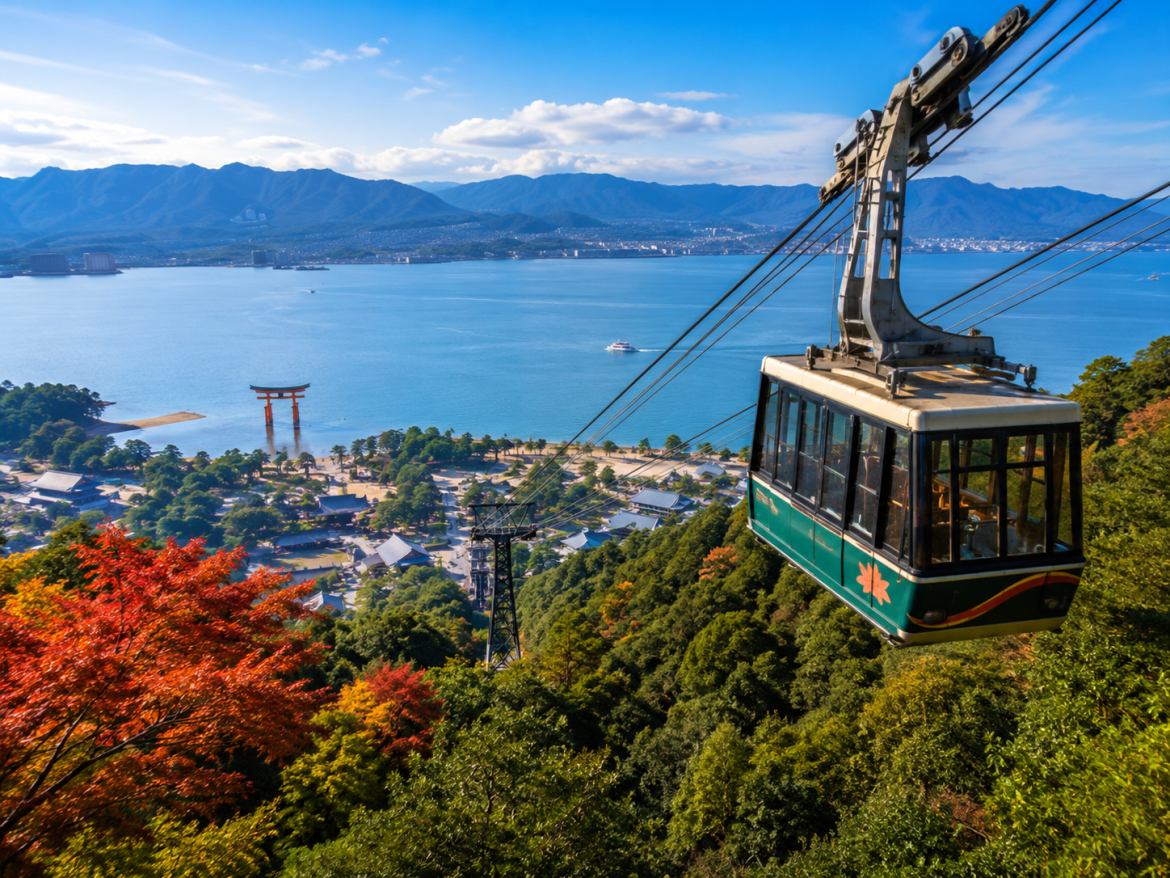
The Miyajima Ropeway is worth considering when you have enough time to leave the shrine waterfront behind and see the Seto Inland Sea from above the forest. On a clear day, the outlook from Shishiiwa can be the highlight of an island visit. You do not have to climb to Mount Misen’s summit to enjoy it.
The important distinction is between riding the ropeway and hiking the summit. The ropeway ends at Shishiiwa Station. The summit is a separate walk with slopes and stone steps, including climbing on the return leg. Plan around your slowest walker, the weather and the last downhill service.
Allow roughly two hours from Miyajima’s ferry pier for the ropeway and Shishiiwa viewpoint, or three to three-and-a-half hours when continuing to the summit. These are planning allowances, not guaranteed completion times. For the mainland journey and the rest of the day, start with the Hiroshima to Miyajima guide.

Is the Miyajima Ropeway worth it?
| Your situation | Recommended plan |
|---|---|
| Clear weather and a full island day | Ride early; decide at Shishiiwa whether to continue to the summit |
| Only two or three hours on Miyajima | Prioritize the shrine, torii waterfront and food street |
| Good views without a mountain hike | Make Shishiiwa your destination |
| Interested in woodland, temple culture and walking | Add the summit route with appropriate footwear and spare time |
| Poor visibility, strong wind or thunderstorms | Choose lower-level island sights and follow suspension notices |
| Need step-free access | The ropeway is not a suitable step-free summit route |
The ropeway takes a meaningful part of the day once walking, tickets, both cable-car sections and queues are included. If your main goal is Itsukushima Shrine at a particular tide, give that visit enough time first rather than treating Mount Misen as a compulsory extra.
A guided tour can help with transport and walking logistics, but these products are not standalone ropeway tickets. Check the actual route, departure city, language, meeting point and inclusions. A Hiroshima-and-Miyajima tour does not automatically include the ropeway or summit.
Understand the two ropeway sections
The journey runs from Momijidani to Kayatani, where everyone changes cars, and then from Kayatani to Shishiiwa. The first section uses small circulating gondolas; the second uses larger cars that depart at intervals. Changing at Kayatani is part of the normal journey, not an optional stop.
| Section | Ride time | What to allow for |
|---|---|---|
| Momijidani–Kayatani | About 10 minutes | Ticket checks, queue and shared eight-person gondolas |
| Kayatani–Shishiiwa | About 4 minutes | Transfer and waiting for the larger car |
| Shishiiwa–Mount Misen summit | About 30 minutes on foot each way | Uneven slopes, steps and extra time for stops |
Adding the two ride times does not give a reliable door-to-door estimate. A practical allowance for reaching Shishiiwa from Momijidani is around 20–30 minutes in ordinary conditions, longer when busy. Use the official mountain route map to distinguish the upper station, nearby viewpoint and summit.
Reservations: required on designated dates
Advance reservations are required on the operator’s designated busy dates, rather than every day. Check your actual date on the official homepage and follow its link to the boarding-reservation calendar. Booking normally opens three months ahead.
The reservation controls an uphill boarding time at Momijidani; it is not the same as buying a ropeway ticket. Keep your booking confirmation and leave time to buy or present the ticket. Aim to reach the lower station at least 10–15 minutes early as a planning buffer, rather than arriving at the island pier at your reserved time.
On ordinary dates, you can buy a ticket and join the queue. “No reservation required” does not mean “no waiting.” Even with an uphill slot, there can be queues at the ticket counter, transfer station and downhill station. Avoid making multiple overlapping reservations; use the system’s change or cancellation process.
Hours, last descent and maintenance
The ordinary operating hours currently listed are 09:00–16:00 uphill, with the last downhill service at 16:30. Check the day’s operating notice before leaving Hiroshima. Strong wind, thunder, inspections and other disruptions can stop the service, including after you have planned or reserved a visit.
Build the day backwards from the downhill deadline. Do not begin a summit walk close to the last descent, and keep a generous margin for returning to Shishiiwa and joining the queue. A round-trip ticket is not a promise that the ropeway will remain open beyond its operating hours.
Maintenance notices are date-specific. The published June 22–July 16, 2026 maintenance closure is a past period, not a reason to assume a later trip is cancelled. Use current notices for your travel date, and never assume next year’s maintenance will follow the same dates.
Tickets, fares and payment
| Ordinary ticket | Adult | Child |
|---|---|---|
| Return | ¥2,000 | ¥1,000 |
| One way | ¥1,100 | ¥550 |
Child fares apply to elementary-school-age children. One accompanying preschool child aged one to under six travels free per guardian; additional children need the relevant fare. Check the official fare conditions for your party, including any documented discount eligibility.
A return ticket is the uncomplicated choice for most first visits. Buy one way only if you have deliberately planned the remaining journey on foot, know the route and have suitable footwear, water, daylight and weather. A spontaneous descent to save a small fare difference can turn a sightseeing day into a much longer hike.
Momijidani accepts credit cards, supported transport IC cards and listed cashless options. Shishiiwa does not accept cashless payment, so carry yen if you may need to buy a downhill ticket there. Discount products may have different payment rules from ordinary tickets.
Is the ferry-and-ropeway bundle better value?
Miyajima Matsudai Kisen’s Enjoy Ticket combines its return ferry, the visitor tax and a return ropeway journey. It costs ¥2,100 for adults or ¥1,100 for children; both prices include the tax. The saving against buying those elements separately is ¥400 per adult or ¥200 per child.
Buy it before crossing, at the Matsudai counter in Miyajimaguchi. The listed selling hours are 08:30–15:00, with validity for two days including purchase. It is not sold on the island, during December 31–January 3, or when maintenance and other operating restrictions prevent sale. A bundle does not replace a designated-day ropeway reservation.
If you already hold a valid JR pass, compare carefully: the bundle uses Matsudai, while your included crossing is on the separate JR ferry. For tram travellers, the Hiroden streetcar-and-ferry day pass has a same-day ropeway return discount of ¥1,500 adult or ¥750 child, paid in cash at Momijidani. The tram-only day pass does not qualify. The Hiroshima transport pass guide helps compare the wider journey.
Getting from Miyajima Pier to Momijidani
From the island ferry terminal, walk toward the shrine waterfront and Momijidani Park, then continue uphill to the lower ropeway station. Allow approximately 25–30 minutes without shopping stops; it can take longer with children or a slower walking pace. The official access page and island map show the lower station and shuttle boarding point.
The free shuttle is from the park entrance
The shuttle runs between the Momijidani Park entrance and the ropeway station. It is not a bus directly from the ferry pier. The current uphill timetable begins at 09:50, generally at approximately 20-minute intervals, with a midday break. Check the published times; this does not solve access for a 09:00 ropeway start. Give priority to older passengers, people with disabilities and small children, as the operator requests.
Keep walking as your fallback if the shuttle is full or suspended. Leave large luggage at your accommodation or a suitable storage facility before starting uphill. A small day bag is easier to handle during the walk, station stairs and shared gondola ride.
What boarding and the transfer feel like
At Momijidani, complete ticketing and any reservation check before joining the uphill line. You may share the first gondola with other groups. Forest and valley views change as the car climbs; a particular seat or unobstructed photography position is not guaranteed.
At Kayatani, leave the first car and follow staff directions to the second section. The current larger gondolas carry up to 35 passengers, with departures generally every 5–15 minutes. Keep the transfer route clear and use the stop to check your return-time margin, rather than treating it as a lengthy sightseeing break.
At Shishiiwa, look at the weather and the downhill queue before deciding on the summit. The original plan can still change here. Turning back after the nearby viewpoint is a complete ropeway visit.
Shishiiwa viewpoint: enough without the summit?
For many visitors, yes. The viewpoint near the station gives a broad outlook over the Seto Inland Sea without the additional summit walk. Around 15–30 minutes is a useful starting allowance for looking around and photographs, adjusted to visibility and crowds.
Do not equate “near the station” with a fully barrier-free attraction. There are still station stairs and outdoor walking. If the view disappears into cloud, waiting briefly may be reasonable, but do not use up the time needed for a safe return.
For photographs, be considerate in shared cars and on the viewpoint. Avoid blocking doors, steps or narrow paths. Look for a clear view rather than moving into an unsafe position or holding up other walkers.
Walking from Shishiiwa to Mount Misen
The summit path takes roughly 30 minutes each way for a suitably mobile walker. Allow at least an hour for the return walk and add time for rests, photographs and any temple stops. It is not a flat promenade: descending on the outward route means climbing some of the same slopes on the way back.
The area around Misen Hondo and the summit combines religious history, woodland and large rock formations. That variety is the reason to continue, rather than simply trying to reach a higher viewpoint. Follow current signs around temple areas. Reikado burned down in May 2026. The temple’s October 2026 notice describes a reconstruction-prayer ceremony at the former hall site, so do not expect to enter the intact historic building. Consult the operator’s current notices rather than treating an older map label as an access guarantee.
Wear shoes with grip, carry water and a layer for changing weather, and keep the return route in mind. Skip the summit if the path is slippery, your party is tired, you are already late, or a fixed train connection leaves no margin. Do not improvise a full mountain descent because you missed the ropeway.
How much time should you set aside?
| Plan | Practical allowance | Main limitation |
|---|---|---|
| Momijidani–Shishiiwa return and viewpoint | About one hour before significant queues | Both ropeway sections and waiting |
| Ferry pier–Shishiiwa visit | Around two hours or more | Island walking and ticketing |
| Ferry pier–ropeway–summit visit | Around three to three-and-a-half hours or more | Hiking pace, breaks and downhill queues |
These allowances are alternatives, not a schedule to follow minute by minute. Peak foliage weekends can need substantially more buffer. If the day is slipping, shorten the summit plan or stay at Shishiiwa instead of speeding up on steps or sacrificing the last-descent margin.
Best time of day, autumn and evening visits
An early ropeway visit leaves more room for queues, weather changes and the rest of Miyajima. If the shrine at a particular tide matters more, build around that time and select an achievable ropeway slot. Clear skies are more important to the mountain view than a fixed month or supposedly perfect photography hour.
Autumn colour adds interest in Momijidani Park, but brings greater demand. Peak colour shifts with the weather each year. Check foliage conditions and the reservation calendar separately: a promising colour forecast does not tell you whether a booking is required.
Ordinary service is not a sunset or night-view operation. Special events are exceptions with their own arrangements. For example, the operator announced a limited night event for October 19–23, 2026; its lottery applications have already closed. This does not extend ordinary hours on other dates or permit a walk-in night visit. Never wait for sunset at the summit on the assumption that a daytime return ticket includes a late descent.
What to do in rain or poor visibility
Light rain does not automatically close the ropeway, but the outlook can disappear in low cloud and paths become slippery. Strong wind or thunder can lead to suspension. Decide from actual conditions and the operator’s notices, not merely from having already bought a ticket.
If a mountain trip no longer makes sense, keep the day on the lower island: shrine corridors, the shopping street, the aquarium or a shorter waterfront walk. Leave room to change plans. The cost of a ropeway visit is also the time spent reaching it and waiting, not just the ticket price.
Children, older visitors and accessibility
Families with school-age children can enjoy the ropeway, but the summit should depend on stamina and weather. With young children, prepare for the uphill approach and carrying what you need; a stroller does not make this a step-free outing. Older travellers may prefer to stop at Shishiiwa and take their time.
The operator states there are no elevators. Strollers and wheelchairs cannot be used in their normal occupied form on the circulating ropeway and are held at the Momijidani office. Anyone who depends on a wheelchair should discuss the actual access requirements with the operator before committing to a trip. The summit path has further slopes and stone steps.
Pets are not permitted; assistance dogs covered by the operator’s exception may accompany their users. Travelling with a family or older companion is a reason to leave more time, not to assume every person must complete the summit.
A realistic ropeway and shrine day
| Part of the day | Suggested order |
|---|---|
| Early morning | Arrive on Miyajima, walk to Momijidani and use your reserved slot if required |
| Morning | Ride both sections; choose Shishiiwa alone or the summit return walk |
| Late morning or lunch | Descend, then eat around the shrine or shopping street |
| Afternoon | Itsukushima Shrine and torii views, adjusted to the tide |
| Remaining time | Daisho-in or shopping, then ferry back to Miyajimaguchi |
For shrine opening and tide planning, use the Itsukushima Shrine guide. If the ideal tide or your ropeway reservation falls later, swap the order only when there is still sufficient mountain time. This is a flexible outline, not a promise that every stop fits.
A detailed Peace Memorial Museum visit, Miyajima’s shrine, shopping and a Mount Misen summit hike are too much for a relaxed single day. Choose which matters most, or split city and island sightseeing across two days using the Hiroshima travel guide.
Guided tours and transport passes
For independent ropeway travel, use the official reservation system on designated dates and buy the appropriate ticket or bundle. Tours solve a different problem: guiding, getting between locations and managing a fixed itinerary. Read each option carefully before paying.
If Mount Misen is your main goal
Compare the existing Miyajima day-tour option below, checking whether your selected departure actually includes Mount Misen, the ropeway, ferries and meals. Do not assume that every product labelled “Miyajima” includes a summit walk.
If you want Hiroshima and Miyajima in one day
A combined city-and-island tour may suit limited time, with less flexibility for tides or hiking. Confirm the meeting city and transport included. The ropeway may not be part of the route.
If you are travelling from Kansai
A JR Kansai–Hiroshima Area Pass can be useful for eligible longer-distance rail journeys and the JR Miyajima Ferry, but does not include the ropeway. Do not buy a large regional pass solely to save on one local island trip.
The Visit Hiroshima Tourist Pass is a separate option for eligible trams, buses and ferries. Check the selected pass’s coverage and tax treatment; it is not a ropeway ticket.
Food and where to stay
Momijidani Station is not the main restaurant area. It is usually easier to return toward the shrine and Omotesando for anago rice, oysters and momiji manju. Eat when your descent and the restaurants’ opening hours make sense rather than fixing an ambitious lunch time before allowing for queues.
Staying on Miyajima makes an early walk to the ropeway easier and gives quieter island evenings. Miyajimaguchi keeps you close to the ferry; Hiroshima offers more restaurant and onward-transport choices. Compare the Miyajima accommodation guide and where to stay in Hiroshima. For regional food ideas, see the Hiroshima food guide.
Miyajima Ropeway FAQ
Does a reservation include the ticket?
No. It is an uphill boarding-time reservation. You still need a valid ropeway ticket or qualifying bundle, and time for ticketing.
Does the ropeway go directly to Mount Misen’s summit?
No. It ends at Shishiiwa. The summit requires a separate walk of roughly 30 minutes each way over slopes and steps.
Can I take a shuttle straight from the ferry?
No. The free ropeway shuttle starts at the Momijidani Park entrance, after an island walk. Its current uphill timetable starts at 09:50, so plan to walk for an earlier ropeway visit.
Can I pay by card at the top?
Shishiiwa does not accept cashless payments. Carry cash if buying a downhill ticket there; ordinary tickets at Momijidani have more payment options.
Should I buy a one-way ticket and walk down?
Only with a deliberate hiking plan and enough daylight, suitable shoes and weather. It should not be a last-minute response to queues or an attempt to save a little money without checking the route.
Is Shishiiwa enough for an older companion?
It can be a good stopping point for someone comfortable with the station stairs and approach walk. The mountain summit is optional, and the ropeway is not fully accessible.
Can I combine it with Hiroshima sightseeing?
Yes, but a summit walk uses much of the island day. For a more relaxed visit, choose either an in-depth city visit or the mountain, or give each a separate day.
Final recommendation
Choose the Miyajima Ropeway for clear-weather sea views and a change from the waterfront. Reserve when your date requires it, compare the ferry bundle with any pass you already hold, and start with a realistic return-time margin. Shishiiwa is a worthwhile destination in its own right; continue to Mount Misen only when your party, the weather and the clock all allow it.