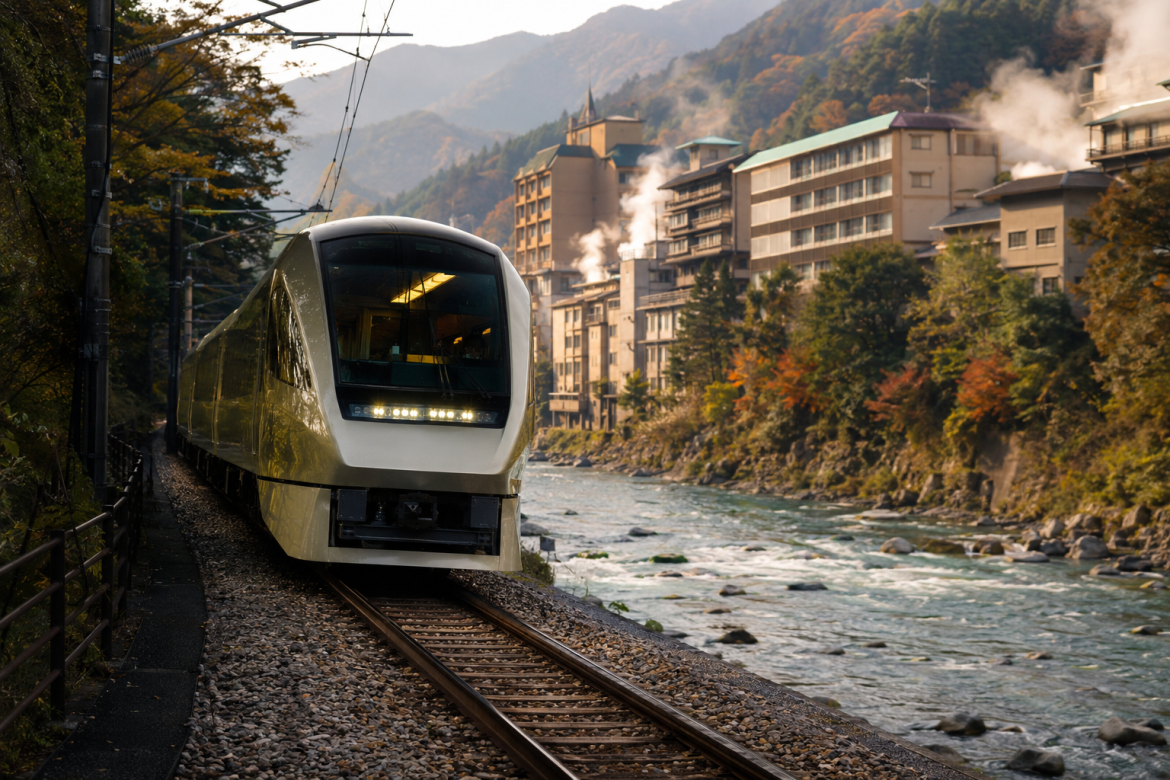

Tokyo to Kinugawa: Match the Train to Your Ryokan
The best way to travel from Tokyo to Kinugawa Onsen is usually a reserved-seat Tobu limited express from Asakusa. The journey takes roughly two hours, requires little or no transferring and brings you directly to the central station of one of Tochigi’s best-known hot-spring resorts.
However, Asakusa is not automatically the best departure point for everyone. Travelers staying in Shinjuku or Ikebukuro may prefer the JR–Tobu limited express, while visitors planning several day trips around greater Tokyo may save money with the JR TOKYO Wide Pass. Budget travelers can use ordinary Tobu trains, although the extra transfers and longer journey make that option less attractive for a short trip.
The first mistake many visitors make is searching only from Tokyo Station. Tokyo Station does not have a direct train to Kinugawa Onsen. The useful departure stations are Tobu Asakusa, Kita-senju, Shinjuku and Ikebukuro, depending on the train and where your Tokyo hotel is located.
The second common mistake is assuming that the train journey ends at the ryokan entrance. Kinugawa’s hotels stretch along both sides of a steep river valley. Some are within ten minutes of Kinugawa Onsen Station, while others require a hotel shuttle, local dial bus, taxi or a walk of 20 minutes or more.
For most first-time visitors, the smoothest plan is to reserve a direct or one-transfer limited express from Asakusa, arrive in the early afternoon and stay one night at a ryokan. Travelers also visiting central Nikko should read the Tokyo to Nikko transportation guide before deciding whether to visit Nikko before or after Kinugawa.
Is Kinugawa Onsen Worth the Journey from Tokyo?
| Question | Practical Answer |
|---|---|
| Is it worth visiting? | Yes for an overnight ryokan stay, a quieter break from Tokyo or a trip combining hot springs with Nikko-area attractions. |
| Best overall route | Tobu limited express from Asakusa to Kinugawa Onsen. |
| Typical journey time | About two hours from Asakusa or Shinjuku, before the final hotel transfer. |
| Typical one-way fare | About ¥3,240 from Asakusa for a standard reserved-seat normal-period example; premium seats and peak-period trains can cost more. |
| Best route from western Tokyo | JR–Tobu limited express from Shinjuku or Ikebukuro if its limited daily schedule fits your itinerary. |
| Cheapest route | Ordinary Tobu trains from Asakusa or Kita-senju, generally with two or more transfers. |
| Biggest difficulty | Choosing the correct train and completing the final transfer from Kinugawa Onsen Station to the ryokan. |
| Suitable for families? | Yes. Reserved seats, toilets and direct trains make the route family-friendly. |
| Suitable for seniors? | Yes, especially when using a limited express followed by a hotel shuttle or taxi. |
| Day trip or overnight? | A day trip is possible, but one night is much more rewarding if the main purpose is an onsen ryokan experience. |
| Best seasons | Autumn for valley colors, winter for a quieter hot-spring stay and spring for mild sightseeing weather. |
Kinugawa is less suitable for travelers who only want to take one quick bath and immediately return to Tokyo. With approximately four hours of return train travel, the destination offers better value when paired with a ryokan stay, Tobu World Square, Edo Wonderland, Ryuokyo Canyon or a second day in Nikko.
Latest Tokyo–Kinugawa Transport Situation
Use the current Tobu limited-express timetable for your travel date. Train destinations and operating days vary; special services may not run daily, and timetable publication is not a guarantee of disruption-free operation.
Do not assume that every SPACIA X, Kegon or Revaty service reaches Kinugawa Onsen. Many trains terminate at Tobu Nikko. A train with “Nikko” in its name may still require a transfer at Shimo-imaichi, while a Kinugawa-bound service may continue toward Shin-fujiwara or Aizu.
The direct bus between central Nikko and Kinugawa Onsen is not a dependable daily connection. Under the current published arrangement, it operates on Saturdays, Sundays and public holidays. On weekdays, use the Tobu train through Shimo-imaichi.
Train schedules can also change during holiday periods, autumn foliage season and severe weather. Check the exact train number, destination and operating date shortly before departure.
Tokyo to Kinugawa Onsen Route Comparison
| Route | Approximate Time | Transfers | Typical Adult Fare | Best For |
|---|---|---|---|---|
| Tobu limited express from Asakusa | About 2 hours | 0–1 | ¥3,240 normal-period Kinu/Revaty example | Most first-time visitors |
| JR–Tobu limited express from Shinjuku or Ikebukuro | About 2 hours | Usually 0 | ¥4,140 published ordinary-seat reference | Travelers staying in western Tokyo |
| Ordinary Tobu trains | About 2.5–3.5 hours | Usually 2–3 | About ¥1,590 from Asakusa | Budget travelers with flexible time |
| Car | About 2.5–3 hours in normal traffic | None | Tolls, fuel and parking vary | Families visiting several rural attractions |
Best Overall Route: Tobu Limited Express from Asakusa
For most international visitors, Tobu Railway offers the simplest journey:
Tobu Asakusa Station → Tobu limited express → Kinugawa Onsen Station → hotel shuttle, dial bus, taxi or walk
Direct services normally take around two hours. Other departures require one straightforward transfer at Shimo-imaichi. Because every limited express seat is reserved, you do not need to compete for a seat after boarding.
Which Asakusa Station Do You Need?
Use Tobu Asakusa Station, located in the Ekimise building beside the Sumida River.
Do not confuse it with:
- Tokyo Metro Asakusa on the Ginza Line and Toei Asakusa on the Asakusa Line
- Tsukuba Express Asakusa Station, which is farther west
Tokyo Metro Asakusa Station is close enough to walk to Tobu Asakusa, but they are separate stations with separate ticket gates. Allow at least 10–15 minutes for the transfer when carrying luggage.
Which Tobu Limited Express Should You Take?
| Train | Main Advantage | What to Check |
|---|---|---|
| SPACIA X | Premium interiors, larger seat choices and a more memorable journey | Only selected departures continue to Kinugawa Onsen |
| Kinu | Traditional direct Kinugawa limited express | Operating frequency and seasonal fare category |
| Revaty Kinu or Revaty Aizu | Modern reserved-seat train with through services toward Kinugawa and Aizu | Correct train section and destination |
| Kegon or SPACIA X to Tobu Nikko | Useful when paired with a transfer at Shimo-imaichi | It does not directly reach Kinugawa Onsen |
SPACIA X is worth considering when its schedule fits naturally and you want the train journey to feel like part of the holiday. Standard seats are sufficient for most travelers; premium seats and private compartments are better suited to couples, families or groups prioritizing comfort.
The current SPACIA X ticket page includes Asakusa–Kinugawa Onsen services. Check both the destination and the complete fare displayed at checkout.
What Happens at Shimo-imaichi?
Shimo-imaichi is the junction where the line divides toward Tobu Nikko and Kinugawa Onsen. If your train is not direct, follow the signs for the Tobu Kinugawa Line, Kinugawa Onsen, Shin-fujiwara or Aizu.
Do not automatically follow passengers heading to Tobu Nikko. Check the platform display and train destination. When using a coupled Revaty train, confirm that your reserved car continues toward Kinugawa rather than another branch.
Best Route from Shinjuku and Ikebukuro
Selected JR–Tobu limited expresses run directly from Shinjuku through Ikebukuro and Omiya to Kinugawa Onsen. The trip takes about two hours and costs approximately ¥4,140 one way for an ordinary reserved seat.
This route is particularly attractive when you are staying near:
- Shinjuku
- Ikebukuro
- Omiya
- Hotels along the JR Yamanote or Saikyo lines in western Tokyo
The main disadvantage is frequency. These trains are not an hourly service, and there may be only a small number of useful departures on your travel date. Build your itinerary around the train rather than arriving at Shinjuku and expecting the next departure to leave soon.
Where to Buy the Shinjuku–Kinugawa Ticket
Buy JR–Tobu through-service tickets through JR channels such as JR East ticket offices, reserved-seat machines or Eki-net. Tobu’s own online limited express service mainly handles journeys within the Tobu network and should not be assumed to sell the JR through train.
Suica or PASMO alone is not sufficient for this direct limited express. You need the correct base fare and reserved-seat ticket covering the cross-company journey.
What Is the Best Route from Tokyo Station?
There is no direct Kinugawa Onsen train from Tokyo Station. Choose one of these routes:
Option 1: Tokyo Station to Asakusa
Tokyo Station → Ueno by JR → Asakusa by Tokyo Metro Ginza Line → walk to Tobu Asakusa → limited express to Kinugawa Onsen
This is usually the most flexible choice because Tobu Asakusa has more limited express departures than Shinjuku.
Option 2: Tokyo Station to Kita-senju
Tokyo Station → Kita-senju by JR or Tokyo Metro → board a Tobu limited express that stops at Kita-senju
This can reduce the need to backtrack into Asakusa, but you must reserve a train that calls at Kita-senju.
Option 3: Tokyo Station to Shinjuku
Tokyo Station → Shinjuku by JR Chuo Line → JR–Tobu limited express to Kinugawa Onsen
This route is worthwhile only when the direct departure fits. Otherwise, traveling across Tokyo to Shinjuku may take longer than going to Asakusa.
Best Routes from Popular Tokyo Districts
| Tokyo Area | Recommended Departure | Reason |
|---|---|---|
| Asakusa or Tokyo Skytree | Tobu Asakusa | Direct access and the widest choice of Tobu limited expresses |
| Ueno | Tobu Asakusa | Short Ginza Line journey to Asakusa |
| Shinjuku | JR Shinjuku | Direct JR–Tobu train when available |
| Ikebukuro | JR Ikebukuro | Selected direct trains stop here |
| Shibuya | Asakusa or Shinjuku | Ginza Line reaches Asakusa directly; JR reaches Shinjuku quickly |
| Ginza | Tobu Asakusa | Direct Ginza Line connection to Asakusa |
| Tokyo Station or Marunouchi | Asakusa or Kita-senju | More timetable flexibility than crossing Tokyo to Shinjuku |
Travelers still deciding where to stay can compare departure convenience in the Tokyo accommodation area guide.
Cheapest Route from Tokyo to Kinugawa Onsen
The cheapest rail journey uses ordinary Tobu trains rather than a reserved limited express. From Asakusa, the basic fare is approximately ¥1,590 one way.
A typical journey may involve transfers at Minami-kurihashi and Shimo-imaichi, although the exact route changes by departure time. Expect approximately 2.5–3.5 hours and ordinary commuter-style seating for much of the journey.
This option is reasonable when:
- You are traveling on a strict budget
- You are not carrying large luggage
- You are staying overnight and do not need to maximize sightseeing time
- You are comfortable checking Japanese platform displays and transfers
It is not the best choice for a day trip. Saving roughly ¥1,500–¥2,000 each way can cost one to three additional hours across the return journey.
Tokyo to Kinugawa Onsen Tickets: What Do You Actually Need?
Tobu Limited Express from Asakusa
You need two fare components:
- A basic fare ticket from your departure station to Kinugawa Onsen
- A limited express ticket for your reserved seat
The basic fare can be covered by a normal ticket, an accepted IC card arrangement or a suitable Tobu pass. The reserved-seat supplement must still be purchased separately unless it is explicitly included in the product you selected.
When Can You Reserve?
Tobu limited express tickets normally go on sale at 9:00 one month before the travel date. Same-day reservations are possible when seats remain, but waiting until the station is risky during:
- Weekends
- Public holidays
- Autumn foliage season
- New Year and major holiday periods
- Popular SPACIA X departure times
Booking the outbound and return trains together is strongly recommended for a day trip.
Which Rail Pass Is Best for Kinugawa Onsen?
| Ticket or Pass | Current Adult Price | Kinugawa Coverage | Limited Express Included? | Best For |
|---|---|---|---|---|
| Point-to-point Tobu tickets | Depends on train | Yes | Purchased separately | One simple return journey |
| NIKKO PASS All Area | ¥8,000 | Yes | No | Kinugawa plus Nikko, Lake Chuzenji or several local journeys |
| NIKKO PASS World Heritage Area | ¥3,000 | Yes, Tobu railway to Kinugawa and Shin-Fujiwara | No | Two-day Nikko temples and Kinugawa stay |
| JR TOKYO Wide Pass | ¥16,000 | JR–Tobu through trains and specified local Tobu sections | Ordinary reserved seats on eligible through trains | Several expensive trips within three consecutive days |
| Japan Rail Pass | Varies | Does not fully cover the Tobu section | No for a Tobu-only Asakusa journey | Travelers already making extensive nationwide JR journeys |
NIKKO PASS All Area
The four-day NIKKO PASS All Area covers one round trip between Asakusa and Shimo-imaichi plus unlimited travel on eligible Tobu trains and buses across the wider Nikko and Kinugawa region.
Choose All Area for the wider bus network, Lake Chuzenji or Okunikko. The cheaper World Heritage Area pass also covers the Tobu railway to Kinugawa Onsen and Shin-Fujiwara; Kinugawa alone is not a reason to buy the ¥8,000 version.
The limited express reserved-seat supplement is not included. You still need to reserve and pay for the limited express portion separately.
The NIKKO PASS Digital Ticket currently offers both the two-day and four-day versions. Compare the two-day World Heritage Area and four-day All Area versions according to your bus journeys and trip length.
JR TOKYO Wide Pass
The JR TOKYO Wide Pass is valid for three consecutive days and covers ordinary reserved seats on eligible JR–Tobu through limited expresses from Shinjuku, Ikebukuro and Omiya.
It can be worthwhile when Kinugawa is combined with other expensive trips such as a Shinkansen journey, a ski trip or another long-distance excursion covered by the pass. It is usually poor value when Kinugawa is your only journey outside central Tokyo.
The pass does not cover Tobu-only limited expresses departing from Asakusa. Choose your departure route before buying the pass.
Does the Japan Rail Pass Cover Kinugawa Onsen?
Not completely. Kinugawa Onsen is on the Tobu Railway network, so a nationwide Japan Rail Pass does not automatically cover a Tobu-only limited express from Asakusa.
Even on a JR–Tobu through service, the private-railway portion may require an additional payment. Do not board assuming that showing a JR Pass will cover the entire journey.
SPACIA X: Is It Worth Paying More?
SPACIA X is worth considering when you value the journey itself, want a premium seat or are traveling as a family or group that can use a compartment. The train offers several seating categories that are more distinctive than an ordinary limited express.
It is not automatically the fastest option, and not every SPACIA X departure reaches Kinugawa Onsen. Some operate only between Asakusa and Tobu Nikko.
Choose SPACIA X when:
- A direct Kinugawa departure matches your hotel check-in time
- You want a scenic, comfortable start to an overnight trip
- You are celebrating a special occasion
- You need a private or semi-private seating arrangement
Choose a standard Kinu or Revaty service when the timetable is more convenient. A less glamorous train that arrives at the correct time is usually the better travel decision.
From Kinugawa Onsen Station to Your Hotel
Kinugawa Onsen Station is the main transport hub, but it is not the entrance to the entire resort. Hotels and ryokan are spread north and south along the river.
Walk
Walking is suitable when the hotel is within approximately 5–15 minutes and you have light luggage. Check whether the route crosses a bridge or includes a slope before leaving the station.
A hotel described as “near Kinugawa Onsen” may still be 20–30 minutes away on foot. Do not judge the distance only from the property name.
Hotel Shuttle
Many larger ryokan provide a scheduled shuttle. Some require advance reservations, while others meet selected limited express arrivals. Contact the property before travel and confirm:
- Whether advance booking is required
- The pickup location
- Which train arrivals are covered
- Whether the shuttle can carry large luggage
- The return schedule on checkout day
Hotel Dial Bus
A local hotel dial bus connects Kinugawa Onsen Station with participating accommodation. It normally departs from bus stop 5 and is primarily designed around afternoon check-in times rather than continuous all-day service.
Do not rely on it for an early-morning arrival, a late-night train or every hotel in the valley. Check that your property participates and confirm the current timetable.
Taxi
A taxi is the simplest final transfer when traveling with large suitcases, small children or a traveler with limited mobility. The ride to many central properties takes only several minutes, although northern hotels are farther away.
Kinugawa Onsen Station or Kinugawa Koen Station?
Kinugawa Onsen Station is the central station and the best default choice. It has the main tourist facilities, taxi access, buses, lockers, elevators and more limited express services.
Kinugawa Koen Station is farther north and may be closer to some northern hotels. Before buying the final ticket, check the hotel’s official access instructions rather than automatically selecting Kinugawa Onsen Station.
Also check whether your limited express stops at Kinugawa Koen. Many terminate at Kinugawa Onsen, making a local train or taxi necessary for the final section.
Luggage, Lockers and Accessibility
Large Suitcases
Reserved limited expresses are considerably more comfortable with luggage than ordinary commuter trains. Train layouts vary, but selected JR–Tobu trains provide luggage areas, and larger cases can normally be placed in designated spaces or near the seat when permitted.
Kinugawa Onsen Station has coin lockers. Availability is not guaranteed during busy weekends, so luggage forwarding or hotel storage is safer when your plans depend on finding a large locker.
Strollers
Kinugawa Onsen Station has elevators and baby-changing facilities. A stroller can be used through the station, but individual hotel routes may include slopes, bridges or uneven riverside paths.
Families should reserve seats and avoid the cheapest multi-transfer route. A direct limited express followed by a taxi or shuttle reduces lifting and platform changes.
Wheelchairs and Limited Mobility
The station includes elevators, escalators and an accessible toilet. Selected limited express trains also provide wheelchair spaces and accessible facilities.
The larger uncertainty is the accommodation. Traditional ryokan may have steps, tatami rooms, low seating or bathing areas without lifts. Confirm room access and private-bath arrangements directly with the property.
Tokyo Airports to Kinugawa Onsen
Haneda Airport to Kinugawa Onsen
The most dependable route is:
Haneda Airport → Keikyu or Tokyo rail network → Asakusa or Kita-senju → Tobu limited express → Kinugawa Onsen
Allow approximately three to four hours after leaving the airport terminal, including the Tokyo transfer. A same-day journey is realistic after a morning arrival, but an evening flight creates a risk of missing the final useful limited express and hotel dinner time.
Airport coach arrangements can change and may run only on selected schedules. Treat a direct coach as an optional alternative only after confirming its current operating date and connection with your flight.
Narita Airport to Kinugawa Onsen
A practical route is:
Narita Airport → Keisei train to Ueno or the Asakusa area → transfer to Tobu Asakusa → limited express → Kinugawa Onsen
Another option is Narita Airport → Shinjuku → JR–Tobu direct limited express, but the limited departure schedule makes the connection difficult to guarantee.
Allow at least 3.5–4.5 hours after leaving the terminal. Travelers arriving in the late afternoon should stay in Tokyo and depart the following morning rather than risk missing ryokan dinner.
Can You Visit Kinugawa Onsen as a Day Trip?
Yes, but the day must remain focused. A return journey consumes approximately four hours before local transfers.
A realistic day trip includes one main attraction, one prearranged day-use bath and a short riverside walk. It should not include central Nikko, Lake Chuzenji, Edo Wonderland and Kinugawa Onsen on the same day.
Sample Kinugawa Day Trip
The times below are an illustrative planning outline, not a train timetable. Select actual departures before booking.
| Time | Plan |
|---|---|
| 07:30–08:00 | Depart Tobu Asakusa on a reserved limited express |
| 09:30–10:00 | Arrive at Kinugawa Onsen and store luggage if necessary |
| 10:00–11:00 | Short riverside walk, bridge viewpoint or station-area footbath |
| 11:00–13:00 | Prearranged day-use onsen and lunch |
| 13:30–16:00 | Visit Tobu World Square or another single nearby attraction |
| 16:30–17:30 | Return to Kinugawa Onsen Station |
| Evening | Reserved limited express back to Tokyo |
Day-use bathing hours vary by hotel and may be suspended when accommodation is busy. Confirm the bath before buying non-refundable train tickets.
Recommended One-Night Kinugawa Itinerary
Day 1: Tokyo to Kinugawa
The times below are an illustrative planning outline, not a train timetable. Select actual departures before booking.
| Time | Plan |
|---|---|
| 09:00 | Depart Asakusa by reserved limited express |
| 11:00 | Arrive at Kinugawa Onsen |
| 11:30 | Lunch near the station |
| 13:00 | Visit Tobu World Square, a river viewpoint or a nearby attraction |
| 15:00–16:00 | Use the hotel shuttle, dial bus or taxi to the ryokan |
| Evening | Onsen, dinner and overnight stay |
Day 2: Kinugawa and Nikko
The times below are an illustrative planning outline, not a train timetable. Select actual departures before booking.
| Time | Plan |
|---|---|
| Morning | Breakfast and a final bath |
| 09:30–10:30 | Travel to Tobu Nikko, normally by train through Shimo-imaichi |
| Late morning–afternoon | Visit the World Heritage shrine and temple district |
| Late afternoon | Return to Tokyo from Tobu Nikko |
Use the Nikko travel guide to decide how much time to reserve for Toshogu Shrine, Rinnoji Temple, Futarasan Shrine and Shinkyo Bridge.
Kinugawa Onsen with Nearby Attractions
Tobu World Square
Tobu World Square is one of the easiest attractions to combine with Kinugawa. Tobu World Square Station is beside the park entrance, and selected limited expresses stop there.
Allow two to three hours. It works well on the afternoon before checking into a ryokan or on the morning after checkout. Read the Tobu World Square guide before choosing between Kinugawa Onsen Station and Tobu World Square Station.
Edo Wonderland Nikko Edomura
Edo Wonderland needs at least half a day because the performances, streets and activities are spread through a large historical theme park. It is better combined with an overnight Kinugawa stay than squeezed into a same-day Tokyo return.
Transport involves a local bus, shuttle or taxi connection rather than simply walking from Kinugawa Onsen Station. Check the day’s show schedule and return transport before entering.
More planning information is available in the Edo Wonderland guide.
Central Nikko
Central Nikko can be completed on the same overnight trip, but it deserves most of a day. The most comfortable order is Kinugawa on Day 1 and Nikko on Day 2, or the reverse.
On weekdays, travel by Tobu train through Shimo-imaichi. Do not plan around the direct Nikko–Kinugawa bus unless your date is one of its published operating days.
Ryuokyo Canyon
Ryuokyo is suitable for travelers who want scenery and hiking rather than another theme park. Local trains continue north from Kinugawa Onsen toward Ryuokyo Station.
The canyon includes steps, uneven paths and potentially slippery surfaces. It is not an effortless add-on for travelers with large luggage, strollers or limited mobility.
Seasonal Transport Advice
Spring
Spring offers mild walking weather and is one of the easiest seasons for combining Kinugawa with Nikko. Weekends around the cherry blossom period can still be busy, so reserve limited express seats.
Summer
Summer brings green valley scenery and outdoor activities, but heat and humidity can make station-to-hotel walks tiring. Use a shuttle or taxi when carrying luggage.
Autumn
Autumn is the most competitive season for train seats and accommodation. Reserve the outbound train, return train and ryokan as early as the booking windows allow.
Road traffic toward Nikko and the mountain areas can be heavy. Rail is usually the more predictable option from Tokyo.
Winter
Winter is attractive for a quieter onsen stay. Central station areas remain accessible, but snow or ice can affect steep hotel approaches and canyon walks. Wear footwear with adequate grip and avoid dragging luggage along icy roads.
Rainy Days
The limited express remains the most comfortable transport choice. Replace canyon walks with a longer ryokan stay, indoor attractions or Tobu World Square only when weather conditions remain suitable for its outdoor displays.
Traveling from Tokyo to Kinugawa Onsen by Car
The drive from central Tokyo is approximately 150 kilometers and normally takes about 2.5–3 hours without severe traffic. A common route uses the Tohoku Expressway, Nikko-Utsunomiya Road, Imaichi Interchange and Route 121.
Driving is useful when:
- You are traveling with several family members
- You plan to visit Ryuokyo, Yunishigawa or multiple rural attractions
- Your accommodation has confirmed parking
- You are comfortable driving on mountain roads
Driving is less attractive during autumn weekends, major holidays or winter weather. Check the hotel’s parking conditions rather than assuming every property provides free parking to day visitors.
Family and Senior Traveler Advice
Families with Young Children
- Reserve seats rather than using ordinary commuter trains.
- Choose a direct train to reduce stroller handling.
- Use the station’s baby-changing facilities before the hotel transfer.
- Confirm whether the ryokan provides child meals, bedding and private bathing options.
- Avoid combining Nikko, Edo Wonderland and Kinugawa in one day.
Senior Travelers
- Use the Asakusa limited express or direct Shinjuku train.
- Avoid the budget route with multiple platform changes.
- Arrange the hotel shuttle or take a taxi.
- Confirm that the ryokan has an elevator and accessible bathing arrangements.
- Allow one night rather than returning to Tokyo after dinner.
Travelers seeking accommodation closer to major Nikko transport can also compare the options in the Nikko hotel guide.
First-Time Mistakes to Avoid
- Searching only from Tokyo Station: the direct trains depart from Asakusa, Shinjuku, Ikebukuro or Kita-senju.
- Going to the wrong Asakusa station: the limited express uses Tobu Asakusa Station, not Tsukuba Express Asakusa.
- Boarding with only Suica: a limited express reserved-seat ticket is also required.
- Assuming every SPACIA X reaches Kinugawa: many services terminate at Tobu Nikko.
- Buying All Area automatically: the cheaper World Heritage Area pass already includes the Tobu railway to Kinugawa; pay more only when the broader bus coverage or longer validity is useful.
- Assuming NIKKO PASS includes the limited express: the reserved-seat supplement is separate.
- Assuming the Japan Rail Pass covers everything: the Tobu section is not automatically included.
- Ignoring the final hotel transfer: some ryokan are a long or sloping walk from the station.
- Relying on the direct Nikko bus on a weekday: use the train through Shimo-imaichi unless the bus is confirmed.
- Taking the cheapest train for a tight day trip: the extra transfers substantially reduce sightseeing time.
- Bringing large luggage without a plan: lockers can fill and river-valley roads are not always suitcase-friendly.
- Leaving the return train unreserved: popular evening limited expresses can sell out.
- Arriving after ryokan dinner time: traditional meal service normally follows fixed check-in and dinner schedules.
- Trying to visit every nearby attraction: choose either Nikko, a theme park or a nature excursion rather than all three.
Tokyo to Kinugawa Onsen FAQ
What is the easiest way to get from Tokyo to Kinugawa Onsen?
Take a reserved-seat Tobu limited express from Tobu Asakusa Station. Choose a direct service or make one transfer at Shimo-imaichi.
Is there a direct train from Tokyo to Kinugawa Onsen?
Yes. Direct Tobu limited expresses depart from Asakusa, and selected JR–Tobu limited expresses depart from Shinjuku and stop at Ikebukuro and Omiya.
Is there a direct train from Tokyo Station?
No. Travel from Tokyo Station to Asakusa, Kita-senju or Shinjuku before boarding the Kinugawa train.
How long does Tokyo to Kinugawa Onsen take?
A limited express usually takes about two hours from Asakusa or Shinjuku. Add time for the Tokyo-side transfer and the final journey to the hotel.
How much is the train from Asakusa to Kinugawa Onsen?
A standard reserved-seat journey is approximately ¥3,240 one way during a normal fare period. The final amount depends on the train, season and seat category.
Do I need to reserve the train?
Yes for a limited express. All seats are reserved, and advance booking is strongly recommended for weekends and peak seasons.
Can I use Suica or PASMO?
An IC card may cover the basic fare on eligible Tobu journeys, but it does not replace the limited express reserved-seat ticket. JR–Tobu through services require the correct cross-company ticket arrangement.
When do limited express tickets go on sale?
Tobu tickets normally go on sale at 9:00 one month before departure.
Does every SPACIA X train go to Kinugawa Onsen?
No. Many SPACIA X trains terminate at Tobu Nikko. Select a departure that explicitly lists Kinugawa Onsen as its destination or stop.
Is SPACIA X worth it?
Yes when its schedule fits and you value premium seating or a more memorable journey. A normal Kinu or Revaty train is more practical when it offers a better departure time.
Which NIKKO PASS covers Kinugawa Onsen?
Both versions cover the Tobu railway to Kinugawa Onsen. World Heritage Area costs ¥3,000 for two days; All Area costs ¥8,000 for four days and adds wider transport coverage. Limited-express supplements are separate.
Does NIKKO PASS include the limited express?
No. It covers the eligible basic journey, but the limited express reserved-seat supplement must be purchased separately.
Does the JR TOKYO Wide Pass cover Kinugawa Onsen?
It covers eligible JR–Tobu through limited expresses from JR stations and specified regular Tobu sections around Shimo-imaichi, Tobu Nikko and Kinugawa Onsen. It does not cover Tobu-only limited expresses from Asakusa.
Does the Japan Rail Pass cover Kinugawa Onsen?
Not completely. The destination is on the Tobu Railway network, so an additional Tobu fare may be required.
What is the cheapest way to reach Kinugawa Onsen?
Use ordinary Tobu trains from Asakusa or Kita-senju. The fare is lower, but expect several transfers and a journey of roughly 2.5–3.5 hours.
Can I visit Kinugawa Onsen as a day trip?
Yes, provided you limit the day to one attraction and one day-use bath. An overnight stay is better for a complete ryokan and onsen experience.
Should I stay overnight?
Stay overnight when you want a kaiseki dinner, multiple baths, a relaxed morning or a second day in Nikko. A day trip is enough for a short bath and one nearby attraction.
How do I reach Kinugawa Onsen from Haneda Airport?
Travel from Haneda to Asakusa or Kita-senju and transfer to a Tobu limited express. Allow approximately three to four hours after leaving the airport terminal.
How do I reach Kinugawa Onsen from Narita Airport?
Take a Keisei train toward Ueno or Asakusa, then transfer to Tobu Asakusa for the limited express. Allow at least 3.5–4.5 hours after leaving the terminal.
Is Kinugawa Onsen Station accessible?
Yes. The station has elevators, escalators, an accessible toilet and baby-changing facilities.
Are there luggage lockers at Kinugawa Onsen Station?
Yes, but large lockers may fill during busy periods. Hotel storage or luggage forwarding is more dependable.
Can I take a stroller?
Yes. The station is stroller-friendly, but hotel approaches and riverside paths may include slopes or uneven surfaces.
Should I use Kinugawa Onsen Station or Kinugawa Koen Station?
Use Kinugawa Onsen Station unless the hotel specifically recommends Kinugawa Koen. Check both the hotel location and whether your train stops there.
Can I visit Nikko and Kinugawa on the same day?
Technically yes, but it is rushed. Stay one night and give central Nikko most of a separate day.
Does the direct bus between Kinugawa and Nikko run every day?
No. Under the current published schedule, the direct service runs only on Saturdays, Sundays and public holidays. Use the train via Shimo-imaichi on other days.
Can I drive from Tokyo to Kinugawa Onsen?
Yes. The drive normally takes approximately 2.5–3 hours, but autumn traffic, holidays and winter weather can increase the journey time.
Can Kinugawa Onsen train tickets be booked through Klook?
Selected SPACIA X journeys and relevant regional passes can be booked through Klook. Always confirm whether the displayed price includes only the limited express component or the complete base fare as well.
Tokyo to Kinugawa Onsen Transportation Summary
The Tobu limited express from Asakusa is the best route for most travelers. It offers the greatest timetable flexibility, reserved seating and a journey of approximately two hours.
Travelers staying in Shinjuku or Ikebukuro should first check the JR–Tobu through-service timetable. A direct train from western Tokyo can be more convenient than crossing the city to Asakusa, but the limited number of departures means it must be reserved around the itinerary.
Buy both parts of the correct ticket. For a Tobu limited express, that means the basic fare plus the reserved-seat limited express ticket. Suica alone is not enough.
Compare the two-day World Heritage Area pass for Nikko and Kinugawa; choose All Area when its wider bus network, Lake Chuzenji coverage or four-day validity justifies the higher price. Choose JR TOKYO Wide Pass only when Kinugawa is part of a larger three-day rail itinerary. For one straightforward return journey, ordinary point-to-point tickets are usually simpler.
Do not finish planning at Kinugawa Onsen Station. Confirm the hotel’s closest station, shuttle schedule and walking route before departure. A taxi or hotel transfer is often worth the small additional cost when carrying luggage.
A day trip is possible, but the destination is most rewarding as a one-night escape. The most balanced itinerary is an afternoon attraction followed by a ryokan stay, then central Nikko or another Kinugawa-area activity the next day.
For route planning beyond the hot-spring district, combine this guide with the complete Nikko guide and avoid trying to fit central Nikko, Lake Chuzenji, a theme park and Kinugawa into one day.
Other Options: Utsunomiya, Tours and Private Transfers
Shinkansen through Utsunomiya
You can take the Tohoku Shinkansen to Utsunomiya, change to the JR Nikko Line for Imaichi, then make the separate street-level transfer to Tobu Shimo-imaichi before continuing to Kinugawa. These are different stations, not adjacent platforms. This makes sense if Utsunomiya is already part of your trip; the extra transfers and luggage handling rarely improve a simple Tokyo–Kinugawa journey. A JR pass does not automatically cover the onward Tobu section.
A sightseeing tour
A Tokyo day tour can connect Ryuokyo, a valley bridge and the onsen district without independently coordinating rural transport. Check the selected itinerary and whether bathing is actually included. A short sightseeing stop is not a substitute for an unhurried ryokan stay, and fixed stops limit how long you can spend in a bath.
A private charter
A hotel-to-hotel vehicle can suit a family or group with substantial luggage or mobility concerns. Confirm the exact pickup, Kinugawa destination, vehicle capacity, tolls, parking, overtime and any overnight arrangements. Keep the itinerary compact: combining Nikko’s shrines, Edo Wonderland, Ryuokyo and an onsen in a single Tokyo return day means much of the day in transit.
Highway buses
The operator currently lists the Tokyo–Nikko–Kinugawa highway route as suspended. Do not use old schedules to plan an arrival or interpret the timetable still shown below the notice as active service. Rail remains the practical default.
Fare Breakdown and the Two NIKKO PASS Areas
The official Kinu/Revaty fare table gives an Asakusa–Kinugawa normal-period adult paper-ticket example of ¥1,590 basic fare plus ¥1,650 limited-express charge: ¥3,240 total. The JR through-train table gives ¥2,040 plus ¥2,100 from Shinjuku: ¥4,140. SPACIA X, peak periods and premium seating have different charges.
Use the official World Heritage Area map to see that its railway coverage reaches Shin-Fujiwara through Kinugawa. The ¥3,000 two-day pass can suit a Nikko-and-Kinugawa overnight trip. The ¥8,000 four-day All Area pass adds wider transport, useful for Lake Chuzenji or Okunikko. Both require separate limited-express tickets and do not include all attraction admissions.
Hotel Bus Boarding and Return-Train Checks
The Nikko Kotsu hotel circular bus leaves Kinugawa Onsen stop 5 and costs ¥300 one way. Check its hotel list; not every property is served. Ask reception to arrange the hotel-to-station direction. Only the operator’s Kinugawa–Edomura–Yunishigawa two-day bus pass is accepted on this service, not NIKKO PASS or a JR pass.
Use the official limited-express boarding diagrams and railway map before travelling. Read the Kinugawa Onsen departure row in the inbound timetable, not the Tobu Nikko row. Direct Asakusa trains, Shimo-imaichi connections and direct Shinjuku trains are different options, and special trains have operating-day restrictions. The last local train is not necessarily the last workable connection to Tokyo.
The local bus timetable and map distinguishes summer and winter schedules on the Edo Wonderland route. Leave transfer time for road delays, and arrange a hotel pickup before a late arrival, especially when approaches are icy.
A Relaxed Kinugawa Escape
Book the train that best fits your Tokyo hotel and ryokan check-in, then compare passes against the exact rail and bus trips you will make. For a simple two-day Nikko and Kinugawa stay, start with the World Heritage Area pass and ordinary tickets; All Area needs a broader itinerary to justify its higher price.