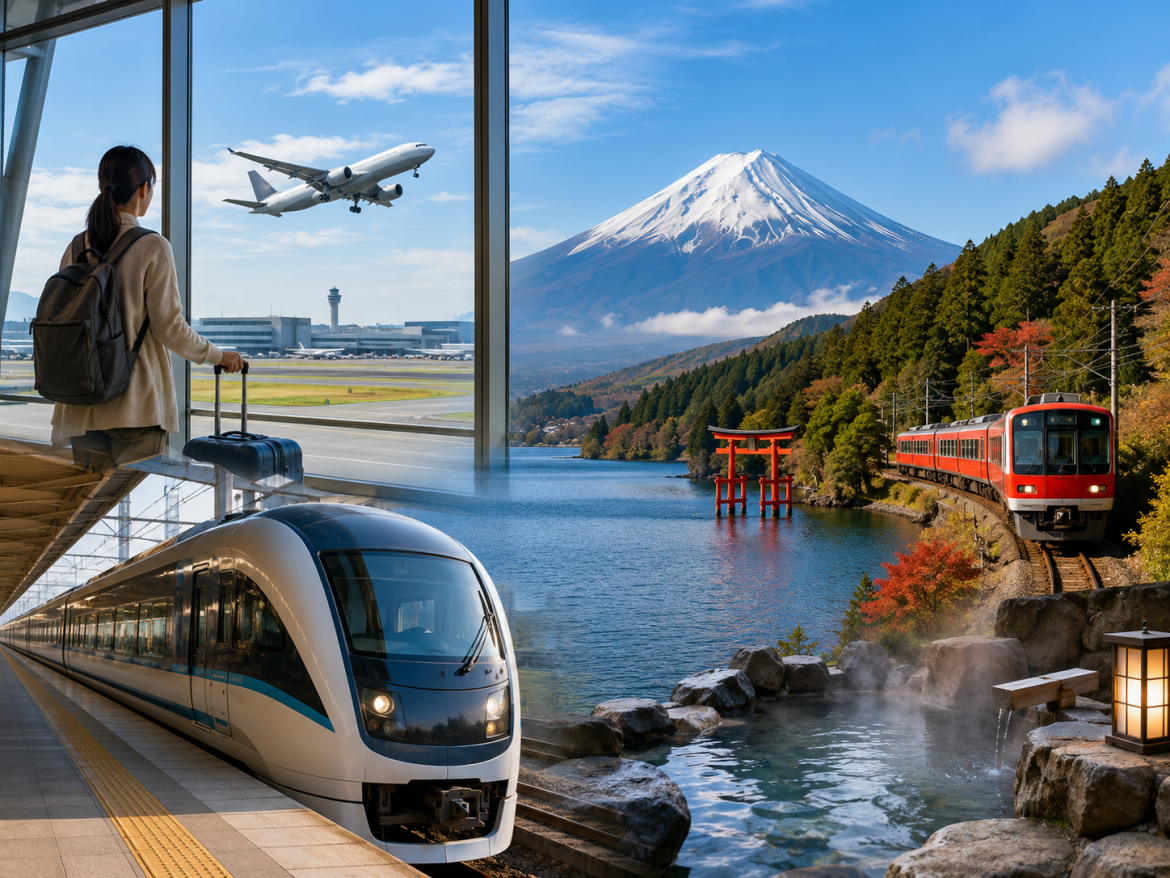

Narita Airport to Hakone: choose the route around your hotel
For Hakone-Yumoto, start by comparing the Narita Express to Shinagawa, a Tokaido Shinkansen to Odawara and the local train into Hakone. If you want to stop in Shinjuku or return there after your stay, the Narita Express plus an Odakyu Romancecar is another straightforward option. For Sengokuhara or Togendai, compare the Shinjuku highway bus against the railway route and a local bus.
Hakone is a mountain region, not one station. A journey that looks convenient for Hakone-Yumoto can leave you a long way from a lakeside ryokan. Check the hotel’s nearest station or bus stop, dinner deadline and final shuttle before buying transport. Our Tokyo to Hakone guide covers the onward journey from the city, while this guide starts at Narita.
No Hakone Freepass includes the Narita Airport leg. Buy the airport connection separately, then choose the pass edition that matches where you enter Hakone. A Romancecar seat also requires a separate limited-express ticket.
Compare the whole journey, not just the airport train
The following are planning allowances from the airport station or bus stop, not from your aircraft’s landing time. They exclude immigration, baggage reclaim and ticket queues. Train connections can change the order of the fastest options; road traffic can make a bus or car journey substantially longer. Add the journey from Hakone-Yumoto or the highway-bus stop to your actual accommodation.
| Route | Planning allowance | What you pay for | Best fit and main drawback |
|---|---|---|---|
| N’EX → Shinagawa → Shinkansen → Odawara → Hakone-Yumoto | Roughly 3–3½ hours to Hakone-Yumoto | Airport rail fare and N’EX supplement; JR fare and Shinkansen supplement to Odawara; local Hakone fare | A strong starting point for a daytime arrival; at least two train changes |
| N’EX → Shinjuku → Romancecar → Hakone-Yumoto | Roughly 3½–4½ hours | N’EX; Odakyu base fare or eligible Freepass; Romancecar supplement | Useful for a Shinjuku stop or return trip; a large station to navigate |
| Skyliner → Nippori/Ueno → JR conventional trains → Odawara → Hakone-Yumoto | Roughly 3½–4½ hours | Skyliner fare and supplement; JR and Hakone fares | Compare for savings against the Shinkansen route; more transfers and no guaranteed JR ordinary seat |
| Keisei ordinary/Access Express trains → Tokyo-area interchange → JR → Odawara | Allow around 4–5 hours to Hakone-Yumoto | Every operator’s ordinary fare along the selected route | Light luggage and a flexible day; longest and most demanding rail option |
| Airport bus → Shinjuku → Hakone highway bus | Allow around 4½–6 hours to Sengokuhara/Togendai, longer in traffic | Two bus tickets and any final hotel connection | Hotels near a northern Hakone bus stop; this is not a through airport bus |
| Private transfer or rental car | Allow around 3–4 hours of driving, potentially much longer in congestion | Confirmed transfer quote; or rental, tolls, fuel, parking and any one-way fee | Door-to-door convenience or a wider driving itinerary; high cost or post-flight fatigue |
Do not compare a discounted airport-only ticket with an entire Narita–Hakone fare. Check a date-specific journey, include every train supplement and local connection, then compare the total for your party. For Keisei routes, use the official journey planner rather than assuming an older tourism fare table is current.
Where in Hakone are you staying?
Hakone-Yumoto
This is the simplest rail gateway for a first overnight stay. The local train from Odawara takes approximately 15 minutes, before waiting and the walk or shuttle to your ryokan. A Romancecar marked for Hakone-Yumoto reaches it without an Odawara change. A hotel described as being in “Yumoto” may still be uphill or require a shuttle, so check the address.
Gora and Kowakidani
From Hakone-Yumoto, change to the mountain railway for Gora; allow roughly another hour including a wait and local hotel access. Kowakidani can work by train or bus depending on the property. These are not equivalent to arriving at Odawara: leave enough time for the slower mountain section.
Sengokuhara and Togendai
These northern areas can be reached by road from Odawara or Hakone-Yumoto, or by selected Shinjuku highway buses via Gotemba. A bus stopping near the hotel may avoid travelling through Yumoto and then doubling back. Gotemba Station, Tomei-Gotemba and the outlets are different stops; a bus terminating at one of them has not necessarily taken you to your Hakone hotel.
Motohakone, Hakonemachi and Lake Ashi
There is no railway station at these lakeside towns. Plan a local bus or a hotel shuttle. Do not rely on a sightseeing cruise or the ropeway as a late-evening hotel transfer: operating hours and weather can prevent that plan. The Hakone itinerary guide helps put the sightseeing areas in context.
For accommodation details in Traditional Chinese, see our Hakone hotel guide and family-friendly Hakone stays.
N’EX via Shinagawa and the Shinkansen
This is worth checking first when you want to reach Hakone-Yumoto efficiently without depending on road conditions. It is not automatically the fastest departure available: the wait for a train stopping at Odawara matters.
- Board the Narita Express at the station for Terminal 1 or Terminals 2 and 3. Terminal 3 has no separate railway station; follow the airport’s route to the Terminal 2 station.
- Choose an N’EX service serving Shinagawa and reserve your seat. Check the destination and carriage information rather than assuming every N’EX follows the same route.
- At Shinagawa, follow signs to the Tokaido Shinkansen transfer gates. Keep the tickets for the two operators/segments ready.
- Take a Kodama or an appropriate Hikari that actually stops at Odawara. Nozomi does not stop there.
- Change at Odawara for the Hakone Tozan line to Hakone-Yumoto, then continue to the mountain railway or a bus if needed.
Tokyo Station is a valid alternative interchange, especially when the timetable works better. Its N’EX platforms are deep underground, so allow for the walk to the Shinkansen. The airport ticket does not pay for the Odawara Shinkansen or onward Hakone transport. Keep this distinction even if you buy the N’EX round-trip offer.
Travel on 6–8 November 2026: JR East has announced engineering-work changes affecting some N’EX services from the evening of 6 November, throughout 7 November and early on 8 November. Some services start or terminate at Tokyo, with the Tokyo–Shinagawa/Shinjuku sections suspended. Airport arrivals on the evening of 6 November and throughout 7 November should check whether their train terminates at Tokyo; the early 8 November changes concern airport-bound services. Check the official affected-train list before reserving a connection.
N’EX to Shinjuku, then the Romancecar
This route makes sense if you plan to spend time in Shinjuku or will return there after Hakone. From JR Shinjuku, walk to the Odakyu station and board a Romancecar bound for Hakone-Yumoto. The limited express is reserved-seat service; your reservation is for a specific departure.
Leave a generous transfer buffer at Shinjuku. Around 30–45 minutes is a sensible planning allowance for a first visit with bags, rather than an official minimum. You may need longer for lifts, ticket collection or shopping. Do not book the onward train against an optimistic aircraft arrival time.
A Romancecar ticket has two components: the ordinary fare and the limited-express charge. The relevant Hakone Freepass can cover the ordinary-fare portion, but not the extra seat charge. The published standard adult supplement from Shinjuku to Hakone-Yumoto is ¥1,200 one way; the official online service lists a ¥50 reduction. Check the ticket channel and departure before paying.
Skyliner and conventional JR trains
The Skyliner is a comfortable reserved-seat airport train, but its fast run into northeastern Tokyo is only the first part of a Hakone journey. It can be worth comparing with N’EX plus Shinkansen when you have light luggage and want to reduce the total bill.
At Nippori, you can change to JR and continue to Ueno for a suitable Ueno–Tokyo Line/Tokaido Line service. Alternatively, travel to Keisei Ueno and walk to the separate JR Ueno station. Check the train’s destination: not every southbound JR service reaches Odawara. If another change is necessary, follow the journey planner rather than boarding any train on the platform.
There is no Tokaido Shinkansen at Ueno. Its Shinkansen platforms serve other routes. To take the bullet train to Odawara, first reach Tokyo or Shinagawa. On conventional JR trains, ordinary accommodation does not guarantee a seat or convenient suitcase storage; the comfort of the airport leg does not carry through automatically.
The cheaper ordinary-train option
Keisei Main Line or Access Express services can reduce airport costs. The right interchange depends on the train’s actual destination and onward JR connection, so compare complete routes to Odawara and Hakone-Yumoto in the planner. “Access Express” does not mean reserved-seat Skyliner service.
This option suits a light-packing traveller with no fixed ryokan dinner deadline. Count stairs, changes and time standing as part of the cost. For a family after a long flight, a modest saving may not justify a much longer trip. Avoid an itinerary with a last mountain connection that leaves no recovery option if an earlier train is delayed.
Airport bus to Shinjuku, then a Hakone highway bus
Plan this as two separate services. An airport limousine ticket to Tokyo and a Hakone transport bundle do not establish a direct Narita–Hakone bus. Confirm the airport bus’s exact Shinjuku drop-off and the walk to Busta Shinjuku, where the onward highway service departs.
The Odakyu Shinjuku–Gotemba–Hakone route serves different destinations by departure. Select a bus reaching the required Hakone stop rather than assuming a Gotemba or outlet service continues there. Standard adult fares include ¥2,490 to Sengoku-kogen and ¥2,560 to Togendai. Add the airport ticket; these are not Narita-to-Hakone totals.
This is particularly worth considering for Sengokuhara or Togendai accommodation, rather than defaulting to Hakone-Yumoto. Leave room for congestion on both road legs, and check amendment conditions before reserving a tight connection. Children under six also need a child-fare seat on this highway service; the operator does not allow lap travel or child seats.
Private transfers and driving
A Narita private transfer can be the easiest physical journey for a party with several suitcases, young children or limited mobility. Enter the full Hakone hotel address and obtain a confirmed quote: an airport-transfer search page does not mean every vehicle serves every mountain property.
Check the number of passengers and bags, child restraints, flight-delay waiting policy, late-night charges, tolls and where the driver meets you. Compare the all-in party price with everyone’s rail tickets and final hotel transfer, rather than comparing one person’s train fare against the entire car.
Hiring a car is more useful if you will continue to Gotemba, the Fuji Five Lakes or Izu. For a stay focused on the classic Hakone loop, parking and traffic may outweigh the flexibility. Include rental collection time, tolls, fuel, parking, any one-way return charge and rest stops. Confirm hotel parking and seasonal tyre requirements. After an overnight flight or an evening landing, sleeping near the airport before driving is the more practical plan.
Which Hakone Freepass should you buy?
Choose the starting point to match your route. The Shinjuku edition includes an Odakyu return journey to the Hakone area, while the Odawara edition is for the Hakone area without the Shinjuku return portion. Neither includes the Narita journey or a Tokaido Shinkansen ride.
| Adult Freepass | 2 days | 3 days | When it fits |
|---|---|---|---|
| From Shinjuku | ¥7,100 | ¥7,500 | You use Odakyu from and back to Shinjuku |
| From Odawara / Hakone area only | ¥6,000 | ¥6,400 | You reach Odawara by JR or do not need the Shinjuku return |
It can be useful for several rides on the designated Hakone trains, buses, cable car, ropeway and sightseeing cruise. It is not an unlimited ticket for every transport company or every highway-bus segment. Check the official coverage and current prices against your itinerary. A quiet night in Yumoto with few local rides may cost less on individual tickets.
Digital QR and station-issued products have different redemption and device instructions. Follow the exact product purchased, particularly when a family shares a phone. A voucher is not automatically the ticket you show at a gate. Check validity dates, exchange requirements and the Romancecar supplement separately.
If comparing the existing airport limousine transport bundles, read the selected option’s inclusions carefully. Do not assume every option contains a Hakone Freepass or a direct airport-to-Hakone ride.
Does the N’EX round-trip ticket help?
The N’EX TOKYO Round Trip Ticket costs ¥5,200 for an adult and is valid for 14 days. It is for eligible foreign-passport holders. It can be useful if you arrive and leave through Narita within that period, even when your outward and return Tokyo-area stations differ within the designated area.
It does not include the Tokaido Shinkansen to Odawara, travel beyond its JR validity area, Odakyu trains or the Hakone local network. If you leave Japan through Osaka or another airport, price a one-way journey instead of buying a return you will not use. Seat reservations and the ticket’s permitted route still matter.
Landing time, last connections and an overnight fallback
A morning arrival offers the best margin for reaching a ryokan without rushing. With an early-afternoon arrival, make the hotel the main objective and keep sightseeing optional. Around 16:00 or later is a useful warning point for planning an overnight stop in Tokyo or near Narita, not a universal last-departure cutoff.
Work backwards from the hotel’s dinner/check-in deadline. Verify the final bus or hotel shuttle, then the train arriving in time for it, then the airport departure. A late train to Odawara does not guarantee a route to a mountain hotel. Check weekday/holiday timetables and any disruptions for your actual date.
If the connections no longer work after landing, contact the ryokan promptly about your arrival and meal arrangements. Do not assume a late taxi will be available or inexpensive. A preplanned Tokyo or airport-area overnight option avoids turning a delayed flight into an improvised mountain journey. The Narita–Shinjuku guide and Tokyo accommodation guide offer more planning detail.
From Odawara to the hotel
| Hotel area | Usual onward route | Planning detail |
|---|---|---|
| Hakone-Yumoto | Local train | About 15 minutes on the train, plus waiting and hotel access |
| Gora | Train via Hakone-Yumoto | Allow roughly an hour or more including the change, then hotel access |
| Kowakidani | Mountain train or bus | Choose by the nearest hotel stop, not only the area name |
| Sengokuhara / Togendai | Bus | Confirm the destination and stop; mountain-road congestion can add time |
| Motohakone / Hakonemachi / Lake Ashi | Bus or prearranged hotel shuttle | Check last service and final walk; there is no lakeside railway station |
Use the official access diagrams and Hakone Freepass map to understand the geography. For the bus alternative, the operator’s route map shows the Gotemba and Hakone branches. Keep the hotel’s stop name saved in Japanese as well as English.
Luggage: train rules and hotel delivery
Reserve appropriate seating for large luggage on the Tokaido Shinkansen. Under JR Central’s baggage rules, suitcases with total dimensions over 160 cm and up to 250 cm need the designated oversized-baggage arrangements; ordinary carry-on limits also apply. Do not assume an unreserved empty space behind a seat is available to you. Keep valuables and anything needed during the journey with you.
The Hakone luggage service accepts bags at Hakone-Yumoto from 08:30 to noon for delivery to participating hotels after 15:00. Regular bags up to 140 cm total dimensions and 15 kg cost ¥1,500; the large category up to 200 cm and 30 kg costs ¥2,500, per bag one way. Confirm the partner hotel and prohibited items first. An afternoon arrival from Narita will usually miss the station drop-off window.
For the return service, arrange it at your participating hotel by 10:00; the published station collection window is 13:30–18:30. Build that collection into the return train plan. Do not pack valuables, fragile items or power banks into the delivered bag.
Day trips, families and common mistakes
An arrival-day return excursion to Hakone gives you very little sightseeing time after immigration and a long one-way journey. A night in Hakone is a better fit; otherwise sleep in Tokyo first and make Hakone a separate day trip. A Hakone transport/day-trip package or a Fuji and Hakone tour has its own starting point, language and inclusions. It does not wait for your incoming flight.
For children or older relatives, prioritise confirmed seats, manageable walking and a hotel near the arrival stop. The fastest rail plan still involves moving bags at least twice; a fewer-change plan may be easier even when slower. Compare lift access and the final hotel transfer before deciding that one route is best for everyone.
- Do not search only for “Hakone Station”: use the hotel’s actual station or stop.
- Do not board a Shinkansen without checking its Odawara stop.
- Do not buy a Shinjuku Freepass simply because you are visiting Tokyo when you actually enter Hakone at Odawara.
- Do not treat a single airport-train fare, a highway-bus fare or a product-card starting price as the entire party’s transfer cost.
- Do not let a late arrival plan depend on the final mountain bus with no backup.
For other days, see day trips from Tokyo. The following Tokyo activity ideas belong on a separate city day and do not include Hakone transport.
Narita to Hakone FAQs
Is there a direct train from Narita Airport to Hakone?
No. You need at least one Tokyo-area interchange; the common routes are via Shinagawa and Odawara or via Shinjuku and the Romancecar. The final transfer count depends on your hotel.
Is there a direct Narita–Hakone bus?
Use a plan with an airport service to Shinjuku and a separate Hakone highway bus. A combined ticket listing is not proof of a through service. Confirm each departure and its final destination.
Can a JR Pass cover the journey?
Coverage depends on the exact pass. JR East regional passes do not cover the JR Central Tokaido Shinkansen. Hakone trains and buses beyond Odawara are not JR. Check the pass’s specific route conditions before choosing it.
Can I use Terminal 3 for the train?
Walk or use the airport’s terminal-transfer arrangement to the station at Terminal 2. Follow the official airport station-access guide; there is no separate Terminal 3 railway stop.
Must I buy a Hakone Freepass?
No. Add up the rides you will actually take. It is easier to justify for a full local sightseeing circuit than for a short stay near Yumoto with only a couple of train rides.
The practical choice
For a daytime arrival and a Yumoto or Gora hotel, compare N’EX via Shinagawa and Odawara first. Choose Shinjuku when it fits the wider trip, and compare the highway bus for a hotel near Sengokuhara or Togendai. If you land late, protect the first night of the trip by staying in Tokyo or near the airport rather than relying on the final mountain connection.