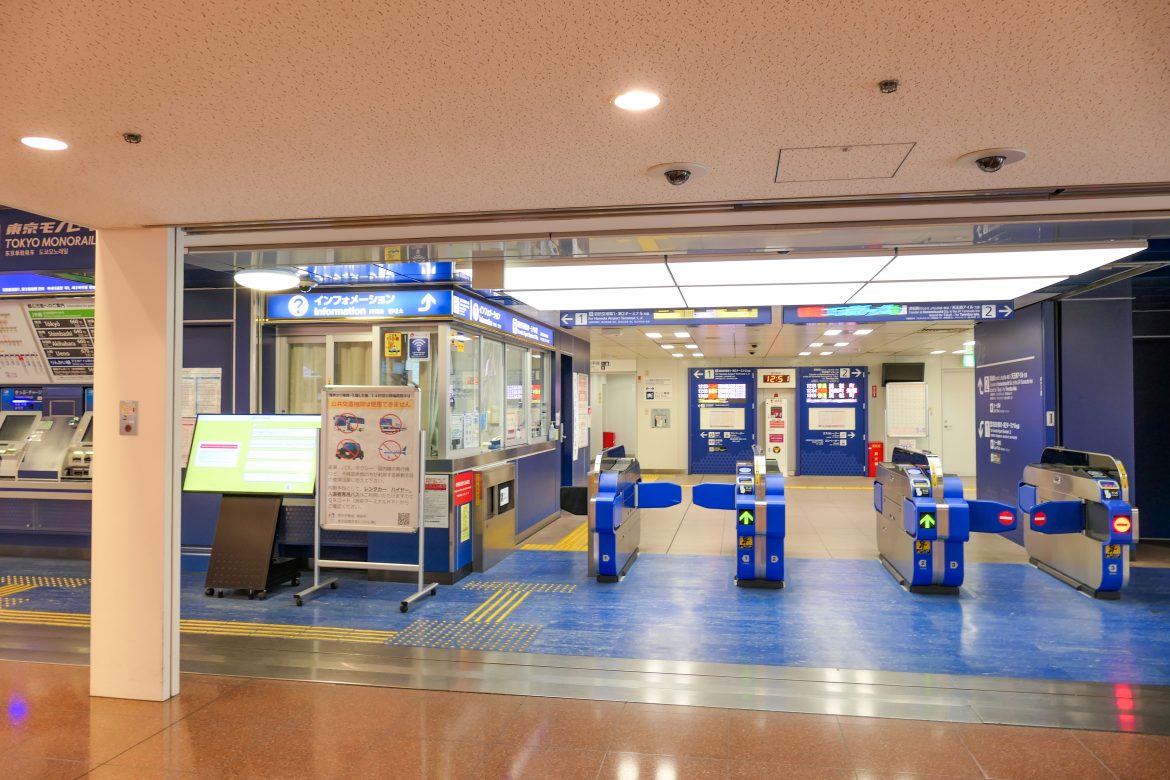
The most practical route from Haneda Airport to Asakusa is usually a Keikyu train that continues onto the Toei Asakusa Line. On a suitable service, you remain on the same train and get off at Toei Asakusa Station, avoiding the luggage-heavy transfers that many first-time visitors expect.
The important qualification is that not every departure is direct. Keikyu trains leave Haneda for several destinations, so boarding the next train without reading the departure board can create an unnecessary change at Sengakuji or another station.
For most solo travellers and couples, the train wins because it costs ¥599–635 by IC card and the scheduled railway journey can be as short as 34–37 minutes. It is not an airport express, however. There are no reserved seats, and large suitcases can become uncomfortable during Tokyo’s commuter peaks.
The airport limousine bus looks easier on paper because luggage is stored below the vehicle, but the Asakusa service is limited and terminates at Asakusa View Hotel. It is useful only when the schedule matches your flight and the stop is close to your accommodation.
A taxi or pre-booked transfer costs far more but becomes reasonable for three or four travellers, late-night arrivals, several large bags, young children or anyone who would struggle with stairs and station corridors.
For a wider comparison of routes to other Tokyo districts, see the Haneda Airport to Tokyo transport guide. Travellers planning their first few days can also compare the best things to do in Tokyo by area.

Haneda Airport to Asakusa: Editor’s Verdict
| Decision factor | Practical answer |
|---|---|
| Best option for most travellers | A direct Keikyu–Toei Asakusa Line through train |
| Rail fare | Terminal 3: ¥599 IC / ¥610 paper; Terminals 1·2: ¥635 IC / ¥650 paper (adult one-way) |
| Official estimated rail time | 34 minutes from Terminal 3; 37 minutes from Terminals 1 and 2 on the fastest suitable services |
| Transfer | None on selected through services; other departures may require a change |
| Bus fare to Asakusa View Hotel | ¥1,300 adult; ¥650 child |
| Bus weakness | Very limited departures and only one Asakusa stop |
| Taxi flat-rate reference | ¥9,100 daytime or ¥10,800 late night/early morning for Taito Ward, plus tolls |
| Best with one medium suitcase | Direct train outside rush hour |
| Best with several large suitcases | Private transfer, taxi or luggage delivery |
| Best for families | Direct train for light luggage; transfer for toddlers, pushchairs and several bags |
| Best for older travellers | Private transfer when walking or stairs are a concern |
| Final walk | About 5 minutes to Kaminarimon from a suitable Toei exit; often 5–20 minutes to a specific hotel |
Asakusa is an excellent first base for travellers who want Sensoji Temple, traditional streets, the Sumida River and easy access to Tokyo Skytree. The airport journey itself deserves less than half a day; the real planning issue is choosing the service and station exit that minimise suitcase handling.
This route may not feel easy if you land during the evening commuter peak, travel with several oversized cases or book a hotel in western Asakusa near the Tsukuba Express station. In those circumstances, the cheapest route is not always the most sensible one.
Essential Route Information
| Item | Verified planning information |
|---|---|
| Airport railway | Keikyu Airport Line |
| Arrival railway | Toei Asakusa Line |
| Correct arrival station | Asakusa Station A18 |
| Recommended payment | Suica, PASMO or another compatible transport IC card |
| Limited-express surcharge | Not required for ordinary Keikyu airport trains on this route |
| Reserved seats | None on the standard direct service |
| Airport bus stop | Asakusa View Hotel |
| Taxi destination ward | Taito Ward |
| Kaminarimon access | About 5 minutes from Toei Asakusa Station Exit A4 |
| Station accessibility | Elevators and an accessible route are available, but the step-free exit may not be the closest exit to every hotel |
Current Transport Status and Terminal 3 Works
Keikyu announced Terminal 3 platform-door replacement for June–October 2026, with signage and interior work beginning from June. The October target specifically concerns the platform doors, not a promised completion date for every renovation. Some doors may be temporarily inactive with staff supervision; follow signs and watch the platform edge. See Keikyu’s station-work notice for the announced scope.
The airport limousine bus remains available, but the service is too infrequent to treat as a turn-up-and-go option. Check the exact date after the airline schedule is fixed rather than planning around an old screenshot or timetable copied into another travel guide.
Railway operations can still change because of weather, signalling problems or through-service disruption. Check the live Keikyu and Toei operating notice after landing if the departure board does not show the expected service.
Which Route Should You Choose?
| Traveller type | Best choice | Reason |
|---|---|---|
| Solo traveller with one case | Direct train | Low cost, frequent service and no road-delay risk |
| Couple with light luggage | Direct train | The fare saving over a taxi is substantial |
| Family with a pushchair and two cases | Private transfer or well-timed bus | Managing children, bags and station exits at once is the real difficulty |
| Group of four adults | Compare transfer and taxi prices | The cost per person can become reasonable when shared |
| Hotel beside Asakusa View Hotel | Bus when the timetable fits | The drop-off may remove the final station walk |
| Hotel near Kaminarimon or the Sumida River | Direct train | Toei Asakusa Station is usually closer than the bus stop |
| Late-night arrival | Pre-booked transfer or taxi | Public transport becomes less forgiving after immigration or baggage delays |
| Wheelchair user unable to climb bus steps | Accessible private transfer | The Asakusa airport bus is not a low-floor service |
Option 1: Direct Keikyu and Toei Asakusa Line Train
This is the default recommendation. The train starts on the Keikyu Airport Line and, on suitable services, continues beyond Sengakuji onto the Toei Asakusa Line. The operator name changes, but passengers do not necessarily change trains.
Step-by-step route from Terminal 3
- After customs, follow signs for Keikyu Line rather than Tokyo Monorail.
- Use an IC card at the gate or buy a through ticket to Asakusa.
- Read the departure board for a through service toward Oshiage or beyond, then check the actual stops. A destination of Sengakuji or Shinagawa alone does not mean the train reaches Asakusa.
- Confirm on the platform display that Asakusa appears in the stopping pattern.
- Board and remain on the train when it reaches Sengakuji if the display and announcements continue toward Asakusa.
- Get off at Asakusa A18. Asakusabashi A16 is a different station two stops earlier, and Tsukuba Express Asakusa is a separate station in western Asakusa.
Step-by-step route from Terminals 1 and 2
Follow the same process from Haneda Airport Terminal 1·2 Station. Terminal 2 also handles some international flights. Check the airline’s actual terminal rather than assuming all international flights use Terminal 3; Terminals 1 and 2 share the Keikyu station.
The official estimated time to Asakusa is 37 minutes from Terminals 1 and 2, compared with 34 minutes from Terminal 3. Waiting for a suitable direct train, slower stopping patterns and the final station exit mean that around 50–70 minutes from the airport railway gate to a nearby Asakusa hotel is a more useful planning allowance; a distant hotel or missed connection takes longer.
How to recognise a direct train
Use the official Keikyu route map to see the through route, and the official fare and journey search for your actual departure.
Do not rely on train colour alone. Read the destination and station list on the electronic board. The displays may use Express (急行), Limited Express (特急 or 快特), Airport Limited Express (エアポート快特) or a through-service label. The useful question is whether that particular train continues through Asakusa; a faster category does not make every destination suitable.
Destination names beyond Asakusa can still be correct. For example, through trains for Oshiage, Aoto, Keisei-Takasago or Narita Airport may stop at Asakusa en route. A train toward Yokohama or Zushi-Hayama goes in the wrong direction for this journey. When uncertain, show “Asakusa A18” to station staff before boarding.
What happens at Sengakuji?
Sengakuji is where the Keikyu and Toei networks meet. Route-planning apps sometimes display separate operator segments and make the journey look like a transfer. On a through service, the train pauses, the operating line name changes and you remain in the same carriage.
If the train terminates at Sengakuji, change there for a train toward Oshiage that stops at Asakusa. Do not board a Nishi-magome-bound train. A train terminating at Shinagawa needs a different connection before it can reach Sengakuji; follow the full journey result rather than assuming every change is at the same platform. This is manageable, but waiting a few minutes for a clearly direct departure at Haneda is usually better with luggage.
When the train is not the best choice
- You have more luggage than the group can carry comfortably without assistance.
- You land during a busy weekday commuter period.
- Your hotel is far from a step-free Toei exit.
- A child needs constant supervision while another adult handles bags.
- A traveller cannot stand safely if no seat is available.
- Your flight arrives close to the end of railway operations.
Option 2: Airport Limousine Bus to Asakusa View Hotel
The limousine bus stores normal suitcases in the luggage hold and provides a seat, making it attractive after a long flight. Its weakness is frequency. The official timetable showed the five departures below. They are a dated planning reference, not a promise for every future travel date.
| Terminal 3 departure | Terminal 2 departure | Terminal 1 departure | Asakusa View Hotel arrival |
|---|---|---|---|
| 11:40 | 11:50 | 11:55 | 13:00 |
| 13:45 | 13:55 | 14:00 | 15:05 |
| 16:45 | 16:55 | 17:00 | 18:05 |
| 17:45 | 17:55 | 18:00 | 19:05 |
| 18:45 | 18:55 | 19:00 | 20:05 |
Check the operator’s date-specific timetable before booking. The listed journey takes 80 minutes from Terminal 3, 70 from Terminal 2 and 65 from Terminal 1, excluding the wait. Immigration delays can make a pre-selected departure difficult to catch, and road congestion can lengthen the journey.
The stop is Asakusa View Hotel on the western side of the district. It is useful for hotels around Kokusai-dori and the Tsukuba Express station, but it may leave a longer walk than the train for accommodation near Kaminarimon, Kuramae or the Sumida River.
The active Klook page offers QR-code boarding for eligible airport limousine routes. Before paying, confirm that “Asakusa View Hotel” is selectable for your exact date, terminal and direction; otherwise book directly through the bus operator.
Bus accessibility warning
The operator’s luggage allowance is up to two checked items per person, each within 50 × 60 × 120 cm and 30 kg. Oversized equipment needs advance confirmation.
The route-specific operator notice says the bus is not a low-floor vehicle. A folding wheelchair may be stored in the luggage compartment if the traveller can board the steps, while a motorised wheelchair may not be accepted. Contact the operator before travel rather than relying on a general accessibility label.
Option 3: Taxi or Private Airport Transfer
A taxi is the easiest door-to-door option. For Taito Ward, the current flat-rate reference is ¥9,100 from 05:00 to 22:00 and ¥10,800 from 22:00 to 05:00, with expressway tolls added. Confirm the flat fare with the driver or dispatcher before departure because ordinary metered conditions may apply in some circumstances.
Allow roughly 30–60 minutes in normal planning, with a wider margin during rain, road incidents and commuter congestion. A taxi can be faster than the train when roads are clear, but it is less predictable at peak times.
A pre-booked transfer is usually better than joining the ordinary taxi queue when the group needs a child seat, a larger vehicle, an accessible vehicle, flight tracking or guaranteed luggage capacity. Compare the passenger and suitcase limits carefully: a vehicle advertised for four passengers may not hold four people plus four large cases.
Select the actual Asakusa hotel address and the number of passengers and bags before comparing transfer quotes; airport-wide listings do not guarantee every vehicle or destination is available.
Why the Tokyo Monorail Is Usually the Wrong Route
The Tokyo Monorail is useful for Hamamatsucho and parts of the JR network, but it is not the natural airport railway for Asakusa. A typical Monorail route requires changing at Hamamatsucho or Daimon and then joining the Toei Asakusa Line.
Technically possible does not mean sensible. Unless you deliberately need Hamamatsucho, the route adds corridors, lifts and suitcase handling without creating a meaningful advantage over a suitable Keikyu through train.
Tickets, IC Cards and Transport Passes
IC card
| Airport station | Adult IC fare | Adult paper fare |
|---|---|---|
| Haneda Airport Terminal 3 | ¥599 | ¥610 |
| Haneda Airport Terminal 1·2 | ¥635 | ¥650 |
A Suica, PASMO or compatible IC card is the simplest payment method. Touch in at Haneda and touch out at Asakusa. Adult one-way fares are ¥599 by IC card or ¥610 by paper ticket from Terminal 3; from Terminal 1·2 Station they are ¥635 IC or ¥650 paper. Use the same card at both gates for the IC fare. Buying a paper ticket with an IC card still uses the paper-ticket fare.
Paper ticket
Choose the Toei Line option at the Keikyu ticket machine and buy a through ticket to Asakusa. Do not buy only to Shinagawa unless you intentionally plan to exit or change there.
Tokyo Subway Ticket
The official adult prices are ¥1,000 for 24 hours, ¥1,500 for 48 hours and ¥2,000 for 72 hours. Paper and QR products exist; check the version purchased and how it is issued.
The 24-, 48- and 72-hour Tokyo Subway Tickets cover Tokyo Metro and Toei Subway services. They do not cover the Keikyu section between Haneda Airport and Sengakuji, so a subway-only pass is not a complete airport ticket.
The pass can still be useful after checking into an Asakusa hotel, especially for a day using the Ginza, Asakusa, Oedo and other subway lines. Calculate the planned journeys before buying rather than assuming every Tokyo train is included.
If combining a subway pass with a separate Keikyu airport fare, ask staff how to use the exact paper or QR product before entering. Tapping an IC card in at Haneda and out at Asakusa charges the whole IC journey; it does not automatically apply a separate subway pass.
Skytree, Keikyu and subway package
Travellers who definitely plan to visit Tokyo Skytree can compare a package combining timed Skytree admission, a Keikyu Hanetoku airport ticket and a Tokyo Subway Ticket. This can be more coherent than buying unrelated passes, but only when all three components match the itinerary.
Do not buy the package simply for the airport ride. It has restrictive date and cancellation conditions, and the Skytree time must remain realistic after immigration, baggage collection and hotel check-in.
Where You Actually Arrive in Asakusa
Save the official Toei Asakusa station map and accessibility information before travelling. It is more useful for finding a lift than a generic map pin labelled “Asakusa”.
The direct airport train arrives at Toei Asakusa Station, station code A18. Do not get off at Asakusabashi A16, a different stop farther south. This is not the same facility as the Tsukuba Express Asakusa Station, which sits farther west near Asakusa View Hotel.
The Tokyo Metro Ginza Line and Tobu Railway also use the name Asakusa in connected or nearby facilities. Navigation apps may show different entrances depending on the destination, so save the exact hotel address rather than searching only for “Asakusa Station”.
Exit A4 is a practical reference for Kaminarimon, which is about five minutes away. It is not automatically the best exit for luggage or reduced mobility. The nearest street exit may have stairs, while the step-free route can require a longer underground walk.
Real Walking, Luggage and Physical Difficulty
The railway journey is easy; the final station-to-hotel section determines whether the arrival feels easy. Toei Asakusa Station has three elevators, an escalator, an established barrier-free route and an accessible toilet, but these facilities do not make every exit equally convenient.
Expect approximately five minutes on foot to Kaminarimon from a suitable exit. Hotels near Sensoji, Kappabashi, the Tsukuba Express station or northern Asakusa can require 10–20 minutes, depending on the chosen exit and pedestrian crossings.
Asakusa’s main streets are mostly flat. The difficulty comes from station stairs, narrow pavements, crowds around Kaminarimon and pulling luggage over textured paving. In summer, even a short walk feels harder after a long flight because of heat and humidity.
Same-day luggage delivery
Travellers arriving early can send luggage from Haneda to an eligible Tokyo hotel and begin sightseeing before check-in. This service covers hotels in Tokyo’s 23 wards and Urayasu, but not private apartments, Airbnb-style accommodation or hostels. The booking name must match the hotel reservation.
Check the counter location, handover deadline, luggage-size category and delivery window before relying on the service. Keep medication, passports, electronics and anything needed that evening with you.
Travelling with Children
For one child and manageable luggage, the direct train remains the best value. Wait for a suitable through service rather than adding a platform change, and avoid the busiest weekday periods when possible.
A pushchair can be used through the accessible station route, but the shortest exit to the hotel may involve stairs. Save the hotel’s recommended station exit and ask reception about elevator access before flying.
The bus provides seats and luggage storage, but waiting for one of a few departures can be harder than taking a train. It works best when the family’s flight arrival comfortably precedes the bus and the hotel is near Asakusa View Hotel.
For two young children, multiple cases and a pushchair, a transfer often offers the best balance of cost and stress. Confirm child-seat rules during booking; do not assume the vehicle automatically includes one.
Older Travellers and Limited Mobility
Older travellers who can manage a moderate station walk may use the direct train, particularly outside peak periods. The main risk is standing with luggage if seats are unavailable rather than a long or steep outdoor route.
Anyone who cannot reliably climb stairs should plan around elevators, even when that means using a less direct exit. The Toei station has a step-free route, but temporary lift faults can still occur.
The Asakusa limousine bus is not a low-floor bus, so it is not the strongest choice for a traveller who must remain in a wheelchair. An accessible private vehicle booked with explicit mobility requirements is the safer option.
Best Route by Arrival Time
| Arrival situation | Recommended approach |
|---|---|
| Early morning | Direct train; send luggage to the hotel if check-in is many hours away |
| Late morning | Compare the next direct train with the 11:40 or 13:45 bus only after clearing immigration |
| Afternoon | Direct train unless a bus departure aligns closely and the stop suits the hotel |
| Weekday commuter peak | Wait for a less crowded train, use luggage delivery or choose a transfer |
| Late evening | Direct train while services remain comfortable; transfer when the margin to the final train is uncertain |
| After normal railway operation | Taxi or pre-booked private transfer |
Last Trains, Early Arrivals and the Return to Haneda
The train does not run all night. Keikyu’s late-night and early-morning page lists a 00:08 Terminal 3 departure to Shinagawa, but this is not the last usable train to Asakusa. Its 05:26 first departure is also a Shinagawa-direction reference. Search the complete journey from your actual terminal to Asakusa A18, allowing for immigration and baggage collection before the departure time.
For the return, use the southbound Toei Asakusa Line platform and a train displaying Haneda Airport Terminal 1·2. Trains for Nishi-magome or other Keikyu destinations are not automatically airport trains. Get off at Terminal 3 first if that is your airline’s terminal; Terminals 1 and 2 share the next, final Keikyu stop.
The official weekday and weekend/holiday Asakusa timetables both start with a 05:03 direct Haneda train. The last direct departures shown are 22:41 on weekdays and 23:17 on weekends/holidays. Later transfer options need a date-specific full-route check. The 00:26 southbound departure goes only to Asakusabashi, not Haneda.
If airline check-in closes before the first train can get you to the correct terminal, stay near the airport or arrange a suitable transfer. After a late inbound flight, use a taxi, pre-booked transfer or nearby hotel when no complete rail connection remains. The limited Asakusa bus is not an overnight backup.
Half-Day Arrival Itinerary
This itinerary works when you reach the hotel by early or mid-afternoon. Do not attach fixed timed tickets immediately after an international flight.
- Arrival + 0:00: Leave luggage at the hotel.
- Arrival + 0:30: Walk to Kaminarimon and Nakamise.
- Arrival + 1:15: Visit Sensoji’s main grounds.
- Arrival + 2:15: Explore the quieter lanes around the temple.
- Arrival + 3:00: Walk to the Sumida River.
- Arrival + 3:45: Eat an early dinner in Asakusa.
- After dark: Return to illuminated Kaminarimon if energy remains.
Night-time Asakusa is calmer than the middle of the day, although Nakamise’s shops close earlier than restaurants and convenience stores. See the Tokyo at night guide for other low-pressure first-evening options.
Complete Arrival-Day Itinerary
This plan suits an early landing, successful luggage delivery and travellers who sleep reasonably well on the flight.
- Morning: Travel directly from Haneda and leave or send luggage.
- Late morning: Kaminarimon, Nakamise and Sensoji.
- Lunch: Eat away from the busiest central Nakamise section.
- Early afternoon: Walk through Sumida Park or take a short riverfront break.
- Mid-afternoon: Continue to Tokyo Skytree by train, bus or a 20–30-minute walk.
- Late afternoon: Visit the Skytree observation deck only with a realistic timed reservation.
- Evening: Return to Asakusa for dinner and an early night.
Separate Skytree admission is more flexible than a transport bundle when the flight arrival time is uncertain. The current Tokyo Skytree ticket options include date- and time-specific packages.
Nearby Combinations from Asakusa
Asakusa and Tokyo Skytree
This is the most natural combination. Visit Sensoji first if arriving in the morning, then continue to Skytree after lunch. Families can use the train rather than walking if children are tired.
Asakusa and Ueno
Ueno works well on a separate morning or afternoon via the Ginza Line. Combining Sensoji, a major Ueno museum and Skytree after an international flight is too ambitious.
Asakusa and a Tokyo day trip
Asakusa is a useful base for Tobu Railway services toward Nikko, but a Nikko excursion deserves a fresh morning rather than the arrival day. Compare realistic choices in the best day trips from Tokyo guide.
Food After Arriving in Asakusa
Asakusa is known for tempura, soba, unagi, sukiyaki, monjayaki, ningyo-yaki cakes and traditional sweets. The correct meal depends more on energy and timing than on chasing one famous queue.
Nakamise is useful for small snacks but should not be treated as a full meal plan. Its shops are busiest in the middle of the day and many close before the district’s dinner restaurants.
After a late flight, choose a restaurant near the hotel rather than walking across the district with luggage. Popular historic restaurants may require queuing or reservations, while casual soba, tempura and izakaya-style options are easier to arrange spontaneously.
Where to Stay in Asakusa for Airport Access
Near Toei Asakusa Station
This is the most practical area for a straightforward Haneda journey. It also suits travellers continuing to airports or districts along the Asakusa Line.
Near Kaminarimon and the Ginza Line
This area balances airport access with easy sightseeing and direct subway travel toward Ueno, Ginza and Shibuya. Check the exact walk from the Toei platforms because a hotel described as “Asakusa Station” may be closer to the Ginza or Tobu side.
Near Asakusa View Hotel and Tsukuba Express
This is the strongest area for the airport bus stop, Kappabashi and western Asakusa. It is less convenient for the direct Haneda train because the Toei station is farther east.
Near Tobu Asakusa Station
Choose this side when a future Nikko trip is a major priority. It remains walkable from Toei Asakusa Station but may not be the shortest luggage route.
An overnight stay is not necessary merely to complete the airport transfer. It is worthwhile when travellers want a quieter traditional base, an early Tobu departure or an easy first evening around Sensoji.
First-Time Mistakes to Avoid
- Boarding the next Keikyu train without checking its destination. Some services do not continue directly through Asakusa.
- Changing automatically at Sengakuji. Remain onboard when the train is a through service.
- Taking the Tokyo Monorail because it appears more “airport-specific”. It normally creates extra transfers for Asakusa.
- Assuming the direct train has reserved seats. It is a normal commuter service.
- Buying a Tokyo Subway Ticket as the complete airport fare. It does not cover the Keikyu airport section.
- Confusing Toei Asakusa with Tsukuba Express Asakusa. They are in different parts of the district.
- Choosing the nearest-looking exit without checking stairs. The elevator route may use another exit.
- Assuming the airport bus stops at every hotel. The Asakusa stop is Asakusa View Hotel.
- Using an old bus timetable. The service is limited and published schedules can change.
- Booking a timed attraction immediately after landing. Immigration and baggage delays are unpredictable.
- Overloading a small transfer vehicle. Passenger capacity and luggage capacity are different.
- Expecting the bus to be step-free. The route is not operated as a low-floor service.
- Walking around Sensoji with all luggage. Leave, store or deliver bags before sightseeing.
- Planning Sensoji, Ueno and Skytree after a late arrival. Protect the first evening from an exhausting schedule.
Haneda Airport to Asakusa 2026 FAQ
1. Is there a direct train from Haneda Airport to Asakusa?
Yes, selected Keikyu services continue onto the Toei Asakusa Line without a train change. Check the destination board because not every departure is direct.
2. Do I have to transfer at Sengakuji?
Not on a through service. The operator and line name change at Sengakuji, but passengers can remain on the same train. Change only when the departure board or full journey plan requires it; the onward train must head toward Oshiage and stop at Asakusa.
3. How much is Haneda Airport to Asakusa by train?
From Terminal 3, adult fares are ¥599 by IC card or ¥610 by paper ticket. From Terminals 1·2, they are ¥635 IC or ¥650 paper.
4. How long does the train take?
The official estimated time is 34 minutes from Terminal 3 and 37 minutes from Terminals 1 and 2 on the fastest suitable services. Allow additional time for waiting and the hotel walk.
5. Which Haneda station should I use?
Use Haneda Airport Terminal 3 Station for Terminal 3 or Haneda Airport Terminal 1·2 Station for Terminals 1 and 2. Terminal 2 also handles some international flights.
6. Which Asakusa station does the airport train use?
It arrives at Toei Asakusa Station A18. It does not arrive at the separate Tsukuba Express Asakusa Station.
7. Which exit is best for Kaminarimon?
Exit A4 is a useful reference and Kaminarimon is about five minutes away. Travellers needing elevators should follow the station’s barrier-free route even when it uses another exit.
8. Can I use Suica or PASMO?
Yes. A compatible IC card is the simplest way to pay the through fare from Haneda to Asakusa.
9. Is a limited-express ticket required?
No separate limited-express surcharge is required for the ordinary Keikyu–Toei route described here.
10. Does the Tokyo Subway Ticket cover Haneda Airport?
No. It covers Tokyo Metro and Toei Subway lines but not the Keikyu airport section. Use an IC card or a package that explicitly includes a Keikyu airport ticket.
11. Is the direct train suitable with large luggage?
It is manageable with one case per person outside peak periods, but seats and dedicated large-suitcase racks are not guaranteed. Consider delivery or a transfer for several large bags.
12. Is the airport bus better than the train?
Only when its limited timetable fits and Asakusa View Hotel is close to the accommodation. The train is faster, cheaper and more frequent for most travellers.
13. Where does the bus stop in Asakusa?
The airport limousine bus stops at Asakusa View Hotel in western Asakusa.
14. How much is the airport bus?
The current fare to Asakusa View Hotel is ¥1,300 for an adult and ¥650 for a child.
15. Is the limousine bus wheelchair accessible?
Not as a step-free low-floor service. Folding wheelchairs can be stored below if the passenger can board the steps; motorised wheelchairs require advance confirmation.
16. How much is a taxi from Haneda to Asakusa?
The current flat-rate reference for Taito Ward is ¥9,100 during the day and ¥10,800 late at night or early in the morning, plus expressway tolls. Confirm flat-rate eligibility before departure.
17. Is a private transfer worth it for four people?
It can be. Compare the total price with four train fares, luggage delivery and the physical effort of the final walk. Confirm that the chosen vehicle holds both passengers and bags.
18. What is the best option for families?
Use the direct train for light luggage and an off-peak arrival. Choose a transfer when managing children, a pushchair and several bags would make the station journey stressful.
19. What is the best option for older travellers?
A direct train is reasonable for travellers comfortable with station walking. A door-to-door transfer is better when standing, stairs or long corridors are a concern.
20. Can luggage be delivered from Haneda to an Asakusa hotel?
Yes, eligible same-day services deliver to participating hotels in Tokyo’s 23 wards. Private apartments, hostels and mismatched reservation names may not be accepted.
21. Can I visit Sensoji immediately after landing?
Yes, provided luggage is left at the hotel or sent ahead. Keep the itinerary flexible and avoid booking a fixed activity too soon after the flight.
22. Can I combine Asakusa and Tokyo Skytree on arrival day?
Yes after an early arrival. Allow time for immigration, hotel access and lunch, and choose a Skytree entry time with a generous buffer.
23. What should I do if the direct train is disrupted?
Follow Keikyu staff instructions. Alternatives include a train requiring a change at Sengakuji, the Monorail and Toei route, an airport bus if available, or a taxi.
24. Is Asakusa a good area for the first night in Tokyo?
Yes for travellers prioritising traditional streets, Sensoji, Skytree and a quieter evening. It is less central for nightlife in Shibuya or Shinjuku.
Final Verdict
Haneda Airport to Asakusa is one of Tokyo’s simpler airport journeys when the correct train is chosen. For most travellers, the best route is a Keikyu service that continues directly onto the Toei Asakusa Line.
The lowest fare is not the only advantage. A suitable through train avoids dragging luggage through Shinagawa, Hamamatsucho or another major interchange.
The detail first-time visitors must remember is that “Keikyu to Asakusa” does not mean every Keikyu departure is direct. Check the destination and stopping pattern before boarding, then remain on the train at Sengakuji when it is a through service.
Choose the limousine bus only when the limited timetable fits comfortably and Asakusa View Hotel is genuinely convenient for the accommodation. Otherwise, waiting for the bus can take longer than completing the entire rail journey.
Choose a taxi or private transfer for a late arrival, several large suitcases, a family managing young children or a group that can divide the fare. The higher cost buys a predictable door-to-door finish rather than faster travel in every traffic condition.
Allow roughly one hour from the Haneda railway gate to an Asakusa hotel under ordinary conditions, then keep the first sightseeing plan simple: leave luggage, visit Kaminarimon and Sensoji, and add the river or Tokyo Skytree only when energy and timing permit.
For most visitors, an IC card and the direct train are sufficient. Buy a transport or Skytree package only when its additional components match a confirmed itinerary rather than treating a pass as automatically cheaper.