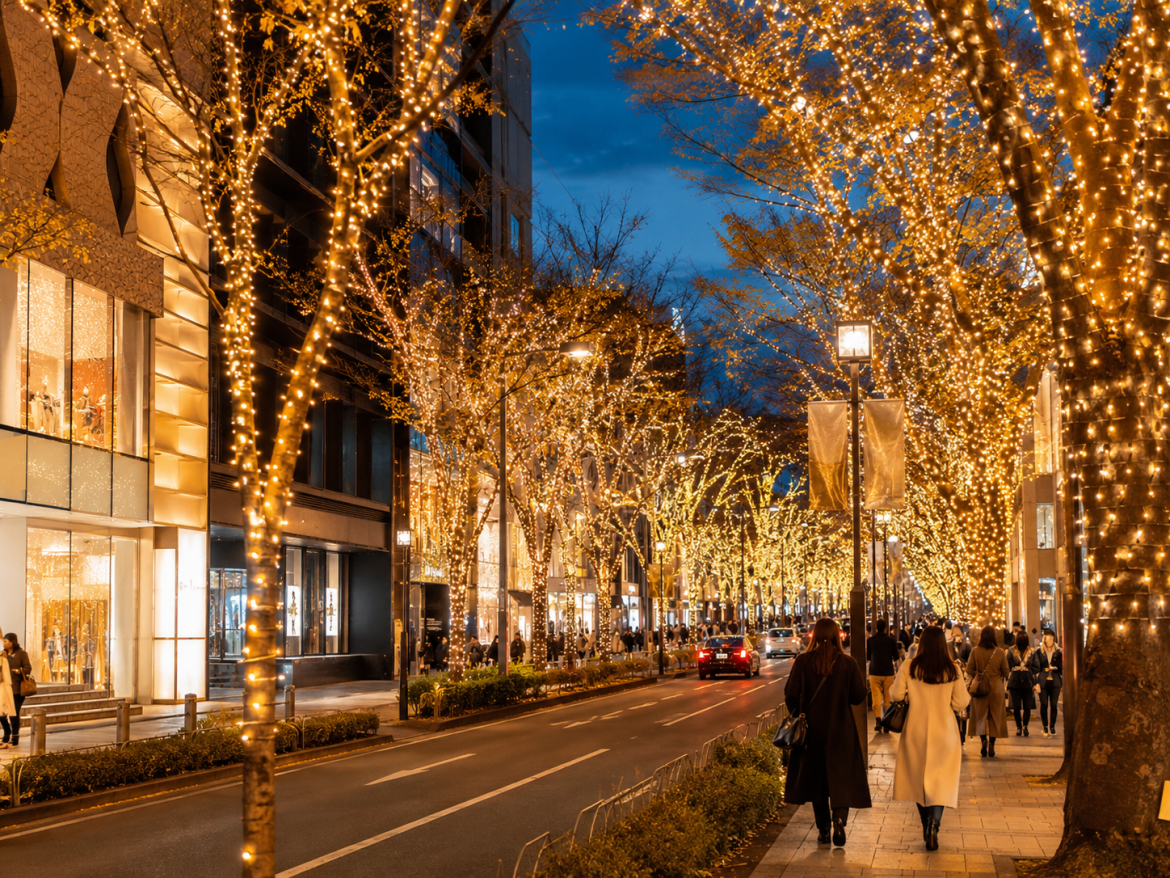
Seasonal event information checked: September 30, 2026. ARTE TOKYO lists the 2026 Omotesando main illumination for December 1–25, covering roughly 1.1 km of the avenue with around 150 zelkova trees and approximately 900,000 lights. Daily lighting hours and details for smaller roadside decorations have not yet been fully announced, so previous-year operating hours should not be treated as confirmed for 2026.
Official Omotesando Illumination 2026 event page
Omotesando Illumination is one of Tokyo’s easiest winter light displays to add to an existing sightseeing day. Rather than a ticketed venue or enclosed light show, it transforms the broad zelkova-lined avenue between Harajuku and Omotesando into a long corridor of warm champagne-gold lights.
The area is already packed with flagship stores, Omotesando Hills, cafés and distinctive modern architecture, so there is little need to build a separate evening around the illumination. A practical first-time route is Meiji Jingu → Harajuku → Omotesando → Aoyama, timing the main avenue for after sunset. You can also continue towards Cat Street and Shibuya for dinner or a night view.

Is Omotesando Illumination 2026 Worth Visiting?
| Question | Quick answer |
|---|---|
| Worth visiting? | Yes, especially if Harajuku, Omotesando, Aoyama or Shibuya is already in your itinerary |
| 2026 dates | December 1–25, 2026; detailed daily lighting hours are still to be announced |
| Lighting hours | The previous edition ran from sunset until around 22:00; 2026 hours may differ |
| Admission | Free; no ticket is required for the street illumination |
| Time needed | About 1–1.5 hours for the illuminated avenue; half a day with Harajuku and Aoyama |
| Best arrival time | Around 30 minutes before sunset for blue-hour and night photos |
| Good for | Couples, friends, families, photographers, shoppers and first-time winter visitors |
| Less suitable for | Travellers expecting amusement rides, a large projection show or an entire evening of activities |
| Easiest route | Meiji Jingu → Harajuku → Omotesando → Aoyama, or Omotesando → Harajuku → Shibuya |
| Rainy-day suitability | Moderate; wet streets photograph beautifully, but umbrellas make the pavements more crowded |
The biggest advantage of Omotesando Illumination is convenience. Harajuku, Meiji Jingu, Omotesando and Shibuya are already common stops on a first Tokyo trip. Extending that day until after sunset adds a seasonal winter highlight without requiring another cross-city journey.
If your priority is a dramatic Tokyo Tower composition, Roppongi’s Keyakizaka illumination offers a very different cityscape. Omotesando works particularly well when you want shopping, cafés, architecture, street photography and winter lights in one walkable district.
Omotesando Illumination 2026 Dates, Hours and Event Details
As of September 30, 2026, ARTE TOKYO lists the 2026 main illumination for December 1–25, 2026. Do not assume that dates for smaller roadside decorations or previous years’ January extensions also apply to the main 2026 illumination.
The previous edition’s main illumination ran from December 1 to December 28, with the zelkova trees illuminated from sunset until 22:00. Smaller shrub lighting continued longer in some past editions. That distinction matters when planning a late-December or January visit.
The main illuminated stretch has recently extended roughly one kilometre from the Jingubashi intersection towards Omotesando intersection, with around 154 zelkova trees decorated using approximately 900,000 LEDs. There is no single entrance or central viewing plaza: the avenue itself is the attraction.
| Item | Details |
|---|---|
| Event | Omotesando Illumination / 表参道イルミネーション |
| Main area | Harajuku and Jingumae towards Omotesando intersection |
| 2026 dates | December 1–25, 2026 |
| 2026 lighting hours | Still awaiting detailed organizer announcement |
| Previous edition hours | Sunset to 22:00 |
| Recent scale | About 1 km, around 154 zelkova trees and approximately 900,000 LEDs |
| Colour | Warm champagne-gold |
| Admission | Free |
| Nearest stations | Harajuku, Meiji-jingumae <Harajuku> and Omote-sando |
| Suggested visit | About 1–1.5 hours |
Can You See the Illumination After Christmas?
For 2026, the main illumination is currently listed through December 25. Past editions have sometimes had smaller decorations continuing beyond the main event, but those historical dates should not be applied automatically to 2026.
Omotesando Hills and individual fashion brands may also run their own Christmas trees, window displays or seasonal installations. Their schedules can differ from the street illumination and change every year.
Tickets and Reservations
Omotesando Illumination takes place along public streets and does not require an admission ticket or reservation. You can start from Harajuku, Meiji-jingumae or Omote-sando and adjust your walking time according to shopping, weather and dinner plans.
This flexibility makes the illumination easy to combine with timed attractions. If you want to finish at SHIBUYA SKY, for example, reserve the observation deck first and work backwards. The free illumination should adapt to the timed attraction, not the other way around.
| Attraction | Payment / reservation | Planning tip |
|---|---|---|
| Omotesando street illumination | Free; no reservation | Simply schedule your walk after sunset |
| Omotesando Hills seasonal displays | Public areas are generally accessible; individual events vary | Useful as a warming-up or rainy-day stop |
| Brand seasonal displays | Depends on the store | Do not assume previous designs return every year |
| Shibuya observation deck | Separate timed ticket required | Book first, then plan your illumination walk around it |
If photography is your priority, a weekday evening will usually be easier than a Christmas-season weekend. Travellers mainly interested in festive atmosphere may prefer visiting closer to Christmas, accepting the larger crowds.
How to Get to Omotesando Illumination
Harajuku Station, Meiji-jingumae <Harajuku> Station and Omote-sando Station all work well. The best choice depends on which direction you want to walk.
If you are visiting Meiji Jingu or Takeshita Street first, start from JR Harajuku or Tokyo Metro Meiji-jingumae. If your afternoon is focused on Aoyama, cafés, architecture or the Nezu Museum area, start from Omote-sando Station and walk towards Harajuku.
| Starting point | How to approach | Best for |
|---|---|---|
| JR Harajuku Station | Walk towards Jingumae and Omotesando | Meiji Jingu + Harajuku + illumination |
| Meiji-jingumae <Harajuku> | Direct access to Jingumae and the Omotesando area | Cat Street and Harajuku shopping |
| Omote-sando Station | Walk from the Aoyama end towards Harajuku | Aoyama + architecture + full avenue walk |
| Shibuya Station | Take Tokyo Metro or walk via the Jingumae/Cat Street area | Shibuya + Harajuku + Omotesando |
| Shinjuku | Take the JR Yamanote Line to Harajuku | The simplest first-time route |
From Shinjuku
The easiest option for first-time visitors is the JR Yamanote Line to Harajuku Station. You can then combine Meiji Jingu, Takeshita Street, Jingumae and Omotesando without a complicated transfer.
From Tokyo Station
Tokyo Station does not have a direct JR service to Omote-sando Station. In practice, use Tokyo Metro with a transfer or take JR towards Harajuku and begin your walk there. If you are already around Ginza, taking the Ginza Line towards Omote-sando is usually more natural than returning to Tokyo Station first.
From Shibuya
Shibuya and Omotesando are close enough to combine easily. You can use Tokyo Metro or walk between the districts via Cat Street and Jingumae, turning the journey itself into part of the sightseeing.
Do You Need a Tokyo Subway Ticket?
Not specifically for the illumination. However, if the same day includes several Metro and Toei Subway areas such as Asakusa, Ginza and Roppongi, compare the Tokyo Subway Ticket.
The pass covers Tokyo Metro and Toei Subway services but not JR. If your route is mainly Shinjuku → Harajuku → Shibuya using the JR Yamanote Line, simply using an IC card may be easier.
Should You Drive?
There is little reason to drive specifically for Omotesando Illumination. The district is one of central Tokyo’s busiest shopping areas, public transport is excellent, and pedestrian traffic increases during the illumination period.
What to See Along Omotesando Illumination
The Champagne-Gold Zelkova Avenue
The highlight is not a single giant Christmas tree but the long perspective created by illuminated zelkova trees on both sides of the avenue. Car lights, shop windows and contemporary buildings add extra layers to the cityscape.
Allow at least 20–30 minutes to walk along the main avenue rather than taking one photo near the entrance and leaving. Different slopes, intersections and architectural backdrops change the composition considerably.
Jingumae Intersection
The Jingumae area combines the illumination with tall buildings, commercial displays and busy pedestrian traffic, creating one of the most recognizably urban winter views.
Do not stop in the middle of a pedestrian crossing for photos or step into the road. Use the pavement and legal pedestrian areas, and consider a longer focal length if you want to compress the lights in the background.
Omotesando Hills
Omotesando Hills sits directly on the main avenue and works well for architectural photos with the illuminated trees. It is also a convenient indoor stop when the weather is cold.
Seasonal indoor Christmas installations can change completely from year to year, so do not plan around an old photograph or previous character collaboration unless the current season’s program has been announced.
Flagship Stores and Architecture
One reason Omotesando feels different from many free illuminations is that the surrounding streetscape is already visually distinctive. Luxury flagship stores and modern architecture around Omotesando and Aoyama create strong backgrounds for winter street photography.
You do not need to detour down every side street. For a first visit, complete the main illuminated avenue and then extend the walk either towards Aoyama or Cat Street.
Blue Hour
The most photogenic period is often just after sunset, when the champagne-gold lights are visible but the sky still retains a deep blue tone. Buildings and the avenue remain easier to distinguish than later at night when the sky is completely black.
If photography matters, arrive around 30 minutes before expected sunset so you can choose positions before the lights become the main focus.
Suggested Omotesando Illumination Routes
Quick Visit: 60–90 Minutes
| Time | Plan |
|---|---|
| 0:00 | Arrive at Omote-sando or Meiji-jingumae Station |
| 0:10 | Begin walking and photographing the champagne-gold avenue |
| 0:30 | Stop around Omotesando Hills |
| 0:50 | Photograph the cityscape around Jingumae intersection |
| 1:10 | Finish at Harajuku or continue towards Cat Street and Shibuya |
This works well when your day is already busy and you mainly want to see the signature winter streetscape.
First Visit: Harajuku + Omotesando Half Day
| Time | Plan |
|---|---|
| 13:00 | Walk through Meiji Jingu |
| 14:30 | Explore Takeshita Street and Jingumae |
| 16:00 | Café break or Omotesando Hills |
| Before sunset | Return to the main avenue and choose photo positions |
| After sunset | Walk through the main illumination |
| Around 19:00 | Dinner in Aoyama, Harajuku or Shibuya |
This is the easiest first-time itinerary because Meiji Jingu works best during daylight, shopping fits naturally into the afternoon, and the illumination becomes the evening finale without backtracking.
Aoyama + Omotesando + Shibuya
Begin in Aoyama with cafés, architecture, shopping or the Nezu Museum area, then return to Omotesando before sunset. After the illumination, continue towards Jingumae and Cat Street before finishing in Shibuya.
If you want SHIBUYA SKY as the final stop, reserve your SHIBUYA SKY ticket first.
SHIBUYA SKY uses timed admission, while Omotesando Illumination is flexible. Work backwards from the paid reservation rather than risking a missed entry slot.
Easy Family Route
Families with young children do not need to walk all the way from Aoyama to Shibuya. Choose either Meiji Jingu or Harajuku during the afternoon, then see the core section between Meiji-jingumae and Omotesando Hills before heading indoors for dinner.
This reduces the amount of continuous walking in cold weather and keeps toilets, restaurants and indoor rest areas nearby.
Best Photo Spots and When to Visit
| Photo area | Best time | Best for | Watch out for |
|---|---|---|---|
| Omote-sando Station towards Harajuku | After sunset | Long avenue perspective and rows of lights | Stay on pedestrian areas |
| Omotesando Hills | Blue hour into evening | Illumination with modern architecture | Heavier weekend crowds |
| Jingumae intersection | After dark | City buildings, lights and pedestrian energy | Never stop in the middle of crossings |
| Middle sections of the avenue | After 18:00 | Portraits and light bokeh | Do not block shop entrances or pavements |
| Towards Aoyama | Weekday evenings | More restrained urban streetscapes | Illumination density varies by section |
What Time Is Best for Photos?
The strongest balance is usually from the start of the illumination through blue hour and into early darkness. Tokyo sunsets are relatively early in winter, so you do not need to wait until late evening.
Which End Should You Start From?
Start from Omote-sando Station if you want a long avenue perspective and an easy progression towards Harajuku. Start from Harajuku if Meiji Jingu and Takeshita Street are already part of your day. Route efficiency matters more than finding one supposedly perfect entrance.
How Do You Avoid the Crowds?
Choose a weekday rather than trying to find an empty Omotesando on a Christmas-season weekend. If you want portraits, move away from the busiest Jingumae intersection towards the middle or Aoyama side of the avenue.
Is It Worth Visiting in the Rain?
Light rain can create attractive golden reflections on the pavement, but umbrellas make already busy pedestrian space tighter. Families and older travellers may prefer shortening the outdoor walk and using Omotesando Hills or nearby shopping facilities as an indoor alternative during heavy rain.
Can You Use a Tripod?
Omotesando is a busy public street, so large tripods are not practical during peak hours if they obstruct pedestrians. A phone’s night mode, camera stabilization or handheld photography is sufficient for most visitors.
Who Is Omotesando Illumination Best For?
First-Time Winter Visitors
It is especially convenient because Omotesando lies directly between classic Harajuku and Shibuya sightseeing areas. There is usually no need to dedicate a separate evening to it.
Couples
The atmosphere is more urban than amusement-park-like, combining warm lighting, cafés, architecture and luxury shopping streets. Aoyama and Omotesando also offer plenty of options for a quieter dinner afterwards.
Families
Families can enjoy the illumination without completing the entire route. The section around Meiji-jingumae and Omotesando Hills already provides the main atmosphere and makes it easy to take indoor breaks.
Older Travellers
The main avenue is straightforward to walk, but Omotesando has some slope and winter evenings can be cold. Consider entering from Omote-sando Station, seeing the central section and stopping for dinner rather than walking all the way to Harajuku.
Street Photographers
The appeal extends beyond the LEDs themselves. Pedestrians, traffic, architecture, shop windows and the sloping avenue all contribute to distinctly Tokyo winter city scenes.
Shoppers
Harajuku, Cat Street, Omotesando, Aoyama and Shibuya form one of Tokyo’s strongest shopping corridors. It is easy to shop through the afternoon, photograph the lights after sunset and continue into Shibuya without sacrificing a separate sightseeing day.
Nearby Places to Combine with Omotesando
| Nearby stop | Location | Why combine it | Best timing |
|---|---|---|---|
| Meiji Jingu | Beside Harajuku Station | Major Tokyo shrine and a natural starting point | Morning or afternoon |
| Takeshita Street | Beside Harajuku Station | Fashion, sweets and character shops | Afternoon |
| Omotesando Hills | On the main Omotesando avenue | Shopping, architecture and an indoor break | Before or after illumination |
| Cat Street | Between Jingumae and Shibuya | Streetwear, select shops and urban photography | Afternoon or after illumination |
| Aoyama | Around Omote-sando Station | Architecture, cafés and luxury shopping | Afternoon |
| Shibuya | Walk or take Metro from Jingumae | Dinner, shopping and SHIBUYA SKY | After illumination |
Route 1: Meiji Jingu + Harajuku + Omotesando
This is the most straightforward first-visit half-day route. Begin at Meiji Jingu, continue through Harajuku and Jingumae, then enter Omotesando before sunset and walk the illuminated avenue after dark.
The scenery changes dramatically without requiring a train: forested shrine grounds, youth fashion streets, luxury architecture and finally the winter illumination.
Route 2: Aoyama Cafés + Omotesando + Harajuku
If Takeshita Street crowds do not appeal to you, begin in Aoyama instead. Spend the afternoon around architecture, shops or cafés and then walk from Omote-sando Station towards Harajuku once the illumination begins.
This direction works particularly well for couples, solo travellers and visitors interested in design and street photography.
Route 3: Omotesando + Shibuya Night View
See the illumination around sunset, continue towards Jingumae and Shibuya, have dinner, then finish at SHIBUYA SKY. The two experiences are visually very different: Omotesando provides a warm street-level light corridor, while SHIBUYA SKY provides a high-altitude Tokyo night panorama.
Book the SHIBUYA SKY ticket first because it requires a designated entry time.
Route 4: Omotesando + Roppongi Illuminations
If winter illuminations are a major focus of your trip, Omotesando and Roppongi can be paired in one evening. Omotesando emphasizes champagne-gold zelkova trees and luxury streetscapes, while Roppongi offers a different cool-toned urban composition.
Two illumination districts are normally enough for one evening. Adding Marunouchi or Shinjuku as well can turn the night into unnecessary transit rather than sightseeing.
Food, Shopping and Where to Stay
Food
Harajuku and Jingumae have plenty of cafés, sweets and casual dining, while Omotesando and Aoyama are better suited to a more formal dinner. Since the illumination itself has no reservation or entrance time, simply work backwards from any restaurant booking.
If you plan to finish in Shibuya and would rather focus on food than an observation deck, you can also compare a Shibuya food tour.
Because a guided food tour takes several hours, avoid combining it with too many other timed evening attractions.
Shopping
Harajuku is strongest for youth fashion and character goods, Cat Street for streetwear and select shops, and Omotesando and Aoyama for luxury flagships, design stores and lifestyle shopping.
Winter window displays and temporary decorations change every year, so treat them as an extra rather than planning your route around old photographs.
Where to Stay
There is no need to change hotels just to be near one evening of illumination. Shibuya is convenient if your itinerary focuses on Harajuku, Shibuya and western Tokyo; Shinjuku is often more versatile if you also have day trips or other western Tokyo plans.
Choose accommodation based on your entire Tokyo itinerary rather than a single seasonal event.
Common Planning Mistakes
Do Not Copy Last Year’s Dates into Your 2026 Itinerary
Sponsorship, start dates, end dates, operating hours and the schedule for smaller decorations can change from year to year. For 2026, the confirmed main dates are December 1–25, while detailed daily lighting hours are still awaiting organizer information.
Do Not Arrive Early Just for the Illumination
Omotesando is worth visiting during the day for shopping and architecture, but the seasonal lights only become the focus after sunset. Use the morning for Meiji Jingu, museums or other attractions and move into Harajuku and Omotesando later in the day.
Do Not Keep Taking Trains Between Harajuku, Omotesando and Shibuya
These districts connect naturally on foot. If your energy level allows, walking often creates a better sightseeing experience than repeatedly entering and leaving stations to save a few minutes.
Do Not Stop in Crosswalks for Photos
The road perspective is attractive, but Omotesando carries substantial pedestrian and vehicle traffic. Use crossings only to cross normally and never step into the road for an empty-street photograph.
Do Not Expect an Empty Avenue on Weekend Evenings
Omotesando is a major shopping district even without the illumination. If clean compositions matter, choosing a weekday will make more difference than waiting ten extra minutes at the busiest intersection.
Do Not Underestimate the Walking
Meiji Jingu, Takeshita Street, Cat Street, Omotesando and Shibuya add up to a long day on foot. Families and older travellers should cut one or two sections and deliberately include indoor café or shopping breaks.
Useful Tickets for an Omotesando Day
Tokyo Subway Ticket
If your day also includes several Metro and Toei Subway areas such as Ginza, Roppongi or Asakusa, compare the Tokyo Subway Ticket. Omote-sando Station is served by the Ginza, Chiyoda and Hanzomon lines.
The pass does not cover JR, so an itinerary built mainly around Shinjuku, Harajuku and Shibuya on the Yamanote Line may be simpler with an IC card. Choose the pass after planning your route rather than changing the route simply to use a pass.
SHIBUYA SKY Ticket
A SHIBUYA SKY ticket pairs naturally with Omotesando Illumination. The two experiences are close geographically while offering very different views.
SHIBUYA SKY requires a timed entry, so secure that reservation first and place the free Omotesando illumination before it.
Shibuya Food Tour
Travellers more interested in local dining than an observation deck can consider a Shibuya food tour after exploring Harajuku and Omotesando.
Because a full food tour occupies several hours, avoid booking both a long dining tour and several other timed evening attractions on the same night.
Omotesando Illumination FAQ
When Does Omotesando Illumination 2026 Start?
As of September 30, 2026, ARTE TOKYO lists the main 2026 illumination from December 1 to December 25. Detailed daily lighting hours and any separate schedule for smaller decorations are still awaiting organizer information.
What Time Does Omotesando Illumination 2026 Turn On?
The previous edition operated from sunset until 22:00. The 2026 daily lighting hours may change and should be checked again once detailed information is announced.
Is Omotesando Illumination Free?
Yes. The main street illumination is free to view and does not require an admission ticket. Shopping, dining and separately ticketed attractions nearby are not included.
Do You Need a Reservation?
No. There is no designated entry time for the street illumination, so you can adjust your visit around shopping, dinner and weather.
What Is the Nearest Station?
JR Harajuku Station, Tokyo Metro Meiji-jingumae <Harajuku> Station and Omote-sando Station are all convenient. Start from Harajuku if visiting Meiji Jingu first, or from Omote-sando if your afternoon is focused on Aoyama.
Should You Start from Harajuku or Omote-sando?
There is no single best entrance. Start at Harajuku for Meiji Jingu and Takeshita Street, or at Omote-sando for Aoyama, cafés and architecture before walking towards Harajuku and Shibuya.
How Long Do You Need?
Allow around 1–1.5 hours for the main illuminated avenue. Add at least half a day if you also want Harajuku, Cat Street, Aoyama and shopping. With Shibuya at night, the area can comfortably fill most of a day.
When Is the Best Time for Photos?
Blue hour just after sunset is particularly effective because the illumination is bright while the sky still retains colour and surrounding architecture remains visible.
Is It Good for Families?
Yes, but young children do not need to walk the full avenue. The area around Meiji-jingumae and Omotesando Hills provides a good introduction to the illumination and easy access to indoor facilities.
Is It Worth Going in the Rain?
Light rain can create attractive reflections on the street, but umbrellas reduce pedestrian space. In heavy rain, shorten the outdoor route and use Omotesando Hills and nearby commercial facilities as indoor stops.
Can You Still See It After December 25?
The main 2026 illumination is currently listed through December 25. Do not apply previous years’ longer schedules for smaller decorations to 2026 unless a separate current announcement confirms them.
Omotesando or Roppongi Illumination?
They offer different experiences. Omotesando combines a champagne-gold avenue with Harajuku, Aoyama, cafés and shopping, while Roppongi provides a different city-night composition. If your itinerary has room, they can be visited on separate evenings or paired as the only two illumination districts in one night.
Omotesando Illumination 2026 Summary
Omotesando Illumination is one of the easiest seasonal events to add to a winter Tokyo itinerary because it is free, requires no reservation and sits directly between several of the city’s most popular sightseeing and shopping districts.
For a first visit, the most efficient plan is Meiji Jingu → Harajuku → Omotesando → illumination after sunset. Travellers more interested in architecture, cafés and quieter streets can begin in Aoyama and walk in the opposite direction towards Harajuku.
The 2026 main illumination is currently listed for December 1–25, 2026. Detailed daily lighting hours are still awaiting organizer confirmation, so the previous edition’s sunset-to-22:00 schedule should not be treated as confirmed for this year.
If you plan to use several subway lines during the day, compare the Tokyo Subway Ticket. If you want to continue to Shibuya, secure your SHIBUYA SKY ticket first and adjust the flexible illumination walk around that reservation.
You also do not need to stay in Omotesando specifically for this event. Choose your Tokyo hotel according to the wider trip, then treat the illumination as a seasonal addition to an existing Harajuku, Omotesando, Aoyama or Shibuya day.