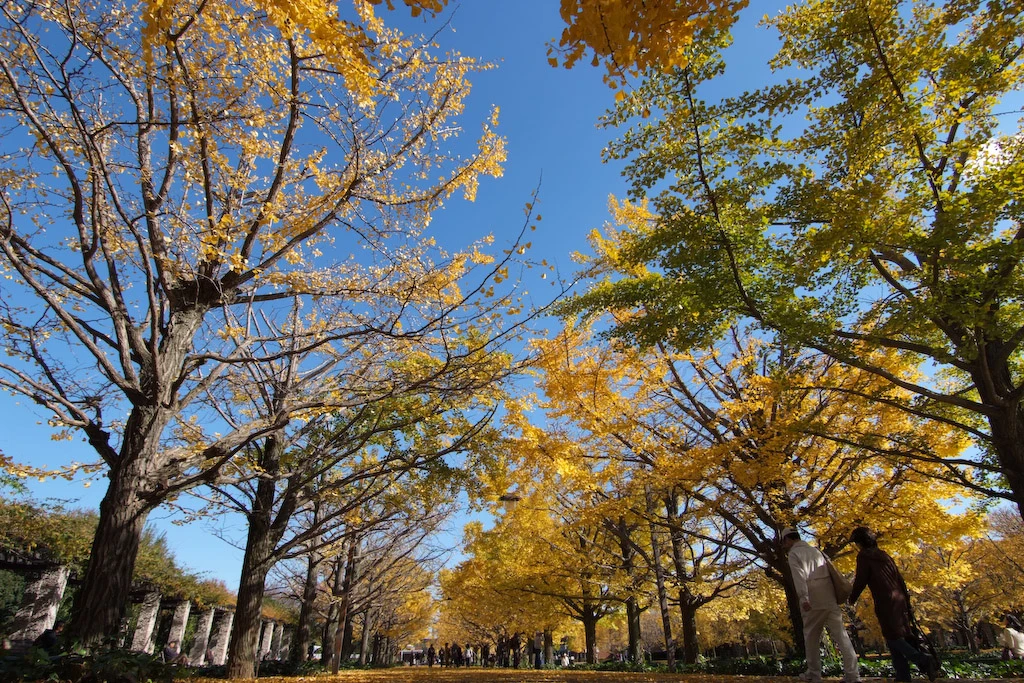
For golden ginkgo trees at Showa Kinen Park, choose between the formal Canal avenue near Tachikawa Gate and the natural canopy of Katarai Ginkgo Avenue deeper inside the park. Add the Japanese Garden for red maples. The 2026 Autumn Night Walk runs from October 29 to November 29, making a half-day or full-day visit worthwhile. With only an hour or two, pick one main area rather than rushing between all three.

When to see Showa Kinen Park’s ginkgo trees in 2026
The park does not change color all at once. The clipped trees beside the Canal, the spreading branches of Katarai Ginkgo Avenue and the Japanese Garden’s maples have different seasonal rhythms. Choose the kind of landscape you want first, then use recent, location-specific photographs to refine your date. A Tokyo-wide forecast cannot tell you the exact best day for every tree in this large park.
| Area | Typical coloring period | Best reason to visit |
|---|---|---|
| Canal (カナール) | Early to mid-November | Symmetrical ginkgo rows, water channels and fountains near Tachikawa Gate |
| Katarai Ginkgo Avenue (かたらいのイチョウ並木) | Mid- to late November | A roughly 300-meter walk beneath naturally spreading ginkgo crowns |
| Japanese Garden | Early to late November | Maples, a pond-side garden walk and evening reflections |
These are typical seasonal reference periods, not guaranteed 2026 peak dates. Check the official plant updates shortly before your visit, noting both the photograph date and the area shown. Strong wind and rain can quickly change the amount of foliage on the branches. A carpet of fallen leaves and a full golden canopy may look their best at different times.
Which autumn area should you prioritize?
The Canal: formal lines and a convenient start
Enter from Tachikawa Gate if the Canal is your first priority. Its water channels create a clean central line between the trees, so the landscape works well both as a wide view and as a backdrop for a portrait. Begin by observing the light and pedestrian flow. You do not need to monopolize the center of a busy path to make an attractive photograph; the side paths also give interesting layers of water, trunks and foliage.
Katarai Ginkgo Avenue: enjoy the walk, not just one frame
The appeal here is the canopy overhead and the changing view as you walk underneath it. Turning around can reveal a very different arrangement of light and branches. Families and visitors who prefer a slower pace can make this their main destination, with a rest stop rather than an ambitious checklist afterward. Distances that look small on the map still require real walking time.
The Japanese Garden: add red maples to your ginkgo day
For more variety, continue to the Japanese Garden. Daylight emphasizes the landscape around the pond; the evening opening shifts attention to illuminated trees and reflections. Look for a calm patch of water rather than forcing your way to one crowded spot. Keep paths clear and stay outside planted or roped-off areas. A full day gives you more freedom to enjoy both the garden and the two ginkgo areas without repeated backtracking.
Autumn Night Walk 2026: dates, tickets and the day-to-night changeover
The event runs October 29–November 29, 2026. Lighting is scheduled for 16:30–20:30, with the park closing at 21:00. Park admission tickets are issued until 20:15 and the last park entry is 20:30. Arriving at the last possible minute leaves little time for the walk from the gate, so come earlier if you want more than a brief look.
| Admission | 2026 price in JPY | What it covers |
|---|---|---|
| Ordinary park admission | 450 for high-school age and above; 210 for ages 65+; free for junior-high age and younger | Includes the illuminated Canal and Katarai Ginkgo Avenue |
| Japanese Garden evening ticket, online | 1,200 for adults and ages 65+; 600 for elementary and junior-high students | Park admission is additional; no separate garden ticket is needed on October 29 or 30 |
| Online park + evening garden combination | 1,600 for adults; 1,410 for ages 65+ | Useful if you do not already have park admission; no child combination ticket |
| Same-day garden counter ticket | 1,300 for adults and ages 65+; 700 for elementary and junior-high students | Cash only; not sold if the online allocation sells out |
Preschool children enter the evening Japanese Garden free and do not need a viewing ticket. The paid child category is for elementary and junior-high students.
Evening garden tickets go on sale one week before the intended visit date. Same-day online purchase is possible when places remain. Use the purchase links on the Autumn Night Walk ticket page, and distinguish a garden-only ticket from a combination that includes park entry. A park annual pass or a concession for ordinary park admission does not automatically waive the separate evening garden charge.
Daytime visitors must leave the Japanese Garden by 16:00 before it reopens for the evening session. This is a garden changeover, not a requirement for everyone to leave the entire park. Allow time for a break, food or movement along the open route. Avoid an itinerary that assumes you can finish the far side of the garden at 16:00 and instantly be at another distant viewpoint.
Tachikawa Gate or Nishi-Tachikawa Gate?
| Station and gate | Approximate walk | Choose it when |
|---|---|---|
| JR Tachikawa north exit → Tachikawa Gate | About 18 minutes | You want to begin with the Canal |
| JR Ome Line Nishi-Tachikawa park exit → Nishi-Tachikawa Gate | About 2 minutes | You want a short station-to-gate walk |
| JR Tachikawa north exit → Akebono entrance | About 10 minutes | You understand this leads into the free cultural zone, with a further walk to the paid gate |
Take the JR Chuo Line to Tachikawa, then either walk to Tachikawa Gate or continue on the Ome Line to Nishi-Tachikawa. Search for your chosen gate, not just the park’s name, when planning the final approach. Train duration depends on the service and connection, so check the journey for your actual departure time. Tokyo Subway Ticket does not cover either JR line.
After dark, entry and exit are limited to Tachikawa and Nishi-Tachikawa gates. Sunagawa and the other entrances cannot be used. Visitors arriving earlier through another gate need to plan a different exit. Cars and brought-in bicycles must be moved to the designated locations by 16:30 before visitors join the evening area; cycling courses are unavailable at night. A gate convenient for the Japanese Garden during the day may be the wrong choice for your return after the lights.
Use the map to choose your gate and walking distance
Locate Tachikawa Gate, Nishi-Tachikawa Gate, the Canal, Katarai Ginkgo Avenue and the Japanese Garden before choosing your route. This general park map does not show which paths open for the evening event; follow the on-site night route. Select the map to open the full park PDF.

A realistic half-day or day-to-night itinerary
For a daytime half-day, consider Tachikawa Gate → Canal → Katarai Ginkgo Avenue → Nishi-Tachikawa Gate, adapting the route to the current foliage and your walking ability. Allow roughly three to four hours as a planning buffer for photographs and breaks. This is an itinerary suggestion, not a guaranteed park tour duration. With small children or limited stamina, one ginkgo area plus a comfortable rest stop can be enough.
For both daylight and illumination, arrive around midday, enjoy the Canal and lunch, then work toward the avenue and Japanese Garden. Complete your daytime garden visit before 16:00 and follow the evening opening arrangements for your chosen ticket. Leave via one of the two approved gates. If one avenue has significantly better leaves that day, devote more time to it rather than repeatedly crossing the park to complete a checklist.
The evening bus uses cashless payment, and queues can grow on busy dates. Its requirement to fold wheelchairs and strollers before boarding may not suit everyone. Treat it as possible assistance rather than a guaranteed, queue-free connection. Before choosing a longer route, compare the gates and points of interest on the park maps and check that day’s operating details.
Photography, families and wet-weather planning
At night, tripods in the Japanese Garden are permitted only at designated places; monopods are allowed, subject to on-site guidance. Eating and drinking are prohibited in the evening garden, and pets cannot enter it. Decide on a workable camera setup before reaching a narrow waterside path. With a phone, a steady stance and slightly reduced exposure can help preserve detail in the bright lights without occupying a large space.
Bring layers and comfortable footwear for the transition from afternoon to evening. Wet fallen leaves can be slippery, so shorten the route when conditions deteriorate. Check the park’s same-day notices during strong winds or severe weather. Families should build toilets, food and rests into the plan early, particularly because only part of the park opens at night.
For alternatives across the capital, see the Tokyo autumn leaves and ginkgo guide. Showa Kinen Park is best suited to travelers happy to devote at least half a day to outdoor walking. Leave a return-journey buffer if you have dinner reservations or another timed booking. Operating arrangements outside the 2026 event period, and all future-year event dates, should be checked again before travel.
Showa Kinen Park autumn FAQs
1. When do the ginkgo trees turn yellow?
Typical periods are early to mid-November at the Canal and mid- to late November at Katarai Ginkgo Avenue. Check recent area-specific updates before traveling.
2. What are the 2026 illumination dates?
October 29 to November 29, 2026, with lighting from 16:30 to 20:30 and park closure at 21:00.
3. Which illuminations are included in ordinary park admission?
The Canal and Katarai Ginkgo Avenue. The Japanese Garden generally requires a separate evening ticket.
4. When is the evening garden included without a supplement?
On October 29 and 30, 2026, visitors only need park admission to see the evening Japanese Garden.
5. Is the evening garden free for children?
Park entry is free for junior-high age and younger. Elementary and junior-high students pay JPY 600 online or JPY 700 at the counter for the evening garden. Preschool children enter the evening garden free without a viewing ticket. No separate garden ticket is needed on October 29 or 30.
6. When do evening garden tickets go on sale?
One week before the intended visit date. Same-day tickets depend on remaining availability; counter tickets are not sold after the online allocation sells out.
7. Which station has the shortest walk to a gate?
Nishi-Tachikawa on the JR Ome Line is about two minutes from Nishi-Tachikawa Gate. Tachikawa Gate is useful for the Canal but about 18 minutes from Tachikawa Station’s north exit.
8. Can I leave through Sunagawa Gate at night?
No. Evening entry and exit are restricted to Tachikawa and Nishi-Tachikawa gates.
9. Must I leave the whole park between day and night?
The Japanese Garden must be vacated by 16:00 before its evening reopening. That garden changeover is different from leaving the entire park; a valid evening garden ticket is still required on applicable dates.
10. Does Tokyo Subway Ticket cover the journey?
It does not cover the JR Chuo or Ome lines. Pay separately for those sections or use another valid ticket that covers them.
11. Are tripods allowed in the evening garden?
Only in designated places. Monopods are allowed, but all equipment use must follow on-site crowd-management instructions.
12. How should visitors with strollers or wheelchairs plan?
Choose a manageable route and consult the official maps. The evening bus requires wheelchairs and strollers to be folded, so it should not be assumed to provide a step-free connection for every visitor.